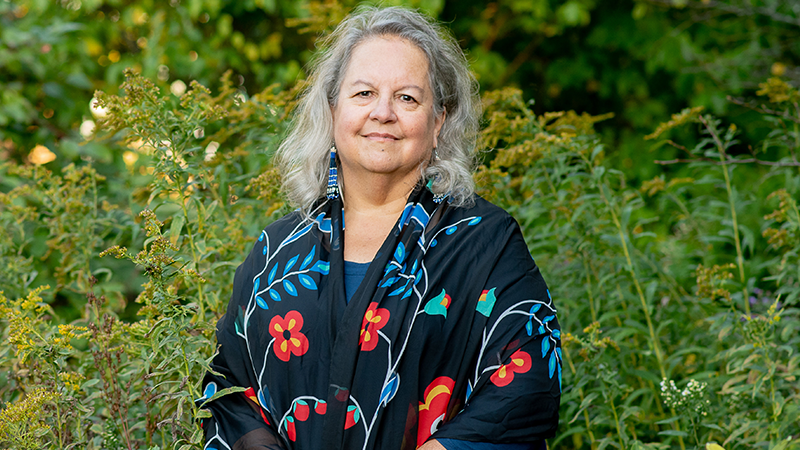
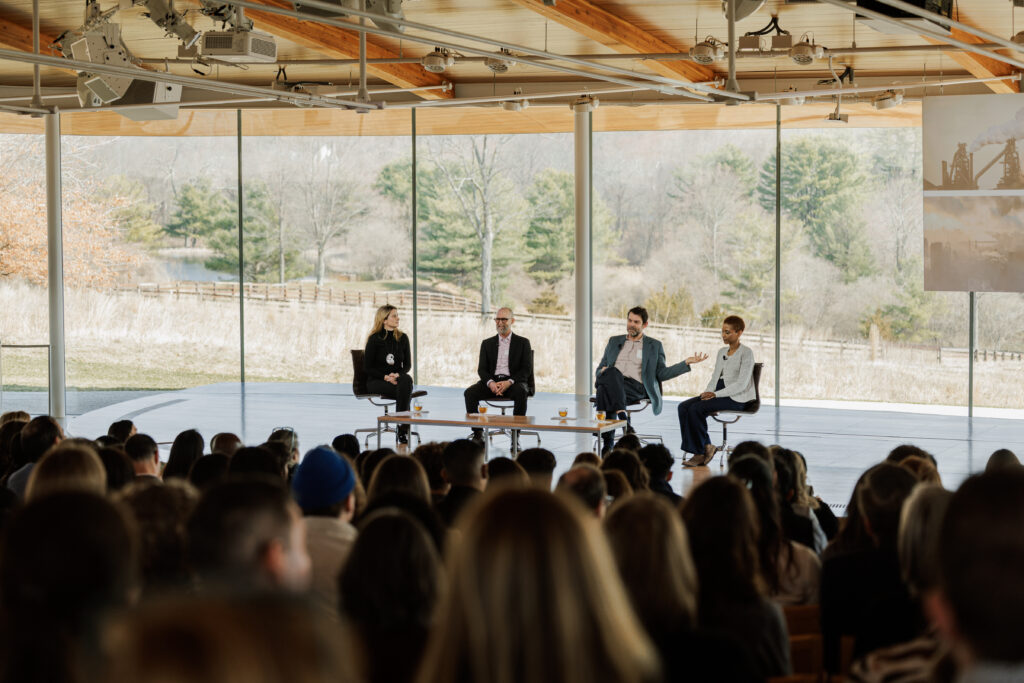
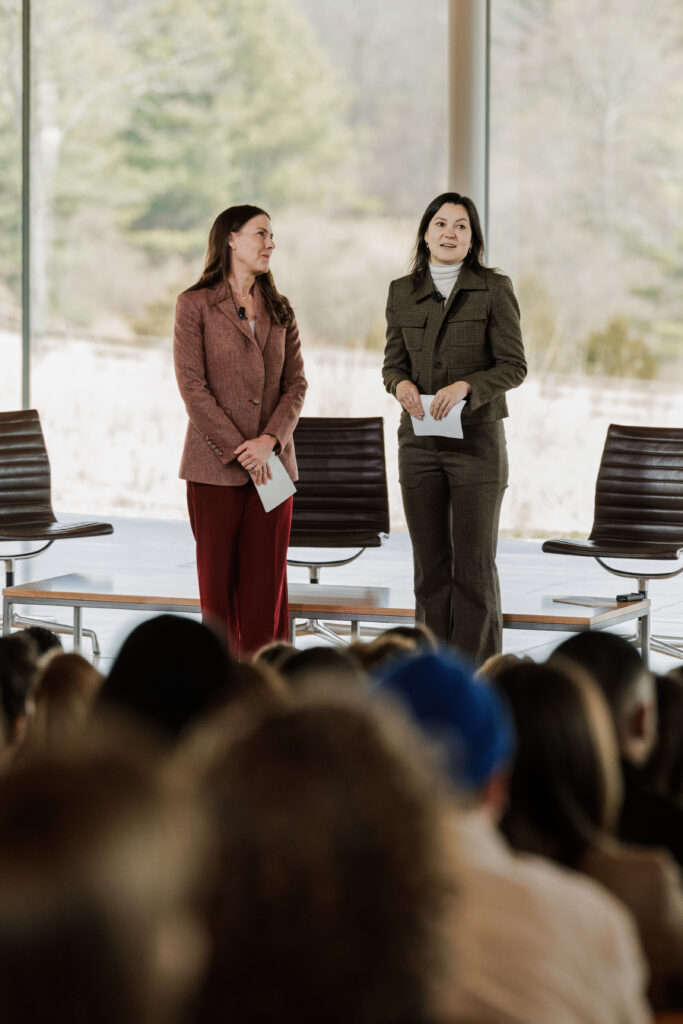
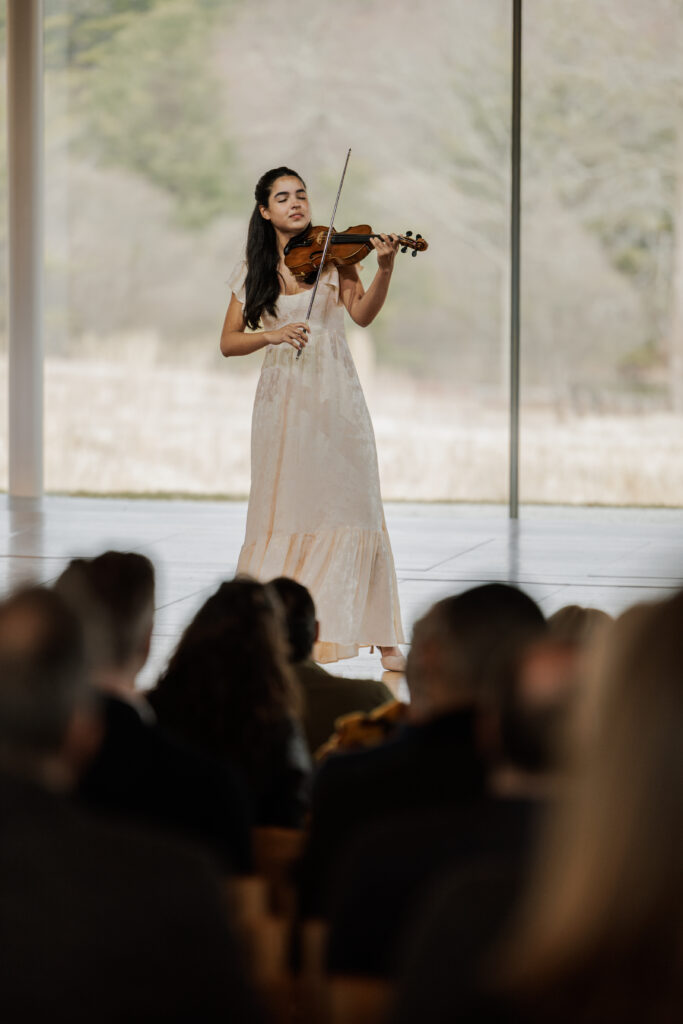
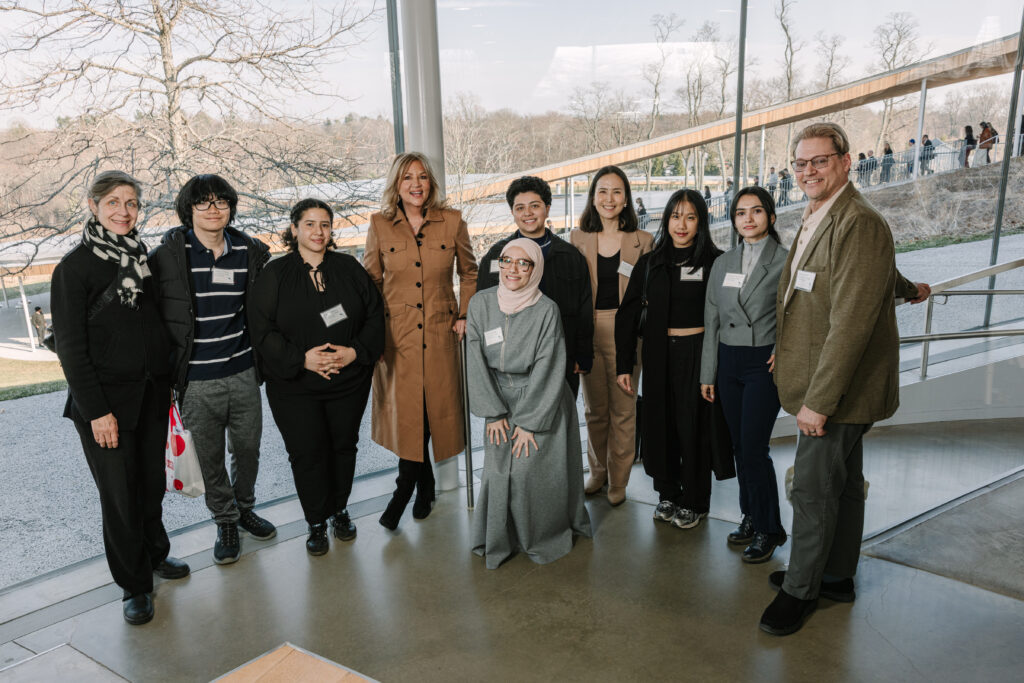
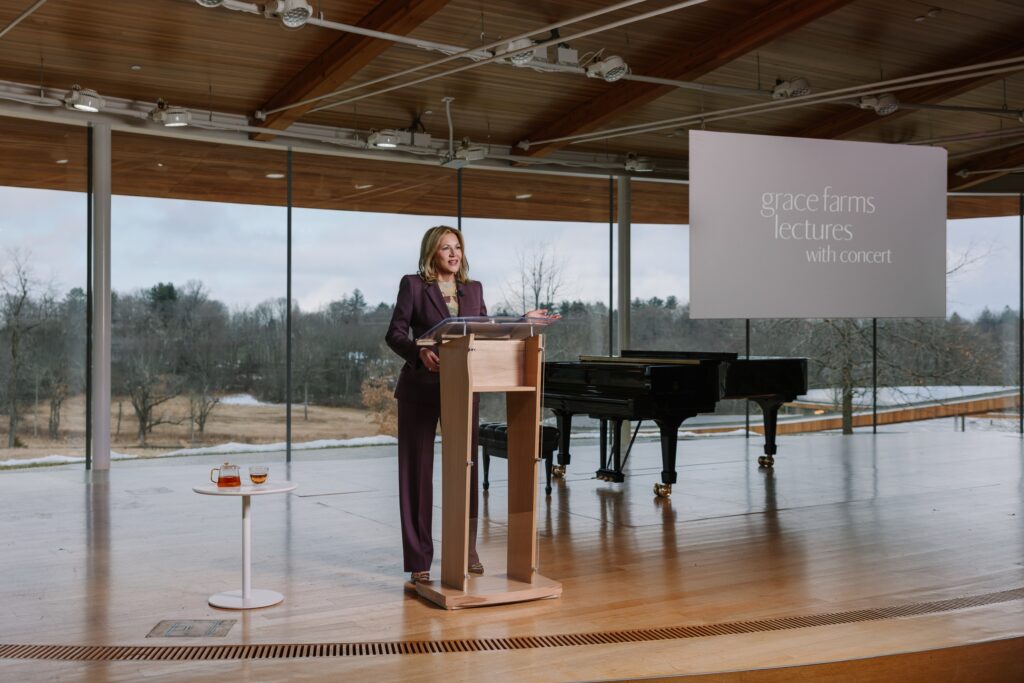
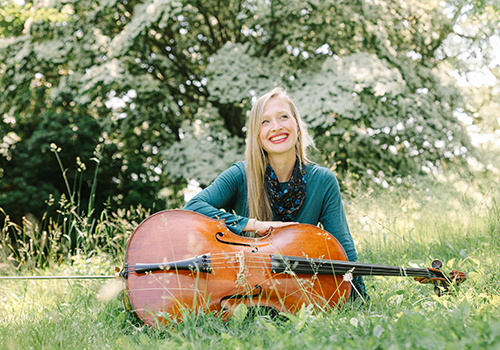
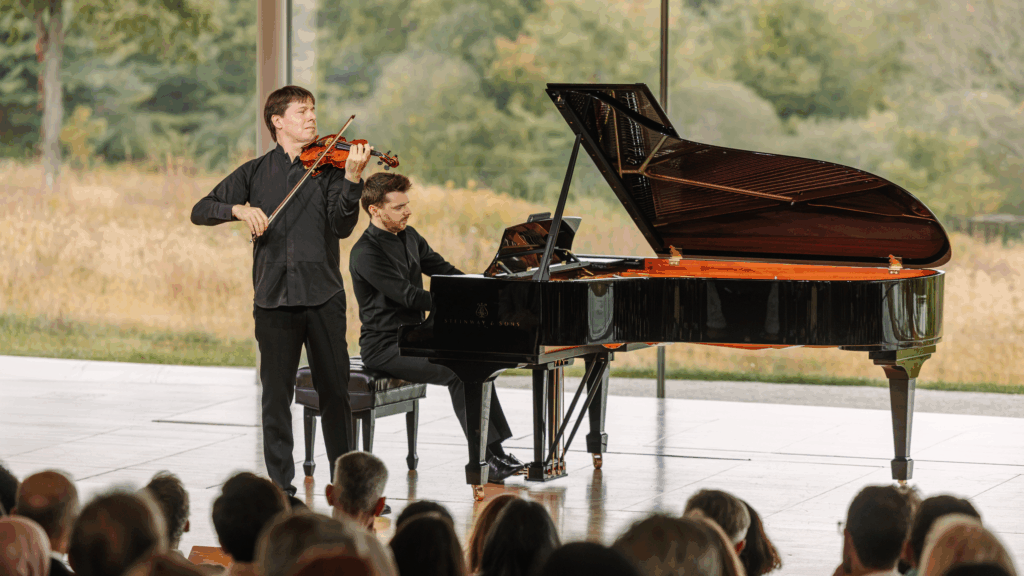
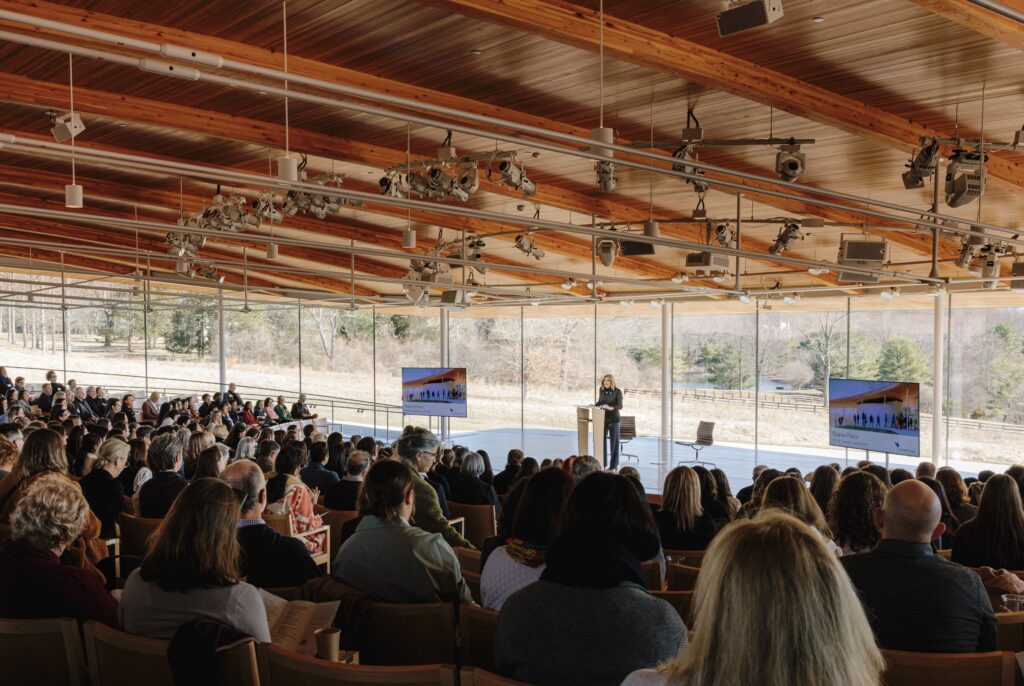
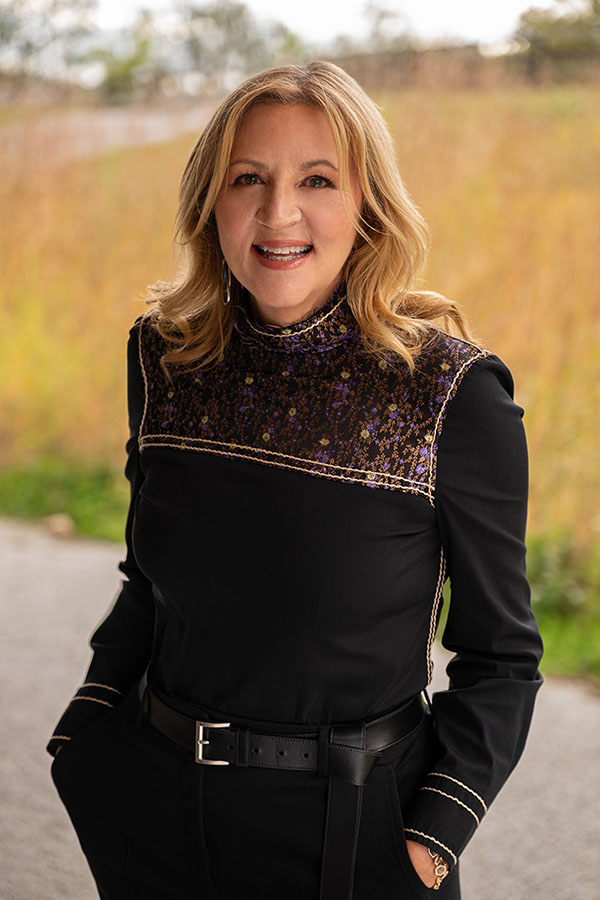
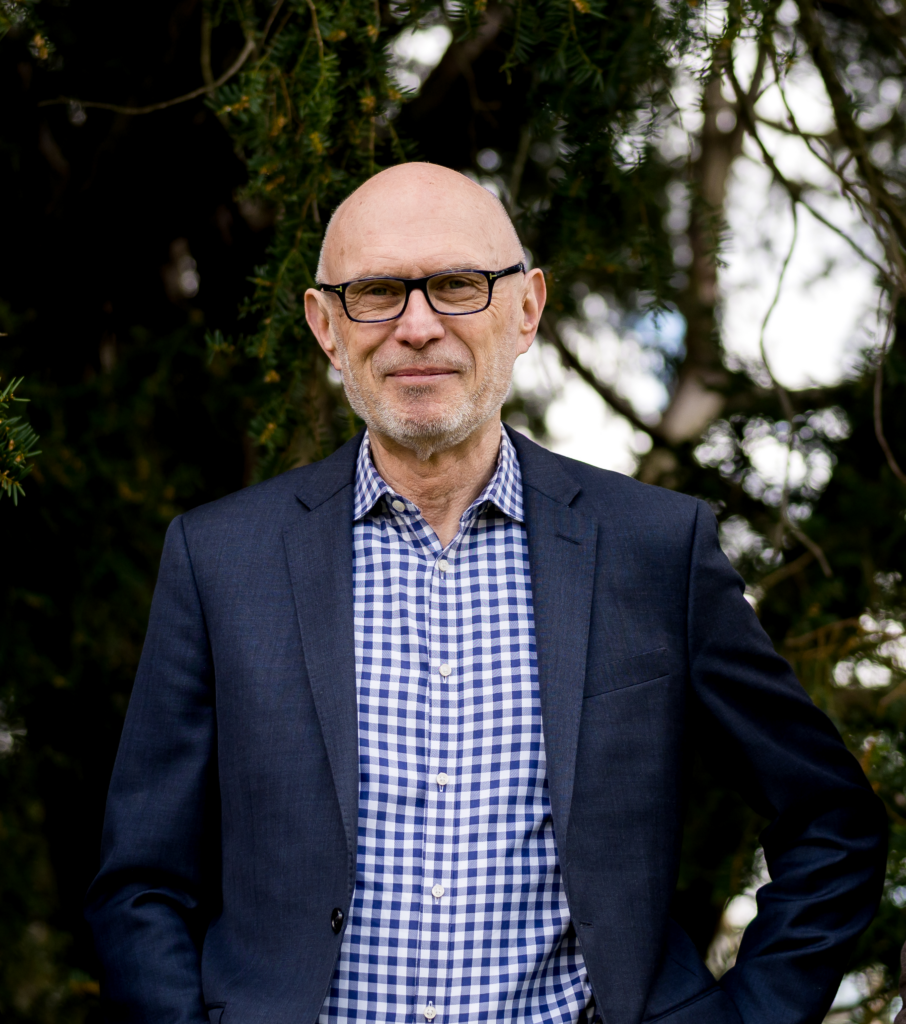
What does the earth ask of us? Visionary author, botanist, and Citizen Potawatomi Nation member, Dr. Robin Wall Kimmerer asked that profound question before a sold-out audience of 700 during her Grace Farms Lecture with Concert in March. “An educated person knows their own gifts and how to give them to the world,” she added.
Dr. Robin Wall Kimmerer, whose award-winning books can be found in our Library.
Drawing from Indigenous wisdom and a lifetime of scientific study, Dr. Kimmerer invites us into establishing a deeper relationship with the living world, one rooted in gratitude, reciprocity, and care. “It’s moving beyond sustainability to where we care for the Earth and in return the Earth cares for its inhabitants,” said Kim Kelly, Grace Farms Director of Horticulture. It’s based a design system of reciprocity, where restoration, regeneration and resilience are prioritized, added Kelly. The system referred to as “permaculture,” short for permanent agriculture, is a way of designing human environments, from farms to communities, that are self-sustaining, resilient, and regenerative, rather than extractive.
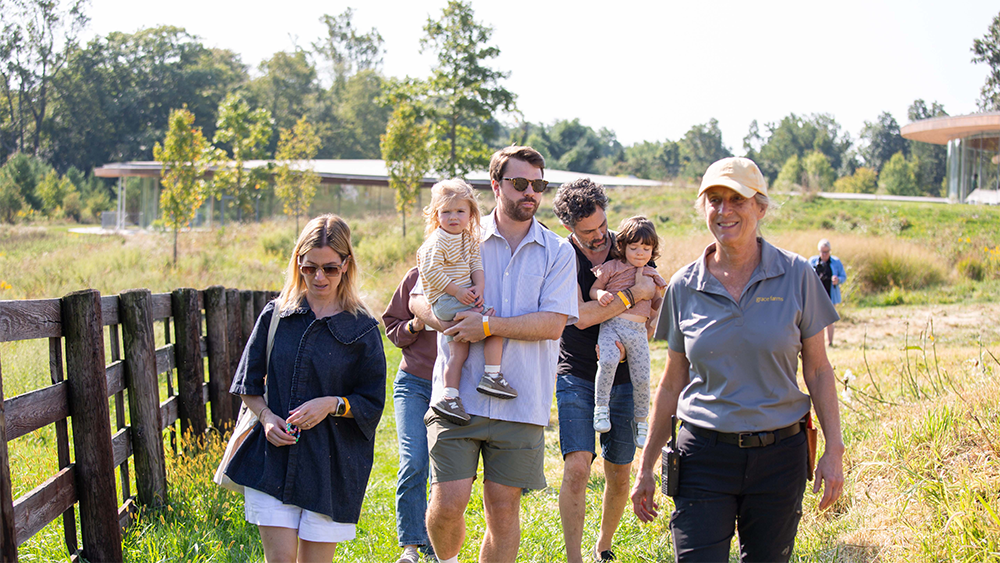
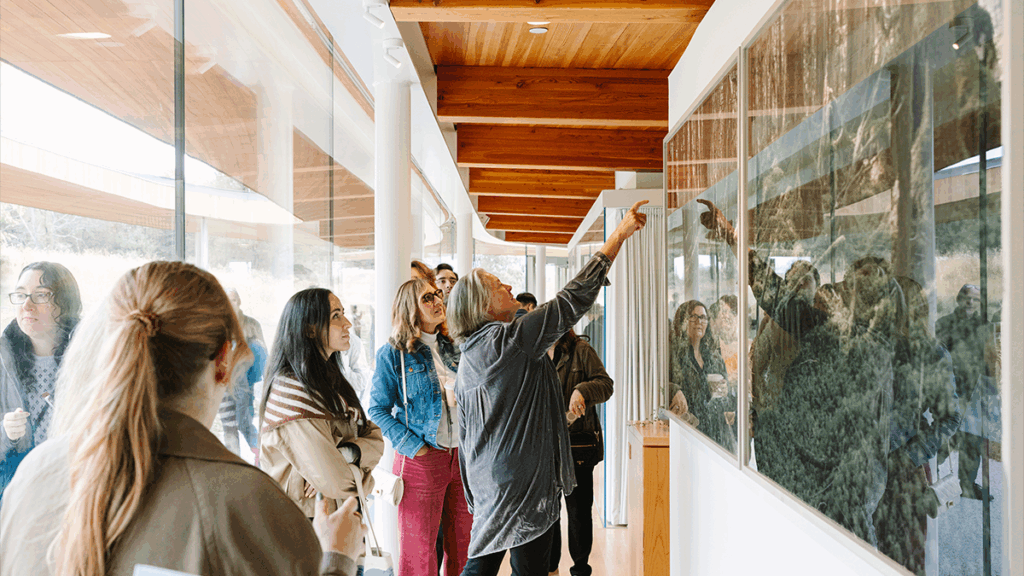
Kim Kelly, Grace Farms Director of Horticulture, during a nature tour at Grace Farms.
Not long after Earth Day was first celebrated on April 22, 1970, the permaculture movement emerged as a philosophy focused on revitalizing land and enhancing biodiversity. Rooted in concepts of permanent agriculture from the early 1940s, permaculture has since become central to global regenerative land care practices.
Popularized by Bill Mollison and David Holmgren, an Australian biologist and ecologist, respectively, their work is grounded in working with, rather than against nature. It is based on the idea that “the natural world holds the key to stable and productive systems,” as explained in The Guardian. This includes planting diverse sets of crops, using perennial species, and creating conditions for soil regeneration.
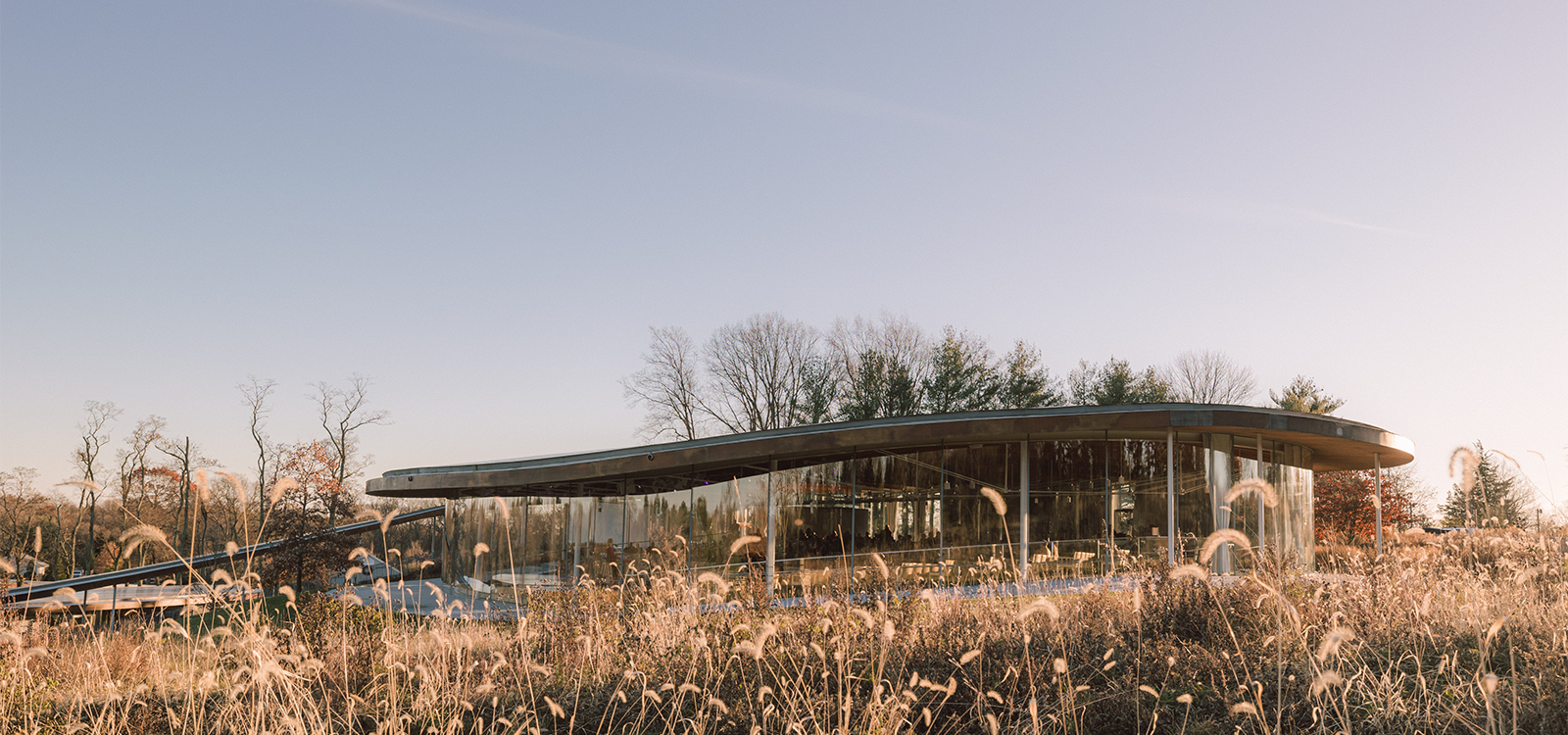
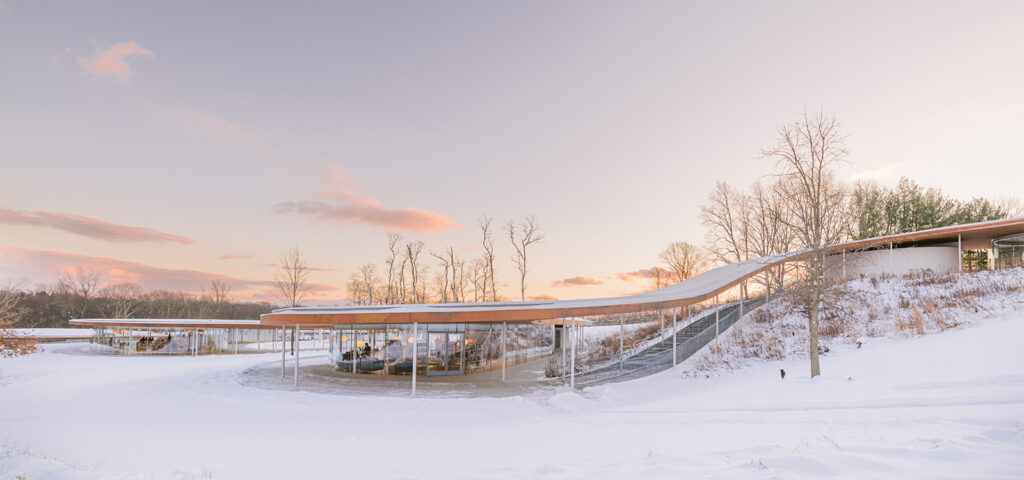
Since its founding in October 2015, Grace Farms has applied restorative and regenerative practices to transform the former equestrian facility into a natural preserve with 10 biodiverse habitats, including open meadows, woodlands, vital wetlands, and ponds. Meadow restoration has focused on planting thousands of native plants and grasses. These efforts strengthen interconnected ecosystems that support water and nutrient cycles. Grace Farms is a Certified Wildlife Habitat Garden, Certified Monarch Waystation, a member of the Xerces Society Pollinator Protection Plan, as well as a founding member of the New Canaan chapter of the Pollinator Pathway.
Nearly 80 acres at Grace Farms serves as a living classroom to learn about biodiversity, pollinators, and the practices used to care for the environment.
“Our stewardship efforts have turned Grace Farms into a model of biodiversity, where the public can learn hands-on through our educational programs,” said Kelly, also the President of the International Association of Butterfly and Exhibitors & Suppliers (IABES). “Our practices focus on feeding the soil, sequestering and adding carbon back to the soil with biomass as a large part of our practices.”
Stewardship in Action
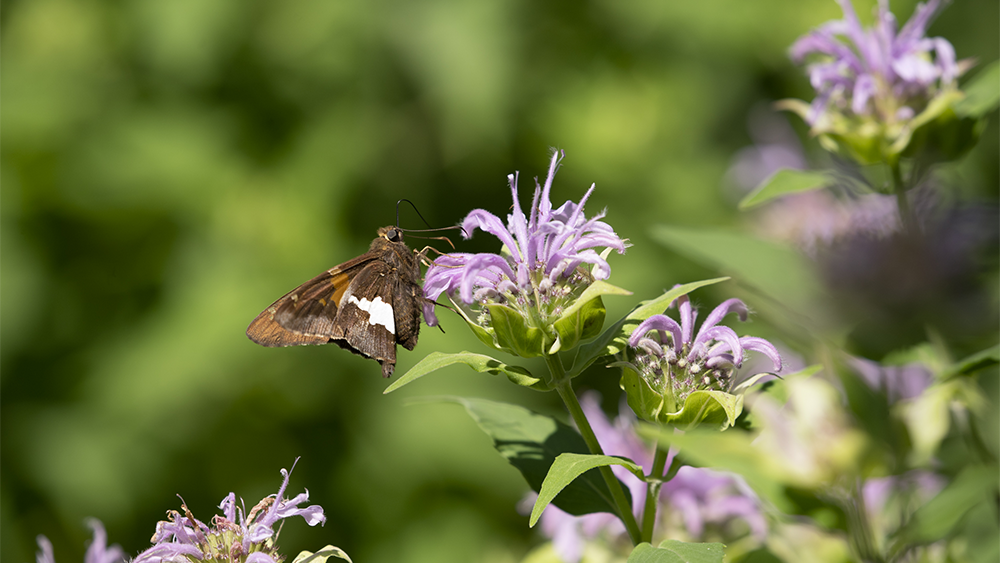
Coneflowers or Echinacea are a magnet for pollinators including bees and butterflies.
3 million + various species of native grasses populated our meadow after sowing 18 pounds of native grasses and pollinator plants in 2024
2,000 + trees representing 50 different species support biodiversity
140 + species of birds identified, including the American kestrel, North America’s smallest falcon
70% of mowed lawn converted to meadows
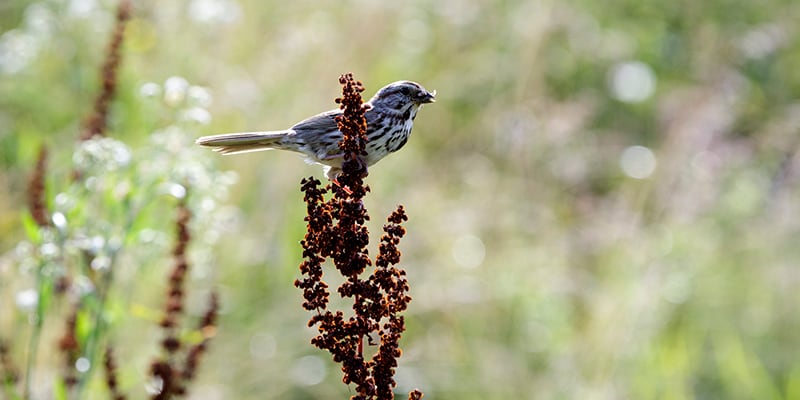
Restoring biodiversity at Grace Farms has created thriving habitats for pollinators and wildlife. Here is a song sparrow in the meadows.
Benefits of Permaculture
The benefits of permaculture are notable. In a 2024 Communications Earth & Environment article, the authors examined nine farms utilizing permaculture-based agriculture in Central Europe. Here are some of their findings: species richness of vascular plants, earthworms, and birds were 457%, 77%, and 197% higher, respectively. Researchers concluded that permaculture is an effective tool for redesigning farming systems toward environmental sustainability. In addition, the same study found 27% higher soil carbon levels on permaculture sites than on control fields. “The process of transferring and storing CO2 from the atmosphere into the soil as part of the soil organic matter, through plants or other organic solids … has substantial and technically feasible potential to stabilize the global climate system.”
Permaculture began as a response to changing modern agricultural practices — industrial monoculture practices that deplete and degrade soil quality. The 12 permaculture design principles outlined in Modern Farmer such as valuing diversity and renewable resources can also be applied on any scale, from home gardens to urban rooftop farms.
The 1,450-square foot organic Garden at Grace Farms implements the design and growing practices based on permaculture or restorative, regenerative and resilient principles, prioritizing variety and adhering to the philosophy of planting the right plant in the right place.
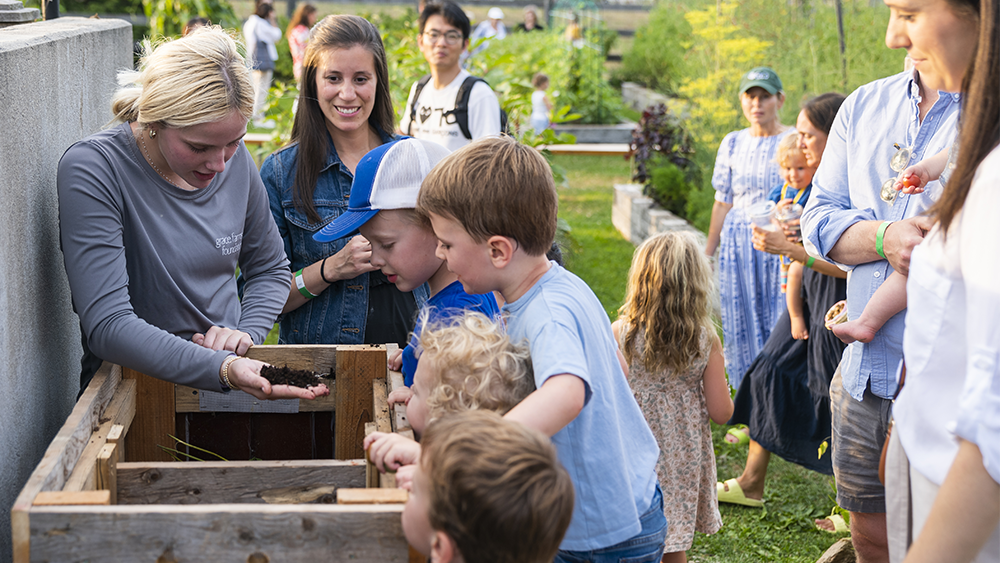
Our large organic garden, besides serving as a source for food for nonprofits, act as a living classroom when people of all ages and backgrounds can learn about soil health and caring for plants.
“These are our goals as students and stewards of the land,” Kelly said. “We should look at permaculture as a way to give back to the Earth that sustains us and the planet itself.”
Preserving and enhancing soil health is fundamental to sustaining life on Earth. Liberty Hyde Bailey, an American botanist, educator, and “Father of American Horticulture,” said in The State and the Farmer (1908) that “every well-managed soil should grow richer rather than poorer; and, speaking broadly, the farm should have within itself the power of perpetuating itself.”
While permaculture may be considered “new” by some, these practices as Bailey noted, have been used for decades. Perhaps, the economic and human toll from climate change is raising awareness about restorative, regenerative and resilient principles. Climate change is displacing people who are already living on the fringes of society, making them vulnerable to human trafficking and forced labor as individuals and families look for work.
What You Can Do
We can get overwhelmed about the Earth’s woes, wondering if our contribution is enough to help a warming planet, its dwindling resources, food scarcity, and more. Dr. Doug Tallamy, a renowned entomologist, wildlife ecologist, and professor at the University of Delaware, suggests rather than focus on all the problems, “focus on the piece of the earth you can influence.”
Here are a few ways to contribute and make a difference:
Plant native species to increase biodiversity, including drought-resistant native plants
Practice no-till gardening, which protects fungal networks (mycorrhizae) that helps plants absorb nutrients and support microbes that cycle carbon and nitrogen
Plant pollinator gardens for bees, butterflies and other pollinators
Avoid pesticides and herbicides
Cultivate a mindset of reciprocity with the Earth
These basic practices have enhanced the biodiversity of Grace Farms. For instance, as mentioned earlier, restoring native meadows and habitats brought back the American kestrel to the area, one of the smallest falcons in North America, which helps control crop pests. In addition, ongoing efforts include removing invasive species such as mugwort and the common reed, which degrade ecosystems and harm biodiversity. The removal makes room for native species to grow.
Earth Day Celebration
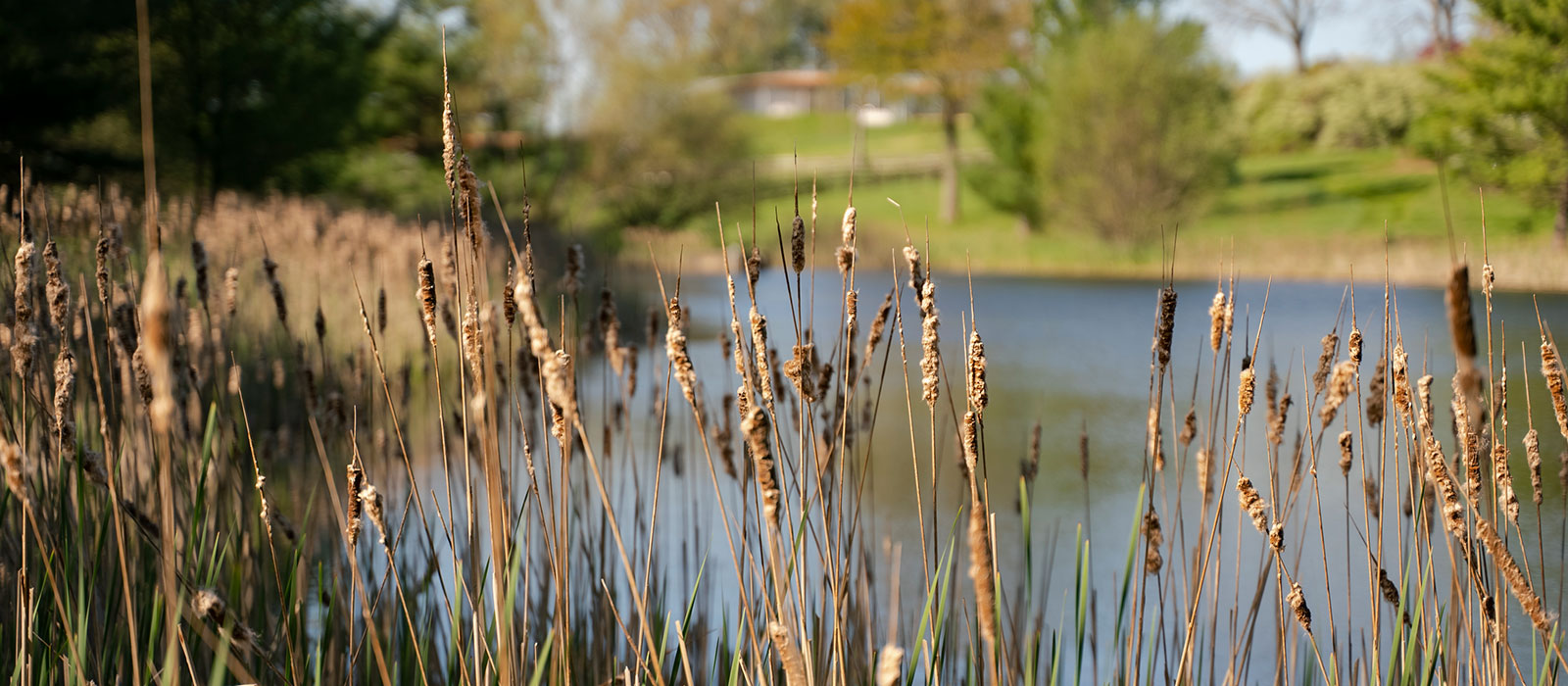
There are acres to explore at Grace Farms, including 10 habitats such as the Cattail Pond, Cattail Pond a peaceful respite for visitors and a home to wildlife including turtles, frogs, birds, and insects, all important for biodiversity.
On April 25, join us as we celebrate Earth Day
10:00 am – 5:00 pm
This fun-filled day offers hands-on activities, art engagements inspired by nature, and endless opportunities for interactive learning. Responding to the work of Potawatomi botanist and author, Dr. Robin Wall Kimmerer, who delivers a Grace Farms Lecture in March, as well as our season’s theme, We all build, Earth Day invites you to explore how architecture and connection to the natural world can inspire communities to build and thrive together.
Learn more about our full schedule of family-friendly experiences hosted throughout the River building and Barns, and surrounding landscape:
10 am – 12 pm
From experienced to novice birdwatchers, the birdwatching tour will inspire and perhaps surprise even the most experienced birdwatcher.
Birdwatching Court Mezzanine Over 144 different bird species have been sighted at Grace Farms! Join an expert birder to see and learn about the different species that call Grace Farms home.
10 am – 4 pm
Open Arts Studio | Landscape Collage Arts Studio Taking inspiration from the Plaza’s new seating, Dancing Trees by Kazuyo Sejima & Associates, and the freshly sprouting lawn, design an outdoor space incorporating structures, plants, color, texture, and wildlife.
11 am – 4 pm
Magnifying Small Wonders and Seed Bar East Barn Hall Explore the unique characteristics of seeds up close using digital scope and microscopes, then create a mix to take home, using seeds harvested onsite.
12 pm & 3 pm
Animal Embassy West Barn Hall Join Animal Embassy to learn about their role as animal rescuers as well as their program, Heroes of the Animal Kingdom — and discover some incredible facts about a variety of animals!
1 & 4 pm
Beneficial Bugs with Educator Patrice Anibal Library
2 pm
Nature Talk with Horticulture Specialist Michael Poulin Education Path
3 – 5 pm
Mocktails with Tea Expert Frank Kwei Pavilion Take a break from exploring to sip a delicious tea-based mocktail with Tea Expert Frank Kwei! Surrounded by 360-degree views of the landscape, enjoy a special mocktail inspired by this year’s Earth Day themes.
Available All Day
Nature Resources in the Library Walking trails With Every Fiber Exhibit in the West Barn Family-Friendly Games in the Court Birdwatch Bingo Letter Sticks Map
Additional Nature Spring and Summer events:
Throughout the year, people are invited to explore nature and how to care for the Earth through hands-on workshops led by our Horticulture and Education Teams.
Grace Farms is a cultural and humanitarian center in New Canaan, Connecticut that brings people together across sectors to explore nature, arts, justice, community, and faith at the SANAA-designed River building and Barns on 80 acres of publicly accessible natural landscape. Since opening in 2015, Grace Farms has welcomed 1 million visitors from around the world to experience its unique integration of arts, architecture, nature, and purpose.
As a destination for arts and culture, Grace Farms presents innovative programming in music, visual and performing arts while fostering contemplation and connection through architecture and nature. Its humanitarian work includes leading the Design for Freedom movement to eliminate forced labor in the building materials supply chain and advancing initiatives to foster more grace and peace locally and globally.
The integration of cultural programming and humanitarian action reflects Grace Farms’ collaborative approach to generating new outcomes and meaningful change.
Membership
Grace Farms members enjoy early access to program registration, a 20% discount on paid programs, retail, and dining, and so much more.
Becoming a member helps us advance our mission to pursue a more peaceful world and supports the preservation of the River building and its surrounding 80 acres.
On March 26, Design for Freedom reached a milestone. Five years ago, Sharon Prince, CEO and Founder of Grace Farms, ignited the Design for Freedom movement, It started with a simple but urgent question : what if the buildings we design and inhabit were built with the dignity of every person who harvests, mines, and processes the materials that make them possible?
That one question launched a global movement to eliminate forced and child labor in the building materials supply chain. As Prince welcomed more than 550 global leaders across the architecture, engineering, and construction (AEC) industry, as well as students from 21 colleges and universities, she said, “In the life of a movement, five years is a foundation … But for the 28 million people trapped in forced labor conditions around the world, working in inhumane conditions to produce the very materials of our built environment, five years is a lifetime.”
In these foundational years, much has been accomplished at an unprecedented pace, from publishing the ground-breaking Design for Freedom Report in 2020, launching the Design for Freedom Summit in 2022, activating more than 12 Pilot Projects across four continents, publishing Design for Freedom toolkits, including the Design for Freedom International Guidance & Toolkit in 2025, and elevating the movement around the world through presentations and engagements that have reached over 50,000 people to date. This acceleration has been driven by Prince’s relentless pursuit to put the issue on the industry’s agenda, taking a top-down and bottom-up approach to the issue. She has invited leaders across sectors who have the agency to make changes, company- and industry-wide to do so. At Grace Farms, she is also initializing public demand for ethically sourced materials and products.
A year after Design for Freedom was launched in 2020, Grace Farms introduced Grace Farms Tea & Coffee, a Certified B Corp giving back 100% of its profits to support Design for Freedom. Tea and coffee have become another way to educate the public about forced and child labor, demonstrating that it’s possible to make ethical and sustainable choices. Grace Farms Tea & Coffee has also been able to expand its reach with the introduction of its Wellness Teas into 26 Whole Foods Markets, as well as expanding its corporate sponsorships to more than 20 organizations, including JPMorgan Chase, UBS, Sciame Construction, and Bloomberg. In 2026, Grace Farms Tea & Coffee café will open at the base of JPMorganChase’s new headquarters in Manhattan.
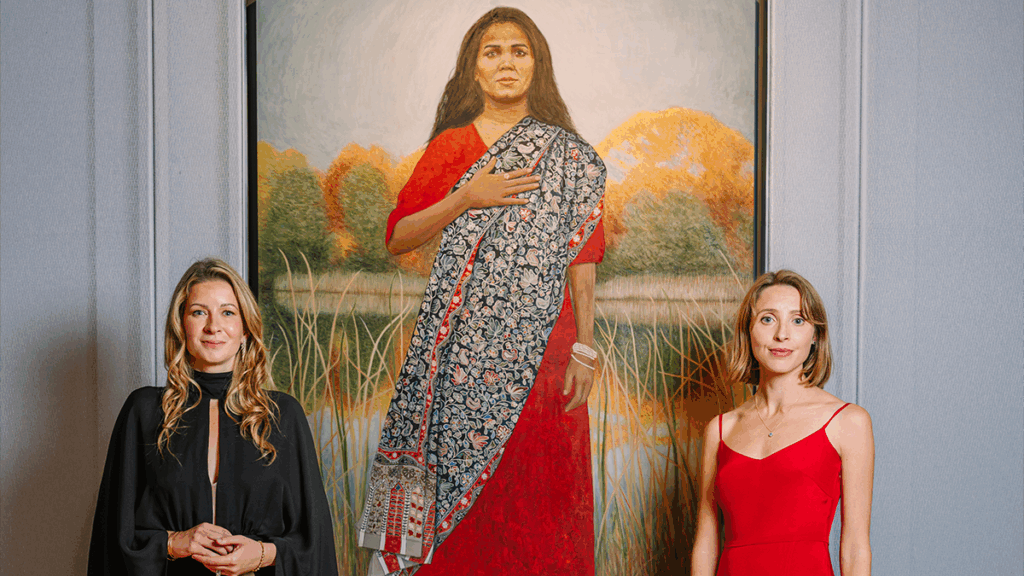
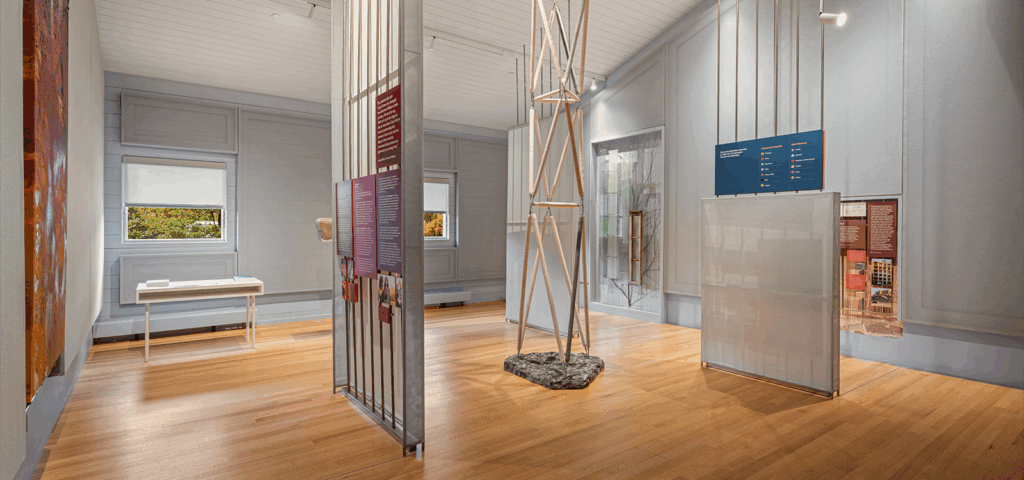
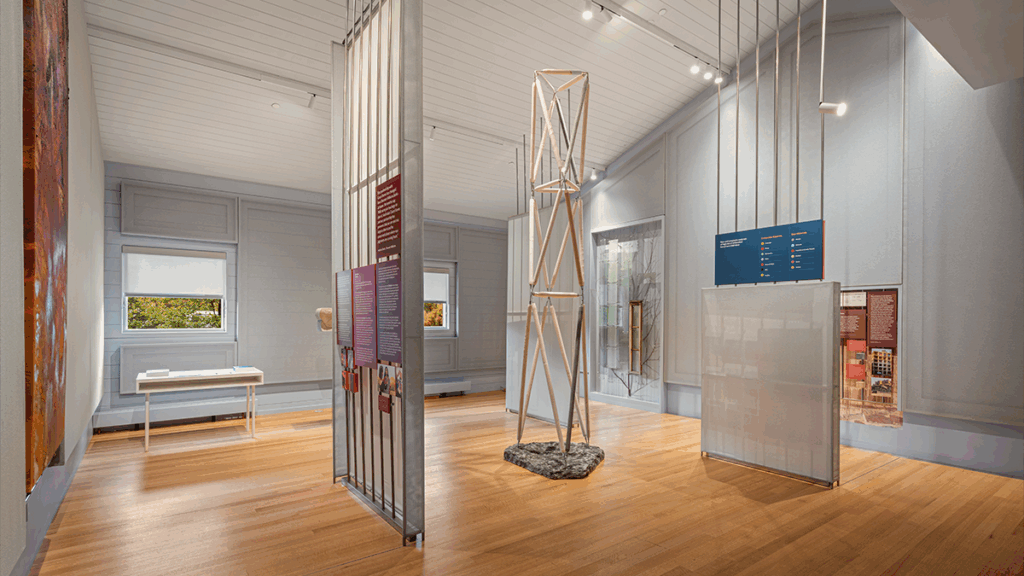
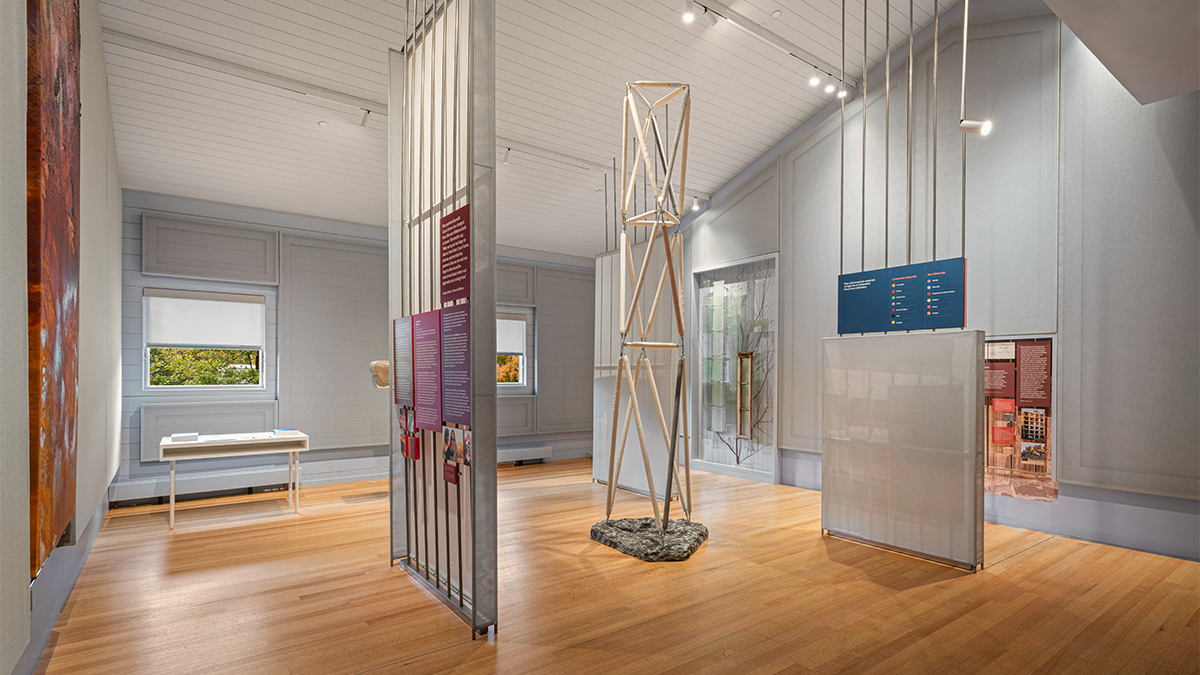
The With Every Fiber exhibit also serves as a way for the public to learn about Design for Freedom. The current iteration focuses on three at-risk materials: stone, pigment, and glass. The stories of these materials are told through a number of commissioned artworks including a portrait of Nasreen Sheikh, painted by artist Dr. Hannah Rose Thomas, a painting by artist and professor, John Sabraw, using pigments made in his studio from recycled mine drain off in the Ohio mountains, a new glass installation by Nina Cooke John, Principal of Studio Cooke and designer of With Every Fiber, along with a sustainable prototype for stone truss work demonstrating engineering solutions, designed by Steve Webb, of Webb/Yates, and fabricated by the Stone Masonry Company.
The London Philharmonic Orchestra, which has a long partnership with Grace Farms, recorded Woven in Tears, a new composition by Evan Williams created for this exhibit.
The next Design for Freedom Summit will be held on March 31, 2027
Highlights from the 2026 Design for Freedom Summit
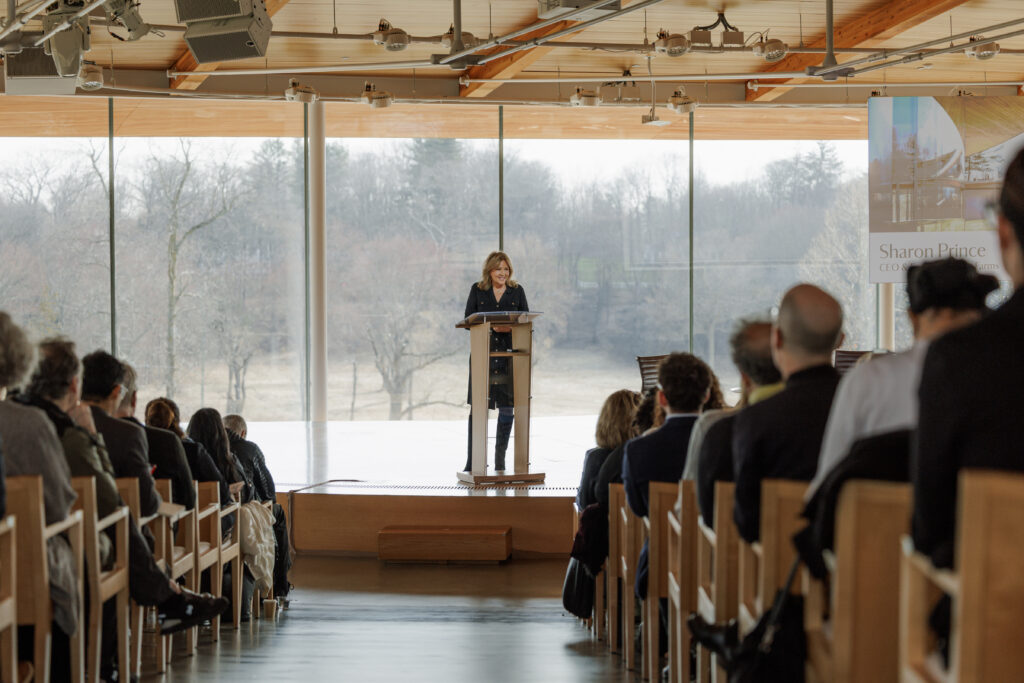
Sharon Prince, CEO and Founder of Grace Farms in the Sanctuary of the award-winning building, where events such as the Summit and performances are held. (Photo by Melani Lust)
Welcome Address, Sharon Prince, CEO & Founder, Grace Farms
Here are excerpts from the address. Read Prince’s full address.
“In the life of a movement, five years is a foundation … But for the 28 million people trapped in forced labor conditions around the world, working in inhumane conditions to produce the very materials of our built environment, five years is a lifetime.”
“This is our moment. The construction industry is now positioned to become a global leader in supply chain transparency and human rights.”
“We refuse to stay at a standstill. We’re creating a radical paradigm shift to move forced and child labor from the building materials supply chain and ignite institutional responses.”
Sharon Prince opens the Summit, welcoming a sold-out audience of global leaders across sectors, including students from leading universities. (Photo by Melani Lust)
“‘Plausible deniability’ cannot be used as a backstop anymore.”
U.S. Foreign Policy: In Conversation with Former Ambassador Cindy Dyer
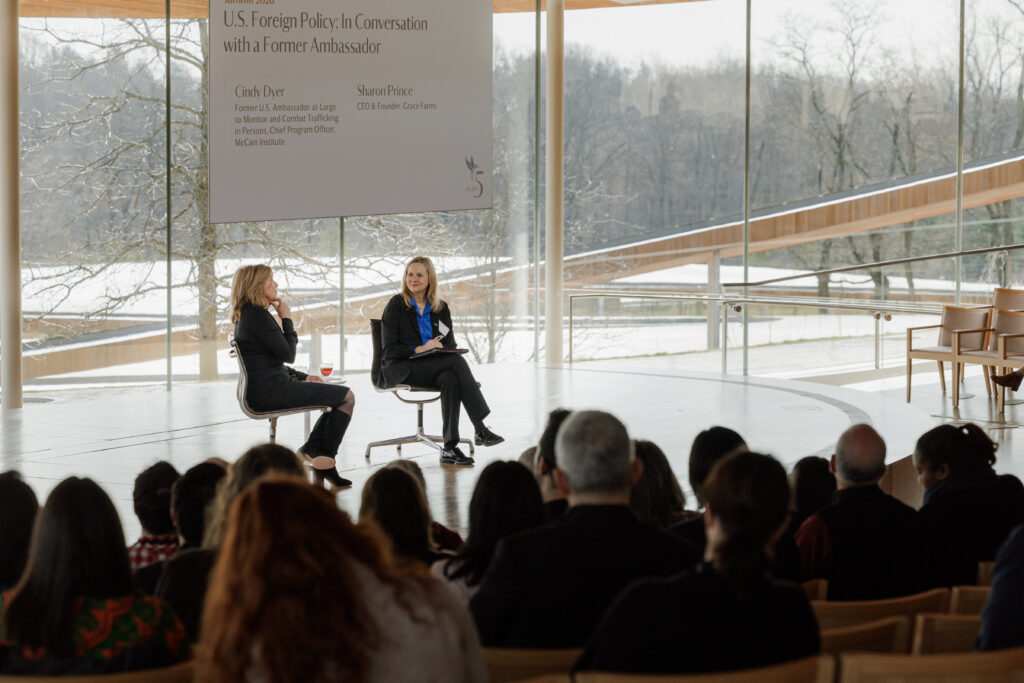
Sharon Prince and Ambassador Cindy Dyer discuss the state of global human trafficking efforts. (Photo by Melani Lust)
Sharon Prince, CEO & Founder, Grace Farms, and Cindy Dyer, Former U.S. Ambassador-at-Large to Monitor and Combat Trafficking in Persons, Chief Program Officer, McCain Institute
The two discussed the state of global human trafficking efforts. Dyer explained how the Trafficking in Persons (TIP) Report works as a powerful tool that assesses anti-trafficking in 188 countries and territories, assigns tier rankings, and carries real financial consequences for the worst offenders. Dyer shared firsthand accounts that illustrated how diplomatic engagement backed by legislation can drive real policy change. Both noted that while the Trafficking Victims Protection Act (TVPA) and the Palermo Protocol have maintained rare bipartisan support, recent staff cuts from 85 to 34 people in the TIP office and from five to roughly two staff on the Uyghur Forced Labor Prevention Act team are undermining enforcement capacity.
The conversation also touched on economic dimensions of forced labor, particularly in supply chains for goods like solar panels, where exploited labor creates an unfair “slavery discount” that undercuts ethical competitors. Dyer emphasized that traffickers are constantly innovating and that governments and businesses must do the same, using every available tool including legislative, diplomatic, and technological. She highlighted the gap in current U.S. policy where trade-driven enforcement is expanding, while the domestic institutions responsible for oversight are being hollowed out. The conversation closed with a call to action for leaders, urging them to leverage their influence and supply chain power to help close the gap between laws and enforcement.
“… the issue of human trafficking does still have bipartisan support and bipartisan relevance. I will note that just last year, we celebrated the 25th anniversary of both the Trafficking Victims Protection Act and the Palermo Protocol. And as Sharon said, the Palermo Protocol has been adopted by the vast majority of countries and the TVPA (Trafficking Victims Protection Act) … not only had bipartisan support in 2000, but it has been reauthorized every few years, always with bipartisan support.” – Cindy Dyer
Ethical Sourcing and Circular Construction in Data Centers
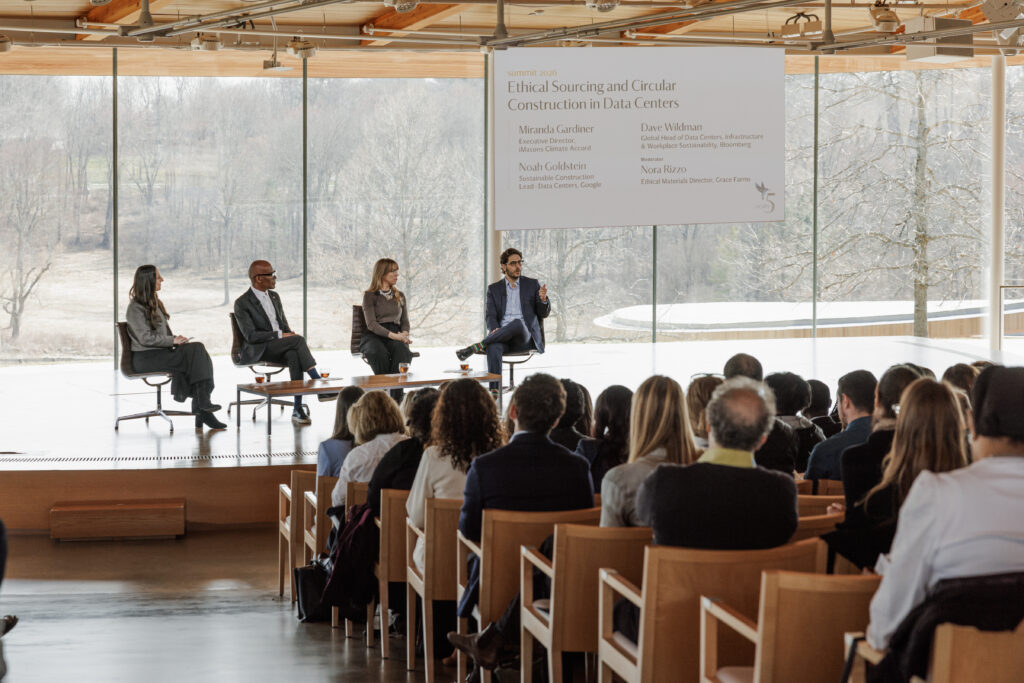
Miranda Gardiner, Executive Director, iMasons Climate Accord Noah Goldstein, Sustainable Construction Lead – Data Centers, Google Dave Wildman, Global Head of Data Centers, Infrastructure & Workplace Sustainability, Bloomberg Nora Rizzo, Ethical Materials Director, Grace Farms (Moderator)
Nora Rizzo, left, moderates the panel that explores the challenges and opportunities in construction with the emergence of AI and data centers. (Photo by Melani Lust)
This panel discussed the sustainability and ethical sourcing challenges facing the rapidly expanding data center industry. Global data center capacity is projected to grow 14% annually, and the U.S. market is expected to reach $112 billion by 2030. Major players in the industry are using their collective purchasing power and contracting language to drive better environmental and human rights outcomes across their supply chains. They emphasized transparency as a core tool, with Google’s Supplier Code of Conduct serving as a concrete example of how existing corporate commitments can be actively deployed in vendor meetings and RFPs rather than sitting unused on a website.
The panel also explored the challenge of translating carbon disclosure and environmental sustainability frameworks that are more mature into social equity and human rights conversations, noting that the data center industry is still in early stages on these discussions. But they were optimistic about the long-term, comparing today’s human rights’ conversations in data center construction to where sustainability discussions were 20 to 30 years ago, arguing that consistent education along the supply chain, combined with the competitive nature of industry leaders can drive positive change.
“There is great opportunity, but also great risk associated with AI and digital infrastructure. Collectively, we are managing one of the most complex supply chains on the planet. How do we get this right?” — Nora Rizzo
” . . . if we invest in the supply chain beforehand, if we invest in the communities beforehand, it actually sets us up for success.” — Noah Goldstein
“Every time somebody says something like, ‘We need it, because it’s cheaper.’ … Cheaper for who? Where along that supply chain is the cheaper piece of it? Who are we impacting?” — Miranda Gardiner
“When you speak to people, and this is a new topic for them, you can see their eyes light up, not because they’re happy, but you’re enlightening them . . . it shows you that there’s hope that people do actually care.” — Dave Wildman
Material Innovation with Dr. Mae-ling Lokko
Dr. Mae-ling Lokko, Founder, Willow Technologies; Assistant Professor, Yale School of Architecture; Assistant Director, Yale Center for Ecosystems + Architecture (CEA)
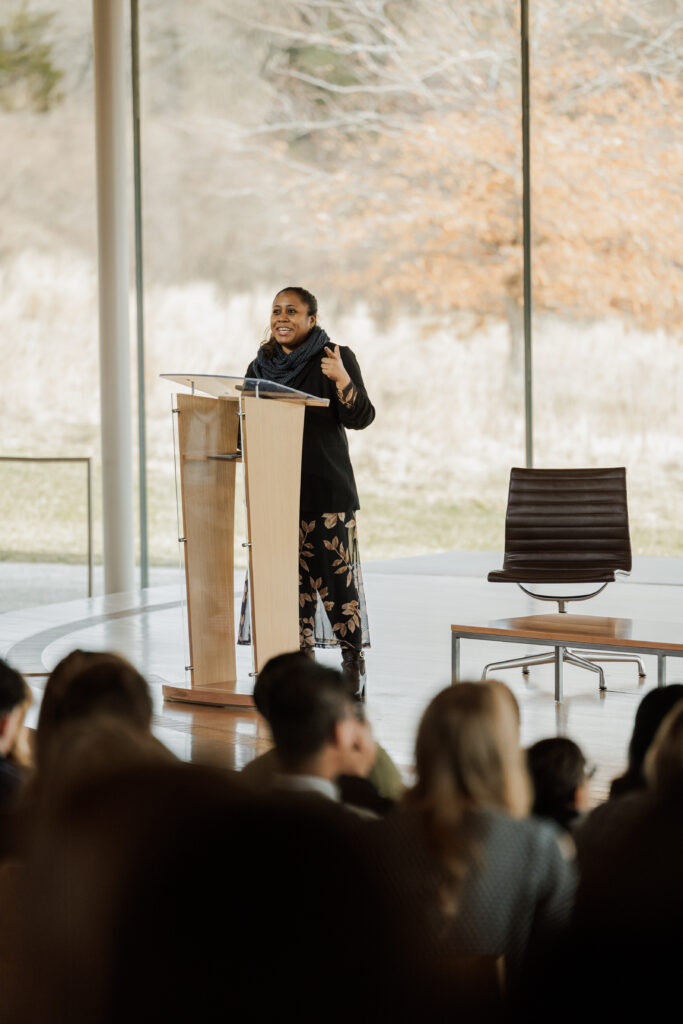
Dr. Mae-ling Lokko, Founder, Willow Technologies; Assistant Professor, Yale School of Architecture; Assistant Director, Yale Center for Ecosystems in Architecture (CEA). (Photo by Melani Lust)
Dr. Mae-ling Lokko presented her research on bio-based and regenerative materials, framing agricultural byproducts — husks, stalks, peels, and stems — as an underutilized and powerful resource for addressing climate change, labor equity, and healthy building materials. She discussed the study from Ghana, where her company Willow worked with a network of women textile makers called Global Mamas to develop an affordable, non-toxic wastewater treatment using Moringa seed press meal. This work prompted a deeper question: rather than treating the symptoms of a toxic system, could materials be redesigned from the ground up with soil health as the goal? This shift led her to develop a new research framework she called “soil systems,” which looked not just at where materials come from, but where they ultimately go, positioning architecture and its supply chains as a form of public health infrastructure.
Dr. Lokko presented four emerging material classes being explored at Yale: carbon sink materials derived from agricultural residues like coconut husk; mycelium-based materials that drew on fungi’s natural ability to cycle nutrients responsibly; earth masonry innovations that moved away from carbon-intensive cement binders; and material banks that repurposed textile and synthetic waste by temporarily storing it in buildings. She emphasized the importance of biodiversity in each category, diversifying fungal strains, celebrating multi-crop farming, and expanding plant-based color systems. She also introduced the Carver Color Lab, a mobile lab that was on display at the Summit. The mobile lab is the outcome of Civilizations of Color, an interdisciplinary research collaboration between the Yale CEA and Tuskegee University that explores the development of healthy colorants for the built environment. Inspired by the African American scientist and inventor George Washington Carver, the Carver Color Lab is a revival of his “jessup wagon,” a mobile classroom and laboratory designed to bring scientific agricultural education directly to farmers in Alabama.
“Biomass from agriculture is a huge opportunity, primarily because all of these materials sequester carbon as they’re growing as plants, and we can actually defer those carbon emissions by burning or downcycling them by storing them in buildings.” — Dr. Mae-ling Lokko
With Every Fiber Exhibit: Pigment, Stone, Glass
Nina Cooke John, Principal, Studio Cooke John John Sabraw, Artist, Activist, Professor, Ohio University Steve Webb, Director, Webb Yates Engineers Chelsea Thatcher, Chief Strategic Officer & Founding Creative Director, Grace Farms (Moderator)
Chelsea Thatcher, left, moderates the With Every Fiber panel. (Photo by Melani Lust)
This panel highlighted three commissioned artists and innovators whose work appears in Grace Farms’ With Every Fiber exhibit, curated by Chelsea Thatcher. They addressed material circularity, environmental repair, and ethical sourcing through pigment, stone, and glass. John Sabraw presented his groundbreaking project in Appalachian Ohio, where he and collaborators developed a process to extract iron oxide pigment from acid mine drainage, a pollution source that has destroyed over 1,300 miles of streams, turning the extract into a commercially viable, non-toxic paint pigment. Steve Webb discussed the compelling case for stone as an underutilized, low-carbon structural material, demonstrating through engineering innovation how pre-stressed stone beams and slabs could rival concrete and steel in performance while carrying a fraction of the embodied carbon. He also acknowledged the quarrying industry’s deep ties to forced labor as a critical challenge to address.
Nina Cooke John talked about her commissioned artwork for the exhibit, which explored glass circularity by salvaging vintage glass from residential and civic buildings and layering it into a composition that reflected both the fragility and transparency of the material and the need for supply chain accountability. A portion of the With Every Fiber exhibit, which Cooke John designed, was chosen for the 2025 Venice Biennale. The curator, Carlo Ratti, included it in the Intelligens CANON, which highlighted the important ideas in the last 50 years.
Across the discussions, a common thread emerged: that material innovation, when paired with community engagement, circular design thinking, and a commitment to the dignity of workers throughout the supply chain, could transform industries rather than simply reform them.
“It is a space curated for presence and attention, where materials rotate to reflect both urgent challenges in the building materials supply chain and innovations advancing more ethical, sustainable practices.” – Chelsea Thatcher, Chief Strategic Officer and Founding Creative Director and curator of the With Every Fiber exhibit
“It’s really important for us that we’re doing this, that we actually activate the creative problem-solving potential of the next generation, even as we encourage them to be stewards of their own backyard.” — John Sabraw
“It’s been really interesting to partner with Grace Farms to explore this and find ways of using stone but also trying to find out how the supply chain can be improved in terms of the dignity and the rights of the people that are working in it.” — Steve Webb
“This layering allows us to lean into the transparency of glass, but also thinking about transparency of exploring global supply chains and how to incorporate that . . . ” — Nina Cooke John
On the Horizon
ACSA Winners Announced with Julia Gamolina, Founder and Editor-in-Chief, Madame Architect, and Karen Kariuki, Managing Director, Strategic Initiatives, Grace Farms
Karen Kariuki, Managing Director, Strategic Initiatives, Grace Farms, left, and Julia Gamolina, Founder and Editor-in-Chief, Madame Architect. (Photo by Melani Lust)
The winners of the Grace Farms and the Association of Collegiate Schools of Architecture (ACSA) student competition were announced. The competition reached over 300 students and faculty worldwide. Participants proposed ways architects can eradicate forced labor from the built environment. The winners were recognized at the Summit by one of the nine jurors, Madame Architect’s Founder, Julia Gamolina.
“…their work is already shaping this movement, and they are very powerfully demonstrating that architecture and justice are inseparable.” — Julia Gamolina
Winners in the Design Project Category:
First Place: Peace Museum – Beyond the Scars
Nidhi Naik & Shamita Shyam Honawar, University of Illinois, Urbana-Champaign
Second Place: Patches in Waiting A Shelter for Equity and Material Justice
Leonor Aguero Vivas, University of Calgary
Third Place: Modular Housing for Material Justice
Sofia Ramirez, University of New Mexico
Winners in the Materials Research Category:
First Place: Unmasking Greenwashing: Creating an Ethical Timber Supply Chain
Natalie Darakjian, Noelle Osborne & Reed Wilson, University of Southern California
Second Place: Behind the Rubber
Xingyu Liu, University of Illinois, Urbana-Champaign
Third Place: Unbuild to Rebuild:
Teodor Mlynczyk & Kritika Sarawagi, Carnegie Mellon University
Grace Farms Tea & Coffee
Adam Thatcher, CEO & Co-Founder, Grace Farms Tea & Coffee
Adam Thatcher, CEO & Co-Founder, Grace Farms Tea & Coffee, talks about the company’s goals and success. (Photo by Melani Lust)
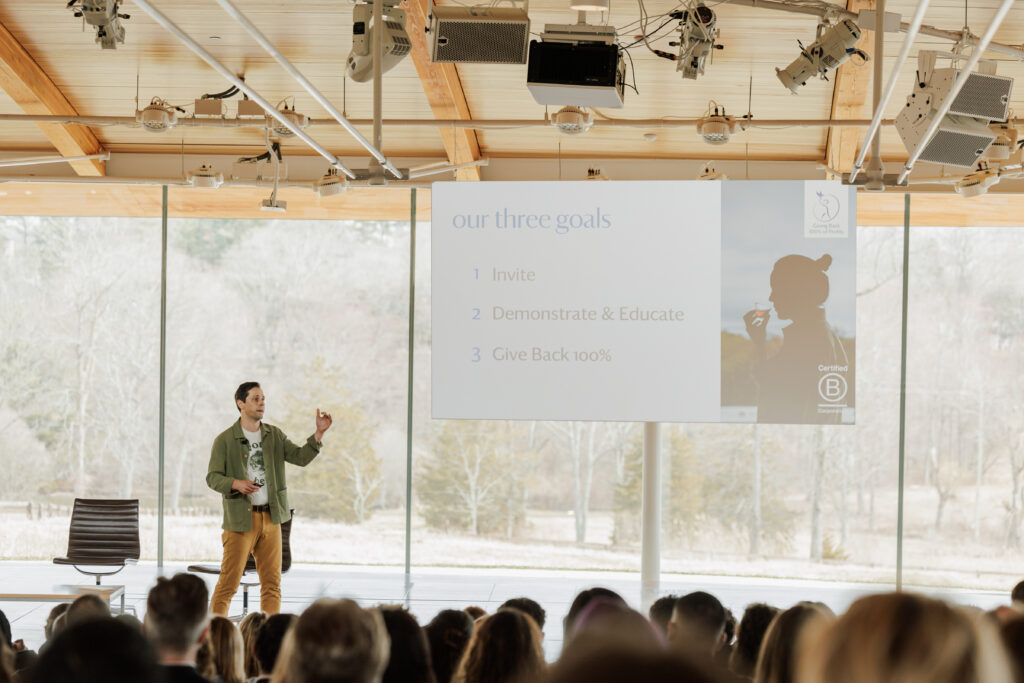
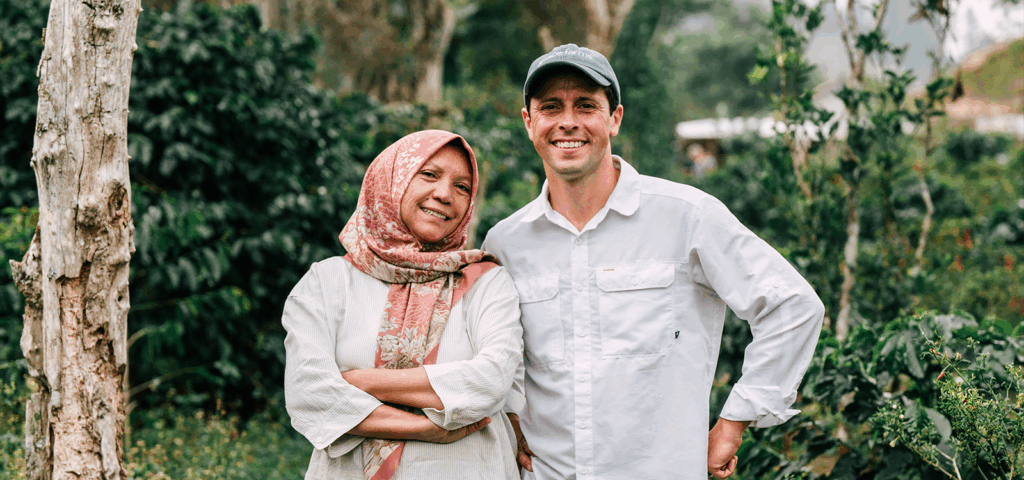
Grace Farms Tea & Coffee, a Certified B Corp launched during the pandemic with three goals: 1) Invite everyone to experience Grace Farms; 2) Demonstrate ethical and sustainable supply chains; and 3) Give back 100% of profits to support Design For Freedom. welcoming visitors through ethically sourced teas and coffees, demonstrating sustainable supply chains, and supporting women-led farming cooperatives. The company has a partnership with the Ketiara Cooperative in Sumatra, Indonesia, a community of 1,100 women coffee farmers led by Ibu Rahmah. Working with Slade Architecture, Grace Farms is developing a “Rest House” concept for the community. When a devastating cyclone struck Sumatra last November, which was the worst disaster to hit the area since the 2004 tsunami, Grace Farms quickly provided humanitarian aid. Grace Farms Tea & Coffee continues to expand its corporate partnerships with the companies like Google and Bloomberg. This year, it will open its first retail location at the base of JPMorgan Chase’s new headquarters at 270 Park Avenue in New York City.
“We’re the first and only US-based tea company to partner with Fairtrade International, the original and most rigorous of fair-trade certifications, and we also source our coffees exclusively from women-led co-ops in Ethiopia, Colombia, and Indonesia.” — Adam Thatcher
“This performance invites us to reflect on what’s possible within each of us, the virtuosity, creativity, and energy waiting to be realized and applied to the Design for Freedom movement. It also reminds us of the value of study and exploration, of taking something apart, understanding it deeply, and practicing it with intention, integrity, and a commitment to human flourishing.” — Chelsea Thatcher
Pilot Projects Announcements
Nora Rizzo, Ethical Materials Director, Grace Farms and Brigid Abraham, Design for Freedom Senior Project Manager, Grace Farms
“These projects model more transparent and ethical supply chains in the built environment. Each project generates its own set of outcomes and research, creating ripple effects throughout the market. These projects tell stories of how our industry is challenging the status quo and bringing a more humane future into view.” — Nora Rizzo
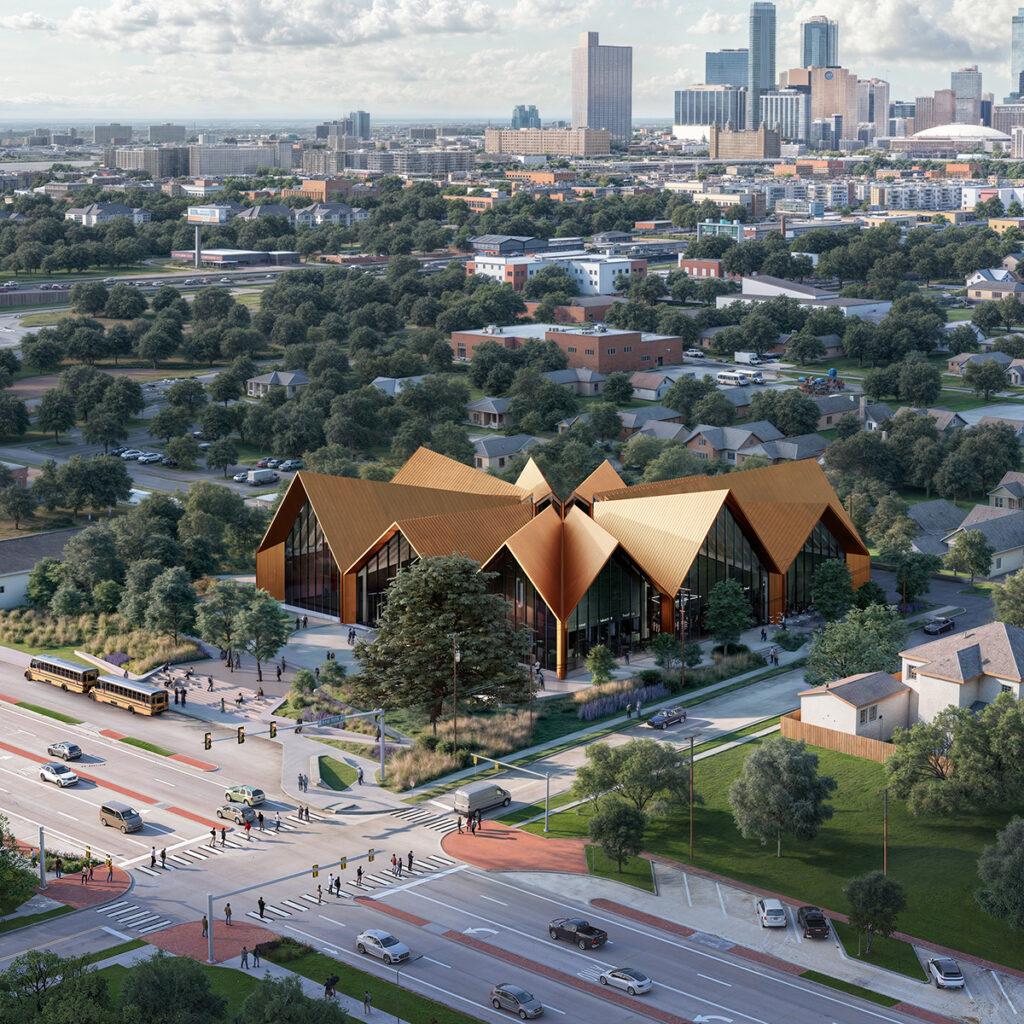
The National Juneteenth Museum (Fort Worth, Texas)
The National Juneteenth Museum will be the epicenter for the education, preservation and celebration of Juneteenth nationally and globally, hosting exhibitions, discussions, and events about the significance of African American freedom. The new building is designed by Bjarke Ingels Group (BIG), Alligood Song Architecture, and architect-of-record KAI Enterprises.
Bloomberg Park Avenue Office Expansion (New York, New York)
Designed by Fogarty Finger and with Socotec as sustainability and advisory partner, the expansion of the company’s Park Avenue Office will create a healthful and inspiring space for Bloomberg employees to gather and collaborate. It demonstrates how Pilot Projects translate principles of integrity into practice, delivering real value in the workplace while illuminating the potential to scale this work across Bloomberg’s broader real estate and property management portfolio.
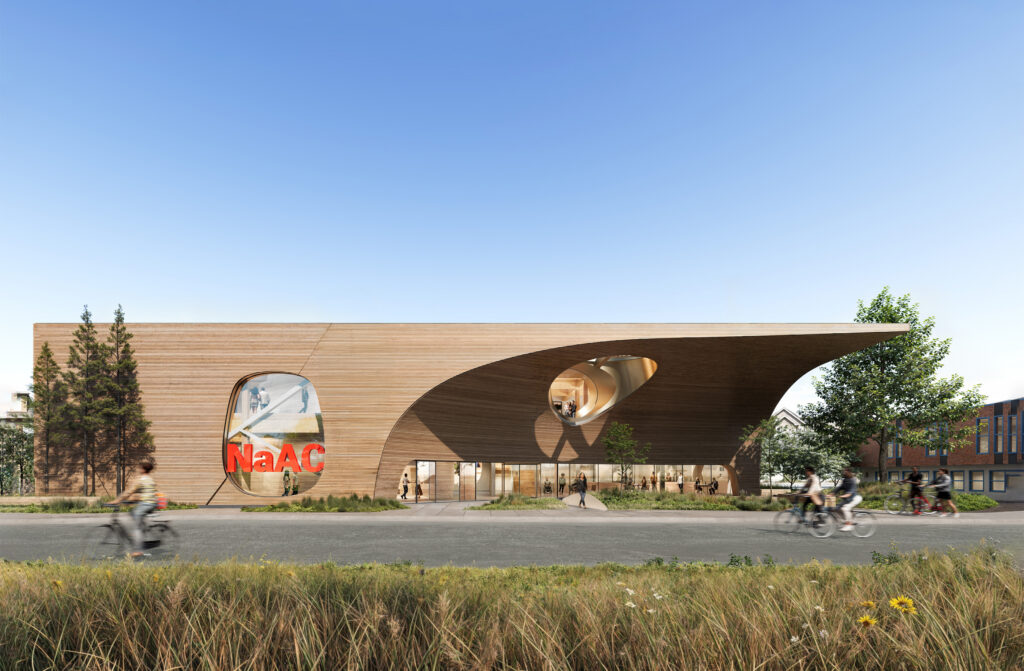
National accessArts Centre (Calgary, Canada)
The National accessArts Centre is Canada’s oldest and largest disability-arts organization, supporting a growing community of more than 400 artists through training, creation, and exhibition opportunities across multiple disciplines. Their new pavilion, the Multidisciplinary Disability Community Arts Hub, will be a home for the performing arts that approaches disability arts as a central force in cultural life. This zero-carbon building is designed for rehearsal and incubation, with public-facing spaces that bring the neighborhood into the campus, and the campus into civic life. The project is designed by DIALOG.
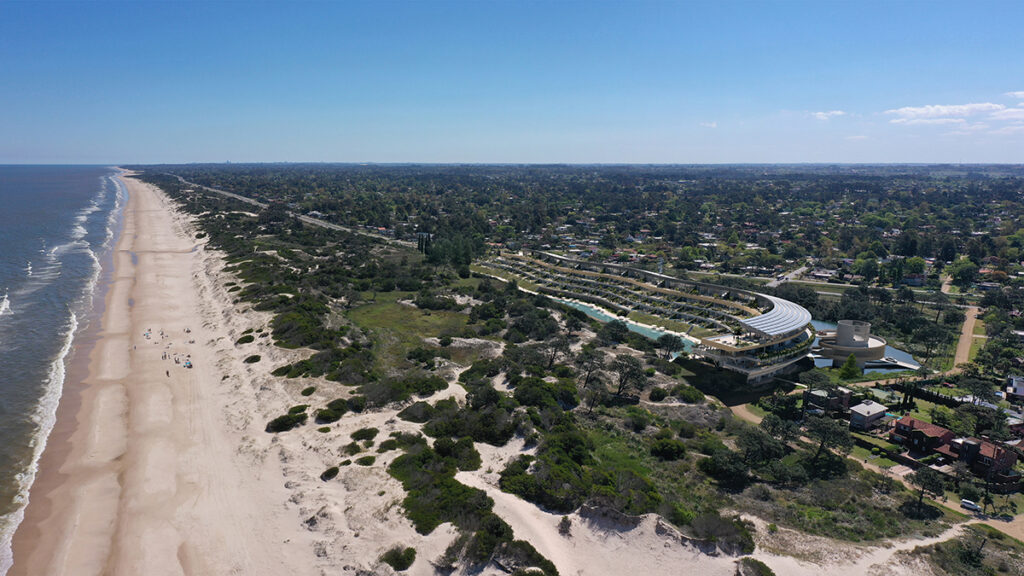
Médano by Viñoly (Montevideo, Uruguay)
Médano by Viñoly is a sustainable beachfront residential development designed by Rafael Viñoly Architects. Positioned behind coastal dunes, its elongated, sinuous form follows the natural topography, preserving the character of the coastline while minimizing its visual presence and framing views of the Atlantic Ocean and a northern lagoon. Stretching 425 meters along the shoreline, the low-lying “landscraper” comprises approximately 120 terraced residences. Conceived as a Nearly Zero-Energy development, the project integrates passive design strategies, renewable energy systems, and generous indoor-outdoor living. This is the first Pilot Project in the residential market and in South America.
Inspiration & Action with Jha D Amazi
Principal, Public Memory & Memorials Lab, MASS Design Group
Jha D Amazi discussed representation and giving a voice to communities long excluded from U.S. memorial landscapes. As a nonprofit design collective, Amazi said, they leverage philanthropic support to undertake research, catalyst projects, and system change initiatives that are focused in areas where design is urgently needed but grossly underfunded.
“Climate change, biodiversity loss, and pollution driven by unsustainable development and resource extraction are accelerating at an unprecedented rate. Simultaneously, conventional construction practices continue to exploit materials and labor, leaving behind environmental destruction and systems that fail both people and the planet. By restoring landscapes, challenging supply chains, and embedding care into the built environment, we create systems that sequester carbon, regenerate biodiversity, and improve human well-being.” — Jha D Amazi
Cultural Context and Risk in the Global Timber Supply Chain
Kai-Uwe Bergmann, Partner, BIG Gustavo Ferroni, Program Manager, Freedom Fund (Brasil) Toshiko Mori, Principal, Toshiko Mori Architect PLLC, Robert P. Hubbard Professor in the Practice of Architecture, Harvard University Graduate School of Design Sharon Prince, CEO & Founder, Grace Farms (Moderator)
Left to right: Toshiko Mori, Kai-Uwe Bergmann, Sharon Prince, and Gustavo Ferroni. (Photo by Melani Lust)
“Timber, like glass…demonstrates the capacity for the built environment to communicate beauty and dignity, as well as exploitation.”— Sharon Prince
This panel explored the connections between forests, indigenous wisdom, forced labor, and ethical material sourcing in the built environment. Mori took the audience on a global tour of forest stewardship models, highlighting Finland’s century-long tradition of sustainable forestry management, Japan’s Hokkaido region where the Ainu philosophy of taking only what is needed has shaped both forest health and community resilience, and the Amazon where archaeological evidence now confirms that indigenous communities cultivated the forest for thousands of years. Ferroni discussed the realities of the Brazilian Amazon, where illegal deforestation driven by cattle ranching contaminates timber supply chains with forced labor, organized crime, and exploitation. He urged companies to build direct relationships with local communities rather than relying solely on certifications and auditors, and to assess risk by territory rather than supplier alone.
Prince shared her firsthand visit to Stora Enso’s forestry operations in Finland, illustrating how private forest ownership and multi-generational community investment create the conditions for traceable and ethical supply chains. Bergmann discussed his firm’s project in Bhutan, where the King commissioned a new city of 80,000 people to reverse a generational drain, designed around Bhutanese Buddhist principles, vernacular architecture, and local craftsmanship. BIG discussed its use of machine learning robots trained by Bhutanese carpenters to help scale traditional wood carving techniques for the new airport, a project the carpenters themselves embraced rather than seeing it as a threat to their craft. Through the discussion, one theme emerged: the ethical sourcing in the timber and construction industries ultimately depends not on certifications alone, but on direct relationships, indigenous knowledge, and a willingness to see forests, and the people who steward them, as living systems deserving of dignity and protection.
“[The forest] has been witness to historical events and tragedies alike, it’s ingrained in the memory of civilization and continues to exist as a cultural monument itself.” — Toshiko Mori
“The Amazon is a living system…it’s a forest and a people together, and we should not ever separate that.” — Gustavo Ferroni
““[The King] invited Bjarke to Bhutan to start thinking about how to envision a future…a new city of 80,000 people…and create a new economic zone on the border with India.
[The airport] is the project we’ve taken on first…Now there’s one issue, which is how many carpenters are there in Bhutan and have they ever built anything or delivered anything at this scale?…So we went to the Biennale in Venice . . . We wanted to address the issue of the carpenters, and the idea of how this incredible craft can actually be learned. We introduced a robot that’s machine learning from the actual carpenters.
We asked the carpenters, ‘Are you afraid? Do you feel threatened by this?’ And they said, ‘No, we actually see this as a chance to really celebrate the craft.’..It’s an evolving conversation that’s very important about cultural appropriation. We’re very clear we’re not wishing to impose a Western approach of Bhutanese architecture, but the King has challenged us to create a conversation that then the Bhutanese can fill out themselves.” — Kai-Uwe Bergmann
Join us for Design for Freedom Summit on March 31, 2027
With the exponential growth of AI and data centers, next year’s Summit will specifically address both mining and data centers “because we must get this right as we build our future,” Prince said. This is “our moment,” she added. “The construction industry traditionally considered a laggard, can become a global leader in supply chain transparency and human rights. While our sector is often considered the least modernized, it also stands to benefit the most from the AI revolution. But to truly benefit and really yield potential, we must first pour a foundation of dignity.”
Design for Freedom Movement is Accelerating
Summit Momentum 2022 – 2026
2550+ industry leaders
350 students
50 Universities represented
85+ panels, interactive breakout sessions, and featured conversations
250 speakers
20 sponsors in 2026, up from 6 in 2022
Global Impact
12+ Pilot Projects across four continents
50,000+ professionals educated through lectures, workshops, and programs
300+ students and faculty participants in ACSA Competition
1st dedicated exhibit With Every Fiber featured in the La Biennale di Venezia, Intelligens CANON
100 Design for Freedom Working Group Members that champion the movement across sectors
1st ethically sourced face mask through partnership with MillerKnoll long-listed by the Dezeen Awards
13,500+ Toolkit downloads since March 2022
Student Impact
84,000+ young people and students under the age of 26 engaged in With Every Fiber exhibit at the 19th International Architecture Exhibition of La Biennale di Venezia, curated by Carlo Ratti
30,000+ visitors experienced the new iteration of the With Every Fiber in 2025, a public exhibit at Grace Farms that demonstrates innovative approaches to ethical sourcing and proves that fair labor practices in the construction industry are within our reach.
Over thirty academics, design practitioners, and environmental thinkers contributed to this book edited by Adnan Zillur Morshed, Professor School of Architecture and Planning The Catholic University of America, including Sharon Prince. Prince’s chapter focuses on Western red cedar that was ethically sourced from Haida Gwaii in British Columbia and used in the River building’s fascia.
The book examined how the contentious ideas of justice and space intersect producing different meanings for different constituencies and how they are experienced as unique social conditions, particularly in the context of an era marked by diverse social justice movements and wide-ranging political reactions to them.
Design for Freedom Working Group member, Katie Swenson of MASS Design Group also contributed to the book.
Support
The 2026 Design for Freedom Summit is supported by Collaborators ASSA ABLOY and Sciame; Advocates Acelab, HKS, ShawContract, and Turner; Contributors COOKFOX, iF DESIGN, International Masonry Institute (IMI), Skanska, Slade Architecture, WXY architecture + design; Supporters Altana, Amanda Martocchio Architecture, Louis Fusco Landscape Architects, Maine Passive House, Material Bank, Perkins Eastman, Stuart-Lynn Company, WRNS Studio; and in-kind sponsors Grace Farms Tea & Coffee and Tony’s Chocolonely.
____________________
About Grace Farms
Grace Farms is a cultural and humanitarian center in New Canaan, Connecticut that brings people together across sectors to explore nature, arts, justice, community, and faith at the SANAA-designed River building and Barns on 80 acres of publicly accessible natural landscape. Since opening in 2015, Grace Farms has welcomed 1 million visitors from around the world to experience its unique integration of arts, architecture, nature, and purpose.
As a destination for arts and culture, Grace Farms presents innovative programming in music, visual and performing arts while fostering contemplation and connection through architecture and nature. Its humanitarian work includes leading the Design for Freedom movement to eliminate forced labor in the building materials supply chain and advancing initiatives to foster more grace and peace locally and globally.
The integration of cultural programming and humanitarian action reflects Grace Farms’ collaborative approach to generating new outcomes and meaningful change.
Membership
Grace Farms members can visit without advance registration and enjoy a 20% discount on paid programs, retail, and dining, invitations to members-only gatherings, complimentary events, and a welcome gift from Grace Farms Tea & Coffee.
Becoming a member helps us advance our mission to pursue a more peaceful world and supports the preservation of the River building and its surrounding 80 acres.
For more information, visit gracefarms.org/membership.
Visit our calendar of events to learn more about upcoming programs.
The Design for Freedom movement reached a new milestone on March 26, as Grace Farms hosted its fifth annual Design for Freedom Summit, convening leaders from architecture, construction, technology, manufacturing, academia, and government to advance the global push toward a more ethical built environment. The day-long Summit brought together voices from across sectors to tackle some of the built environment’s most pressing challenges, including U.S. foreign policy and how it can be used to help end forced labor, ethical sourcing for data centers, material circularity in construction, the narratives of monuments in underrepresented communities, and ethical decarbonization.
Reflecting the movement’s growing reach, Grace Farms announced four new Design for Freedom Pilot Projects, including two international projects. Grace Farms also recognized student leaders who won the 2026 ACSA Design for Freedom Competition for architecture students. More than 550 leaders attended this year’s sold-out Summit, as well as students from 21 colleges and universities nationally.
Featured speakers included Sharon Prince, CEO and Founder of Grace Farms; Ambassador Cindy Dyer (ret.), Former U.S. Ambassador-at-Large to Monitor and Combat Trafficking in Persons; Dave Wildman, Global Head of Data Centers of Infrastructure & Workplace Sustainability at Bloomberg; Jha D Amazi, Principal, MASS Design Group; architects Toshiko Mori and Kai-Uwe Bergmann, Partner, BIG.
“Five years ago, we asked a simple but urgent question: what if the buildings we design and inhabit were built with the full dignity of every person who harvests, mines, and processes the materials that make them possible? Today, that question is a global movement. This is our moment. The construction industry is now positioned to become a global leader in supply chain transparency and human rights.” – Sharon Prince
Below is Prince’s opening Summit address in its entirety.
____________________
Hello, and welcome to the Fifth Annual Design for Freedom Summit. Five years!
You’re bringing the sunshine, that’s for sure. All right. Five years ago, we posed a simple but urgent question: What if the buildings we design and inhabit are actually built with the full dignity, with those that harvest, that mine and process the very materials that are within them?every person who harvests, mines, and processes the materials within them?
Sharon Prince, CEO and Founder of Grace Farms, at the entrance of the River building’s Sanctuary. (Photo by Melani Lust)
So today, because of you and thousands of others, that question has become a global movement.
In the life of a movement, five years is a foundation. It is the time required for the reports, the research, the presentations that ground us. But for the 28 million people trapped in forced labor around the world — working in inhumane conditions to produce the very materials of our built environment — five years is a lifetime.
We refused to stay at a standstill. We are creating a radical paradigm shift to remove exploitation from the building materials supply chain and ignite institutional responses. We said what we would do, and we are doing it together.
Sharon Prince welcomes over 550 global leaders across sectors, including students and universities, to the sold-out Design for Freedom Summit. (Photo by Melani Lust)
When I look around this room, I am looking at leaders, designers, manufacturers, and innovators gathered from across the globe. One thing is clear: This movement is accelerating.
Well over 50,000 people have directly engaged with Design for Freedom through presentations, outreach, and global events. And then add in the ripple effect. Since Grace Farms opened 10 years ago, one million people have crossed over the words “Grace and Peace” etched into the Plaza walkway — which is both a welcome and an invitation.
Chelsea Thatcher, Chief Strategic Officer & Founding Creative Director, Grace Farms, left, discusses the innovative approaches to ethical sourcing with the contributors to the With Every Fiber exhibit. (Photo by Melani Lust)
And now, global leadership matters. Corporate engagement, where it matters because it is both a human rights and business issue, has increased exponentially. We have 20 corporate sponsors today, including the largest firms in the built environment, Skanska, Turner, Sciame, Assa Abloy, Shaw and leaders of industry presenting that can sway the marketplace — Bloomberg, Google, Saint-Gobain, Durst, and iMasons. 25 Promotional Partners. Thank you all. Fast Company came on board as our lead media sponsor along with Architectural Record, Metropolis, Architype and Oculus at the table. Grace Farms Tea & Coffee has created an ethically and sustainably sourced coffee blend for JPMorganChase, now served to their 10,000 employees. And soon we’re going to be opening a Grace Farms Tea & Coffee public café at the base of their new Manhattan headquarters! Incredible, right? You’re going to see that happen like the next few months.
We’ve also launched a dozen Pilot Projects on three continents. More will be announced today with AEC teams and owners on board. Perhaps one even on another continent.
Incredible, right? You’re going to see that happen like in the next few months. And all these things, these numbers really don’t capture it all.
We are witnessing a compounding effect. Here, we make a commitment and then figure out how to do it. People and companies like yourselves are doing the same. And all these things, these numbers really don’t capture at all. They’re really talking about it; but also taking the baton and running with it.
Architects are demanding transparency. Construction firms are working to normalize fair labor inputs. Manufacturers are pivoting and changing their practices. Students are entering the workforce armed with really important hard questions. Simultaneously, policymakers are escalating modern-day slavery legislation and corporate accountability. Every stakeholder in this complex value chain holds power—but our most essential task is empowering rightsholders. To correct the severe power imbalances in global supply chains — the voices of workers, farmers, and local communities must be at the center.
We have reached a definitive inflection point. Geopolitics has thrust supply chains into a spotlight we couldn’t have imagined five years ago. Just last week, forced labor moved to the forefront of global trade negotiations, even as democracy and human rights are threatened.
‘Plausible deniability’ cannot be used as a backstop anymore.
The materials of our trade—steel, concrete, timber, and glass—are now a part of the global conversation on critical minerals and global dependencies. And with the explosion and growth of AI, data centers are being scaled at a staggering pace, consuming these same materials in massive quantities.
Toshiko Mori, Principal, Toshiko Mori Architect PLLC; Professor, Harvard University Graduate School of Design, Kai-Uwe Bergmann, Partner, BIG, Sharon Prince, CEO & Founder, Grace Farms, and Gustavo Ferroni, Program Manager, The Freedom Fund. On their panel they discussed the cultural context and risk in the global timber supply chain. (Photo by Melani Lust)
This is our moment. The construction industry—traditionally considered a laggard—can become a global leader in supply chain transparency and human rights. While our sector is often considered the least modernized, it also stands to benefit the most from the AI revolution. But to truly benefit and really yield potential, we must first pour a foundation of dignity.
Design for Freedom is a movement focused on the materials that shape the largest, highest at-risk industrialized sector on Earth. And from the start, we chose a deliberate, multi-pronged approach because radical transformation requires both a top-down and bottom-up approach.
It’s also a rarity for Design for Freedom to be accelerated from within the industry and it is clearly aligned with leading sustainability associations, which you’ll see here this afternoon. So you can see Design for Freedom is a herculean effort, but it can also make an enormous impact due to the sheer weight of the construction sector at 13% of global GDP. Slavery doesn’t reverse on its own and it does need intervention.
Sharon Prince, CEO & Founder, Grace Farms, in conversation with Cindy Dyer, Former U.S. Ambassador-at-Large to Monitor and Combat Trafficking in Persons; Chief Program Officer, McCain Institute. (Photo by Melani Lust)
Today, we invite more of your expertise and due diligence. We are normalizing conversations about fair market pricing in an industry known for its thin margins. People often ask, “Is this going to cost more?” Instead, we ask, “Are you willing to accept the slavery discount?”
So, we are chipping away to map supply chains and create transparency. We are prioritizing and documenting circularity that truncates the supply chain at the extractives, where it’s the highest risk of exploitation. An automatic lever. I feel like it’s double. You can really serve immediately the planet and also serve humanity at the same time.
Many of you are using the Design for Freedom Interoperability Chart that can guide usage of many tech platforms available to us today. And there’s more that are proliferating. Acelab added Design for Freedom Principles to its new Materials Hub for our sector. Design for Freedom is a partner in the World Economic Forum’s (WEF) Global Data Partnership Against Forced Labor. And there is yielding also new ways to consider federated data. We’re going to talk about that later.
And speaking of technology, we cannot address the future of forced labor in the built environment without talking about the explosion of AI.
AI a double-edged sword. On one edge, artificial intelligence offers us unprecedented tools for supply chain transparency to identify risk patterns, trace materials and illuminate dark corners of global commerce in ways we could not have imagined even a few years ago.
Nora Rizzo, Ethical Materials Director, Grace Farms, Moderator, Dave Wildman, Global Head of Data Centers, Infrastructure & Workplace Sustainability, Bloomberg, Miranda Gardiner, Executive Director, iMasons Climate Accord, and Noah Goldstein, Sustainable Construction Lead – Data Centers, Google, discuss ethical sourcing and circular construction in data centers. (Photo by Melani Lust)
But here’s the other edge: the servers and data centers powering this AI revolution are themselves being built at hyperscale, right now, without adequate material inspection. AI-related categories contributed to roughly 39% of total GDP growth in 2025 alone. New mines are coming online to supply the copper, cobalt, and lithium these facilities demand. Urban mining is quickly shifting from a nascent concept to a critical industrial strategy driven by resource scarcity and instability in global supply chains. As of 2025, only about 16% of raw materials used in major economies are secondary, recycled. I am super excited about the partnership with Saint-Gobain, Durst, and Infinite Recycled Technologies. It is literally taking the architectural glass from landfills and putting it into insulation products.
We must stay focused, and we must do this to invest in ethical and sustainable solutions during this new sector’s birth and boom cycle. This is why today’s program and next year’s Summit will specifically address both mining and data centers because we must get this right as we build our future. And we must move from literally taking extracted material mindset to a model of land and cultural reverence.
As Professor and author Robin Wall Kimmerer, who lectured here at Grace Farms earlier this month, reminds us, “all flourishing is mutual.” There are many professors and students here today, about 100 from 25 universities. Where are you? I want to see if they made it. There you are. So you have literally brought your class, I think for the last five years, and so tremendous. You can see how there’s a compounding effect. And we’ve deliberately put into our plan next-generation leadership for Design for Freedom
Students from the New York Institute of Technology (NYIT) with Sharon Prince, center, and Illya Azaroff, Professor at New York City College of Technology and President of the AIA American Institute of Architects, far right. (Photo by Melani Lust)
As we look ahead to the next five years, our race to Design for Freedom will meet the technology race head on. We aim to upend AI right where we have the ability to do so. AI cannot flourish without the datacenters, the servers, the infrastructure you are building. So, when 46 miles of deep foundation piles and 26 million pounds of structural steel are specified and procured, we are advocating for your pressure points to be clear. Think about that power. We must build without using the slavery discount, without exploitation built into the next generation of AI or the next generation of workers.
Even more broadly, for every building to tell a story of dignity, I hope you will figure out the next step you will take, the next partnership, the next building, and the next research project that will help steer the built environment towards human dignity and respect.
Thank you for being here. Thank you for taking up the baton. Thank you for being part of this movement.
Now let’s get to work.
____________________
About Grace Farms
Grace Farms is a cultural and humanitarian center in New Canaan, Connecticut that brings people together across sectors to explore nature, arts, justice, community, and faith at the SANAA-designed River building and Barns on 80 acres of publicly accessible natural landscape. Since opening in 2015, Grace Farms has welcomed 1 million visitors from around the world to experience its unique integration of arts, architecture, nature, and purpose.
As a destination for arts and culture, Grace Farms presents innovative programming in music, visual and performing arts while fostering contemplation and connection through architecture and nature. Its humanitarian work includes leading the Design for Freedom movement to eliminate forced labor in the building materials supply chain and advancing initiatives to foster more grace and peace locally and globally.
The integration of cultural programming and humanitarian action reflects Grace Farms’ collaborative approach to generating new outcomes and meaningful change.
Membership
Grace Farms members can visit without advance registration and enjoy a 20% discount on paid programs, retail, and dining, invitations to members-only gatherings, complimentary events, and a welcome gift from Grace Farms Tea & Coffee.
Becoming a member helps us advance our mission to pursue a more peaceful world and supports the preservation of the River building and its surrounding 80 acres.
For more information, visit gracefarms.org/membership.
Visit our calendar of events to learn more about upcoming programs.
“Creating an ambulatory experience keeps you moving forward into the awe and wonder of nature, toward the distant ponds and meadows, less tethered to technology, casting your views upward.” – Sharon Prince
From profound acts of kindness to transformative performances that expand our sense of belonging, certain experiences evoke awe. Awe can be difficult to articulate, yet we recognize it when we feel it – that moment when something vast or beautiful compels us to consider life’s deeper meaning.
In Sharon Prince’s inaugural Grace Farms Lectures with Concert, she described the immersive journey of creating Grace Farms, a cultural and humanitarian center that brings people together to explore nature, arts, justice, community, and faith, as an awe-evoking process. The vision began with the land itself, she said. “Our natural, living landscapes inherently hold awe and wonder, so by preserving and honoring these 80 acres and long vistas, we started off on the right foot.”
Sharon Prince launches the inaugural Grace Farms Lectures with Concert series, which brings together visionary global leaders. The lectures are followed by a chamber music concert curated by Grace Farms Artist-in-Residence Arlen Hlusko. (Photo by Melani Lust)
Prince intentionally oriented the yearslong design of the award-winning River building and Barns around nature. After acquiring 80 acres slated for development, Grace Farms Foundation restored the former equestrian facility into a nature preserve with 10 biodiverse habitats, including native meadows and woodlands. Awe, she noted, can arise from the vastness of nature, encounters with art and architecture, collective gatherings, profound kindness, or even big ideas and epiphanies.
Benefits of Awe
In her lecture Grace and Peace | Space Communicates, Prince reflected on being “highly influenced” by her 16 trips to Iceland’s breathtaking, endless landscapes and her travels across 52 countries.
“Awe provides significant social benefits – it fosters generosity, connects individuals to something larger than themselves, and offers a vital counterbalance to modern life’s individualism, stress, and division,” Prince said. “We become more receptive to new information, new experiences, and life’s deeper meaning.”
In discussing awe, Prince referenced the research of Dr. Dacher Keltner, Distinguished Professor of Psychology and Co-Director of the Greater Good Science Center at UC Berkeley. In his 2023 book, Awe: The New Science of Everyday Wonder and How It Can Transform Your Life, Dr. Keltner explores awe as a fundamental human emotion.
“Awe is the emotion we experience when we encounter vast mysteries that we don’t understand,” he writes. “Because we have a basic need for awe wired into our brains and bodies, finding awe is easy if we just take a moment and wonder.”
Interestingly, Prince had already sought to design an experience of “awe and wonder” before encountering Dr. Keltner’s research a few months prior to Grace Farms’ opening in October 2015. “As it turns out,” she reflected, “they play a significant part in advancing good in the world.”
That belief shaped Grace Farms’ early commitment to confront modern slavery. “Our stake in the ground at opening was to address and eradicate modern-day slavery by putting people in proximity to this most brutal, egregious human rights issue – in a hopeful place, so that we, as a society, would be drawn into doing our part versus being repelled which I had often seen since 2001.”
Since opening, more than one million visitors have encountered aspects of awe and wonder through Grace Farms’ initiatives across nature, arts, justice, community, and faith. Interconnected, the collective work has led to outcomes such as Design for Freedom, a global movement launched in 2020 to eliminate forced labor in the built environment. To date, more than 2,550 industry leaders have attended the Design for Freedom Summit, over 50,000 professionals have been educated through global lectures, workshops, and programs, and over 12 Design for Freedom Pilot Projects have been launched across three continents.
“There has been a deeply seeded fire in me to shorten the timeline for the Design for Freedom movement to take hold. We don’t have 30 years to make amends and for DFF to take hold like the Green Building movement did – we aimed for five years,” Prince said.
Design for Freedom has “taken hold” within five years. Besides Prince’s own desire to eliminate forced and child labor in the built environment, Dr. Keltner might also add that awe also factored into building momentum. Awe, he says, can be a “collective” emotion that motivates people to do seemingly impossible goals for the greater good.
In the sold-out event on March 7, Dr. Robin Wall Kimmerer, botanist and member of the Citizen Potawatomi Nation, invited the public to explore how we might reimagine our relationship with the living world in her Grace Farms Lectures with Concert. In her book, Braiding Sweetgrass: Indigenous Wisdom, Scientific Knowledge, and the Teachings of Plants, Dr. Kimmerer calls for a shift from unchecked consumption to reciprocity and care – a transformation rooted in wonder, gratitude, and responsibility.
Reimagining our relationship with each other and the world may also require hope, that change given all our societal challenges is indeed possible. “A space infused with light communicates hope,” Prince said. “When building, light is one of the critical determinants of spatial dignity.” “The River building was the only building at opening with 203 individually sized and curved glass panels installed on site.” The River building’s open architecture is designed to break down barriers between people and nature, inviting conversation, curiosity, and proximities.
Music & Awe
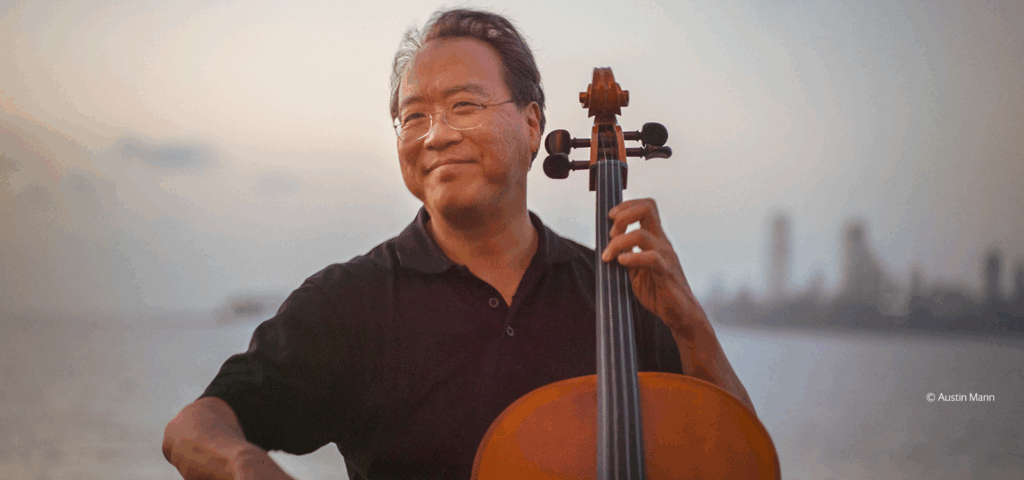
The elimination of these barriers can be profoundly experienced within Grace Farms’ 700-seat Sanctuary, an indoor amphitheater for lectures, events, and performances. Overlooking the expansive landscape, world-class performances in this one-of-a-kind setting – from Yo-Yo Ma to the London Philharmonic Orchestra – deepen our sense of beauty and belonging.
Yo-Yo Ma (Photo by Austin Mann)
“Music does evoke a sense of wonder and awe for lots of people,” neuroscientist Daniel Levitin of McGill University noted in a 2023 NPR interview. In the same article, Dr. Keltner added that awe-inducing experiences like music can counter one of the epidemics of our time: loneliness. Through shared experience, we feel part of a community. That sense of belonging directly supports our health and well-being.
Grace Farms celebrated its ninth anniversary with a special benefit performance by a 31-musician chamber ensemble of the London Philharmonic Orchestra (LPO), conducted by LPO 2023/24 Fellow Conductor Luis Castillo-Briceño.
“Our spaces communicate values that will either contribute to disruption and exploitation or grace and peace – human flourishing,” Prince said.
As Grace Farms launched its 2025–2026 season, Chief Strategic Officer and Founding Creative Director Chelsea Thatcher, reminded us: “We all build,” each of us having a stake in advancing good, locally and globally. Perhaps recognizing our individual and collective contribution begins with a pause – a moment to reflect on purpose and possibilities. “I have long loved to perch on roofs, where boundaries are not seen and the possibilities are as open as the landscape,” Prince said. “Seeing possibilities is the beginning of creating something new.”
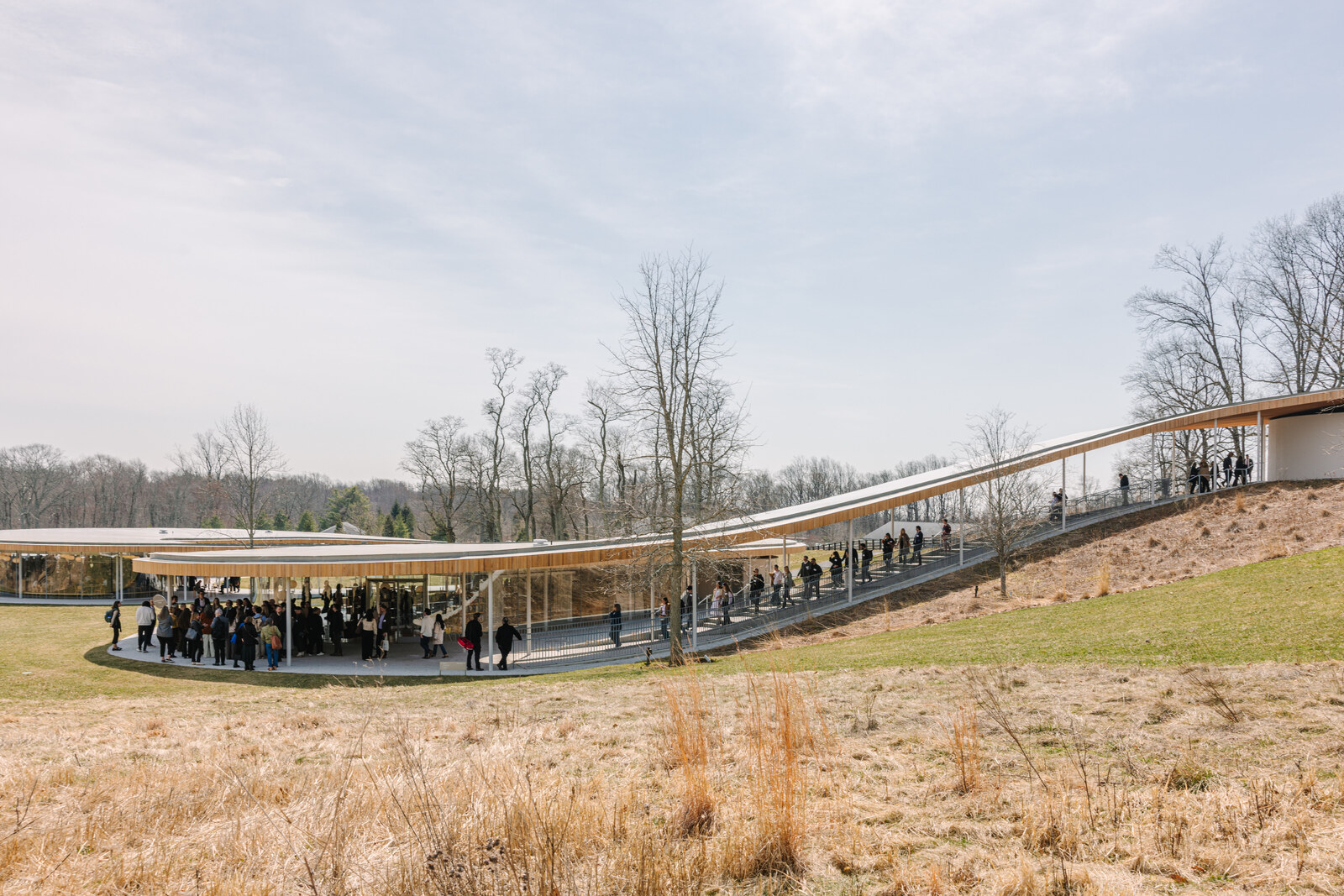
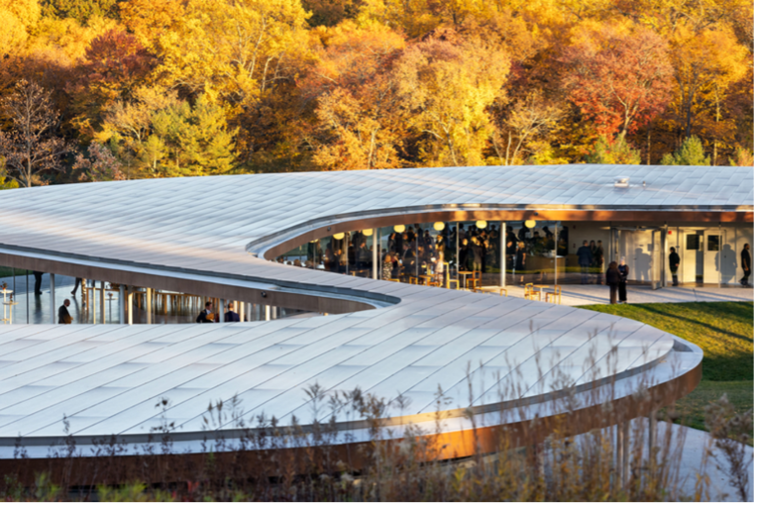
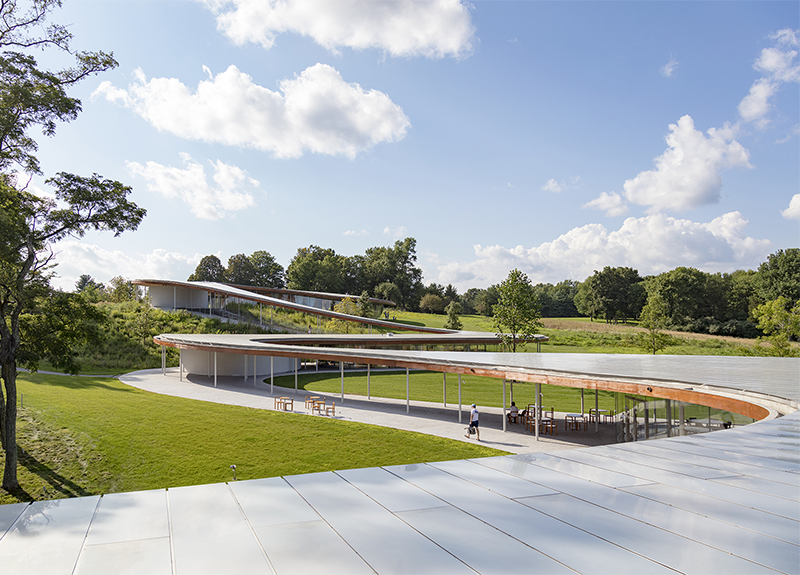
Sharon Prince on the River building’s single long roof, designed to flow like a “river” along the natural contours of Grace Farms’ expansive landscape. (Photo by Dean Kaufman)
While rooftop gazing may not be always possible, we can immerse ourselves in the awe and wonder of nature, music, architecture, and acts of great kindness. Less tethered to technology, we can cast our views upward and beyond.
________________________
About Grace Farms
Grace Farms is a cultural and humanitarian center in New Canaan, Connecticut that brings people together across sectors to explore nature, arts, justice, community, and faith at the SANAA-designed River building and Barns on 80 acres of publicly accessible natural landscape. Since opening in 2015, Grace Farms has welcomed 1 million visitors from around the world to experience its unique integration of arts, architecture, nature, and purpose.
As a destination for arts and culture, Grace Farms presents innovative programming in music, visual and performing arts while fostering contemplation and connection through architecture and nature. Its humanitarian work includes leading the Design for Freedom movement to eliminate forced labor in the building materials supply chain and advancing initiatives to foster more grace and peace locally and globally.
The integration of cultural programming and humanitarian action reflects Grace Farms’ collaborative approach to generating new outcomes and meaningful change.
Membership
Grace Farms members can visit without advance registration and enjoy a 20% discount on paid programs, retail, and dining, invitations to members-only gatherings, complimentary events, and a welcome gift from Grace Farms Tea & Coffee.
Becoming a member helps us advance our mission to pursue a more peaceful world and supports the preservation of the River building and its surrounding 80 acres.
For more information, visit gracefarms.org/membership.
Visit our calendar of events to learn more about upcoming programs.
Books such as the Secret Lives of Trees and The Architecture of Trees invite us into a rarely seen world, revealing how trees grow, how they support one another, and how they are part of a complex and beautiful web of life that is critical to the health of our planet. Beautiful and majestic, each species, with its unique characteristics and contributions, also serves as a source of inspiration for architectural design.
The 17-century Chêne Chapelle in France, for instance, was built into an ancient oak tree, according to Grist. Although lightning hollowed out its center, the tree surprisingly continued to live, even producing acorns. The clergy at the time believed that the fact that the 800-year-old oak tree continued to thrive after the lightning strike meant that the oak was imbued with “divine” powers. Rather than have the chapel dictate the design, the architects or builders embedded the chapel in the hollowed-out oak, following its natural contours.
Centuries later, nature is still influencing architectural design. Biophilic design has integrated nature into design to enhance our connection to the environment. For instance, the Ford Foundation’s 12-story-high atrium in New York is filled with magnolias, eucalyptus, jacaranda, pear trees, and more, while Singapore’s Jewel Changi airport features 2,500 trees, native to Madagascar, Australia, Malaysia and Indonesia, according to an AP article.
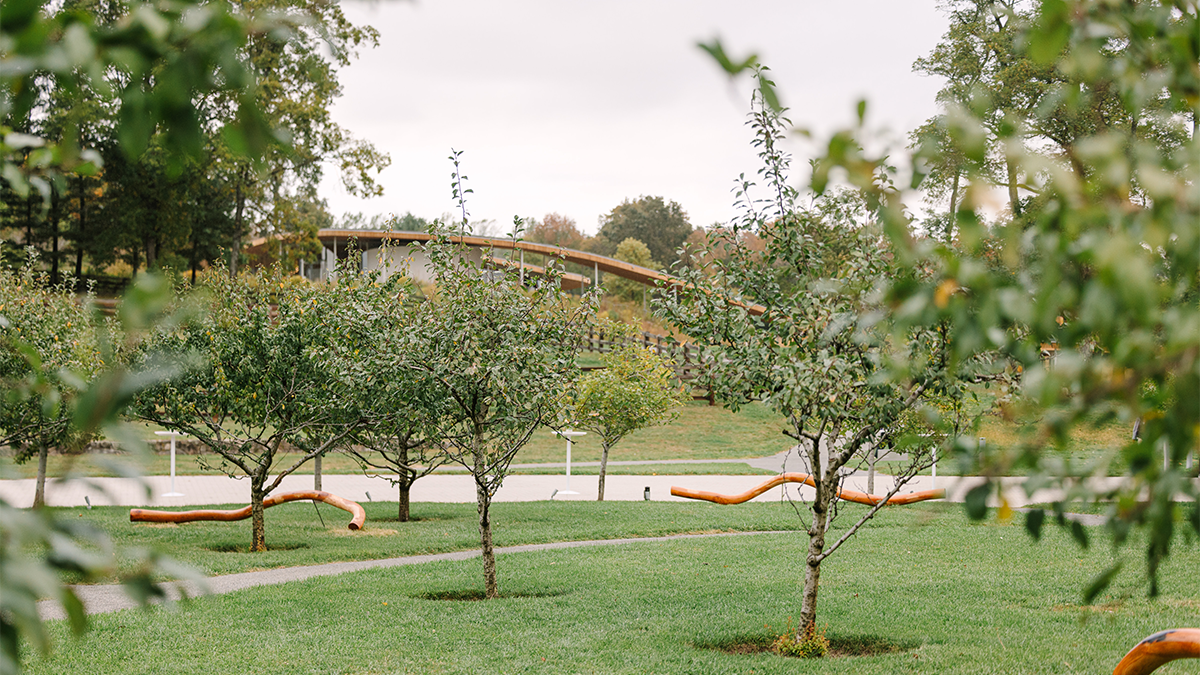
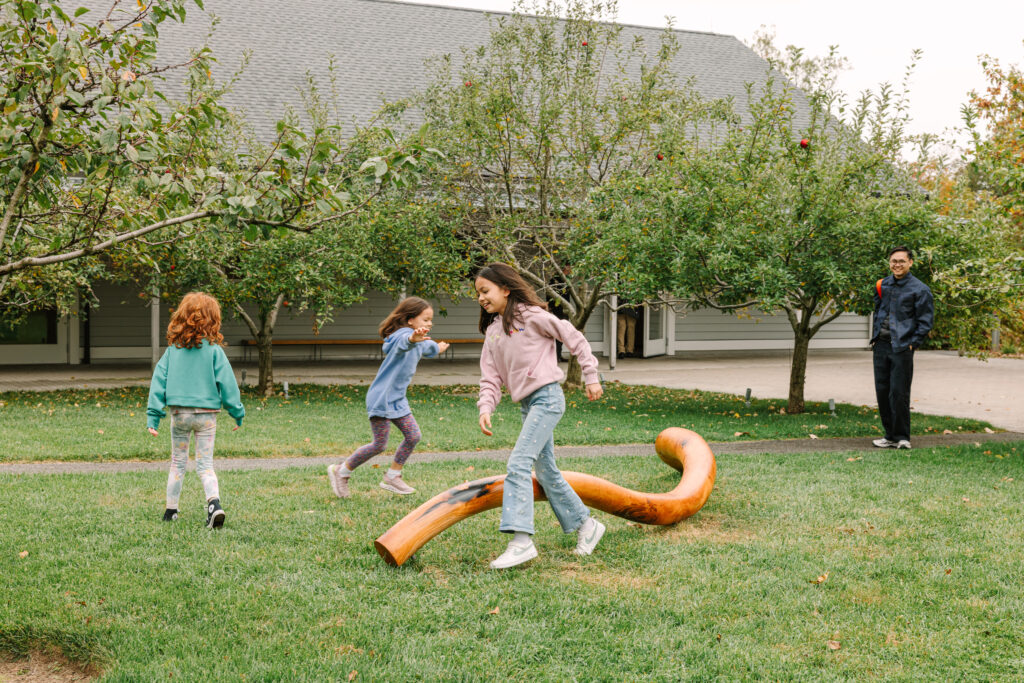
But what if nature were the actual designer, going beyond just mere integration with architecture? Last year Grace Farms intentionally set out to design seating with that in mind. For Grace Farms’ 10-year anniversary last October, the foundation commissioned Kazuyo Sejima to design six site-specific sculptural benches for the Plaza, a welcoming space flanked by two renovated barns, with the center of the grassy Plaza surrounded by fruit trees. Sejima and Ryue Nishizawa (SANAA) designed Grace Farms’ award-winning River building and Barns. Dancing Trees (2025) are six site-specific sculptural benches that conform to the natural curves of the black cherry wood, which was sourced nearby in Western Connecticut.
The journey of making Dancing Trees is featured in a short film that premiered at Grace Farms’ Humanity in Architecture Film Festival in January, hosted in collaboration with Architecture & Design Film Festival. In the film, Kimbery Kelly, our Director of Horticulture, discusses the characteristics of black cherry, how it grows, and why certain trees were chosen for Dancing Trees. In this Perspective, Kelly takes us on a deeper journey into why this species was chosen and the importance of listening to nature.
Even though they are anchored in the soil, plants move, performing dances in their amazingly complex world. – Kimberly Kelly
____________________________
Look at the forest, or any natural setting: there is an intricate tapestry woven together, revealing a symphony of movement and life. Even though they are anchored in the soil, plants move, performing dances in their amazingly complex world. How and where does each leaf, branch, root, or flower need to be to thrive? What triggers from within send a vine searching upward for the sun, curling around a neighbor? It has been common belief that nature has always had a ‘survival of the fittest’ approach. Now we are learning so much more about cooperation, adaptation, and complex symbiotic relationships that exist in the natural world.
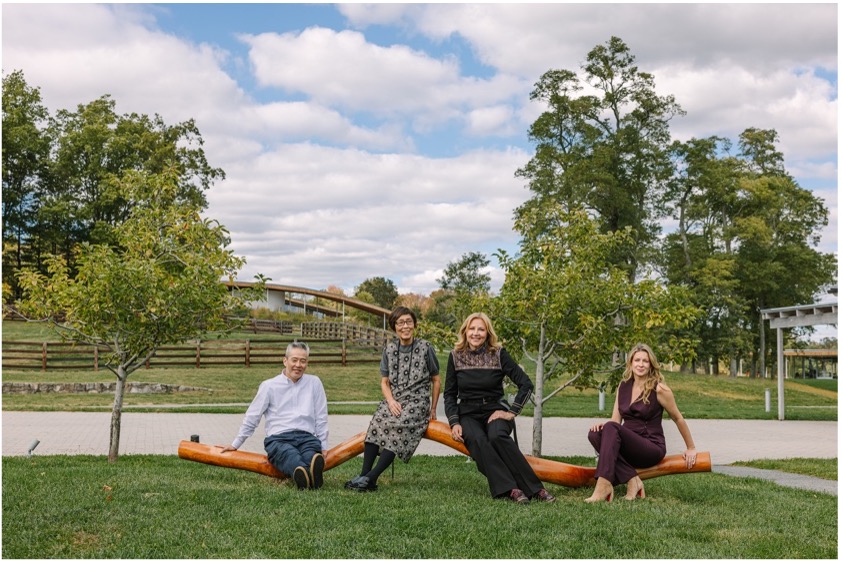
The unveiling of Dancing Trees in the Plaza, the new site-specific sculptural benches designed by Kazuyo Sejima of SANAA. From left to right: Toshihiro Oki, Grace Farms Architecture Advisor Kazuyo Sejima, Sharon Prince, CEO and Founder of Grace Farms, Chelsea Thatcher, Founding Creative Director, Grace Farms. (photo by Melani Lust)
The Shaping of Black Cherry
How do plants move? How do these amazing shapes and patterns grow from a tiny seed, to explore the world around them? Through physiological processes, such as trophic and nastic movements, plants respond to the environment to fulfill their basic needs and, as we are discovering, the needs of those around them. There are also times when these natural movements are interrupted or respond to other environmental stimuli resulting in unique forms.
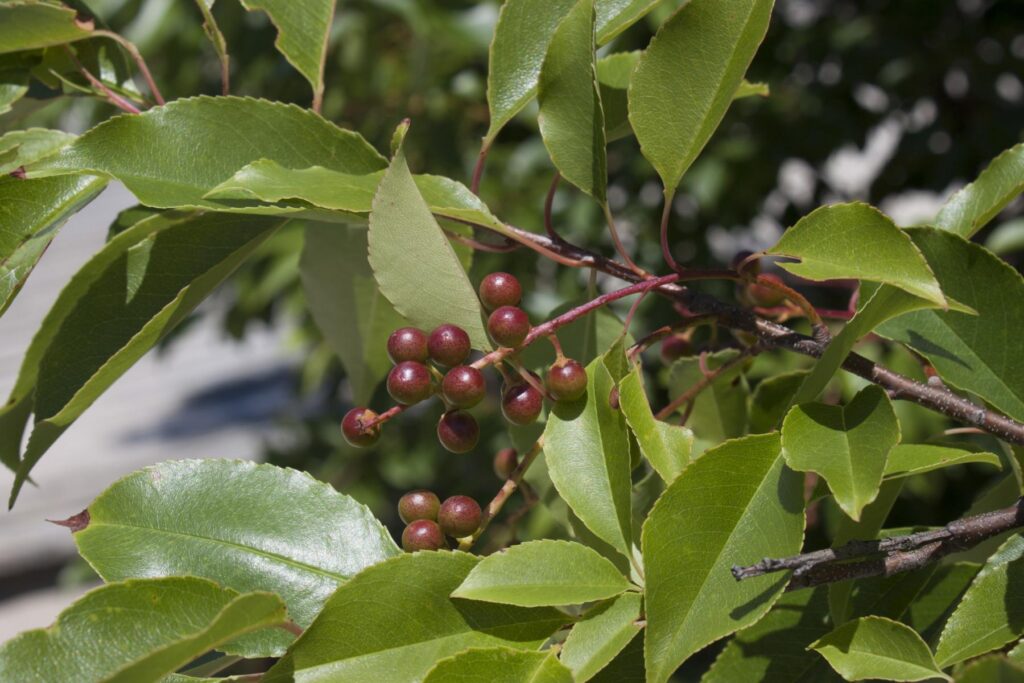
As an early- to secondary succession plant in the forest, Prunus serotina (Black cherry), is a rapid grower. It is also considered an important keystone tree as it is host to over 300 species of caterpillars! (Tallamy et al). Caterpillars are the second or larval stage in the four-stage metamorphosis of the transition into a moth or butterfly, an important pollinator for flowers, fruits and vegetables.
A Food Source
Black cherry, a fast-growing shade tree with fragrant white flowers that bloom in spring, attract bees and butterflies during this time. And when the fruit ripens in late summer, it’s a food source for over 30 species of birds. (American Beauties, Native Plants). The North American native is a “bird magnate” for Robins, Woodpeckers, Mockingbirds, and more.
Ripened fruit of the Black cherry tree in late summer, a source of food for birds and wildlife. (Photo source: USDA)
As beneficial Prunus serotina is to wildlife and pollinators, Black cherry trees are also highly regarded by architects and designers for their rich, reddish-brown hard wood often used in furniture, cabinets, and veneers. But how they grow, sometimes by a process of natural ‘shaping’ make the Black cherry even more prized. This process is caused by a fungus commonly referred to as Black knot, a serious disease of plum and cherry trees (Prunus species) throughout the United States. While it can get progressively worse over time — stunting a tree’s growth or killing it — the damage may be less severe on sweet and sour cherry trees (The Morton Arboretum).
During the 10-year anniversary celebration, and the unveiling of Dancing Trees, children explored and played around the sculptural benches. (photo by Melani Lust)
Nature as our Partner in Design
Black knot, (University of Minnesota Extension) which would normally be considered entirely detrimental to trees, does have its benefits: As a Black cherry tree naturally grows toward the sun, in a curvature dance with others competing trees for the sun, the fungus can further curve and shape Black cherry. The gall or knot can encircle a limb or branch, restricting the flow of sugars, water, and hormones past the infected site. This imbalance can lead to deformation or curling of the branch beyond the gall. This ‘deformation’ creates some of the most beautiful burlwood, highly valued by woodturners, craftspeople, and decorators.
The incorporation of nature into the fields of architecture and interior design, or Biophilia, defined as the “love of life” in ancient Greece (Arch Daily), continues to take hold. It connects people with nature to improve their well-being and quality of life. Perhaps the next step in the design, as in Grace Farms’ approach to the design of Dancing Trees, is to invite nature to be our partner in the process of building and design.
____________________________
About Grace Farms
Grace Farms is a cultural and humanitarian center in New Canaan, Connecticut that brings people together across sectors to explore nature, arts, justice, community, and faith at the SANAA-designed River building and Barns on 80 acres of publicly accessible natural landscape. Since opening in 2015, Grace Farms has welcomed 1 million visitors from around the world to experience its unique integration of arts, architecture, nature, and purpose.
As a destination for arts and culture, Grace Farms presents innovative programming in music, visual and performing arts while fostering contemplation and connection through architecture and nature. Its humanitarian work includes leading the Design for Freedom movement to eliminate forced labor in the building materials supply chain and advancing initiatives to foster more grace and peace locally and globally.
The integration of cultural programming and humanitarian action reflects Grace Farms’ collaborative approach to generating new outcomes and meaningful change.
Membership
Grace Farms members can visit without advance registration and enjoy a 20% discount on paid programs, retail, and dining, invitations to members-only gatherings, complimentary events, and a welcome gift from Grace Farms Tea & Coffee.
Becoming a member helps us advance our mission to pursue a more peaceful world and supports the preservation of the River building and its surrounding 80 acres.
For more information, visit gracefarms.org/membership.
Visit our calendar of events to learn more about upcoming programs.
“And souls are candles, each lighting the other.” — Gennady Aygi, poet
Introduction
On October 10, 2015, Grace Farms published a commemorative book called And Souls Are Candles. One of the poems by Gennady Aygi reminds us of how we each light the way for each other. At Grace Farms, this lighting of ways over the past 10 years, and the unprecedented outcomes that have emerged, have been nothing less than extraordinary.
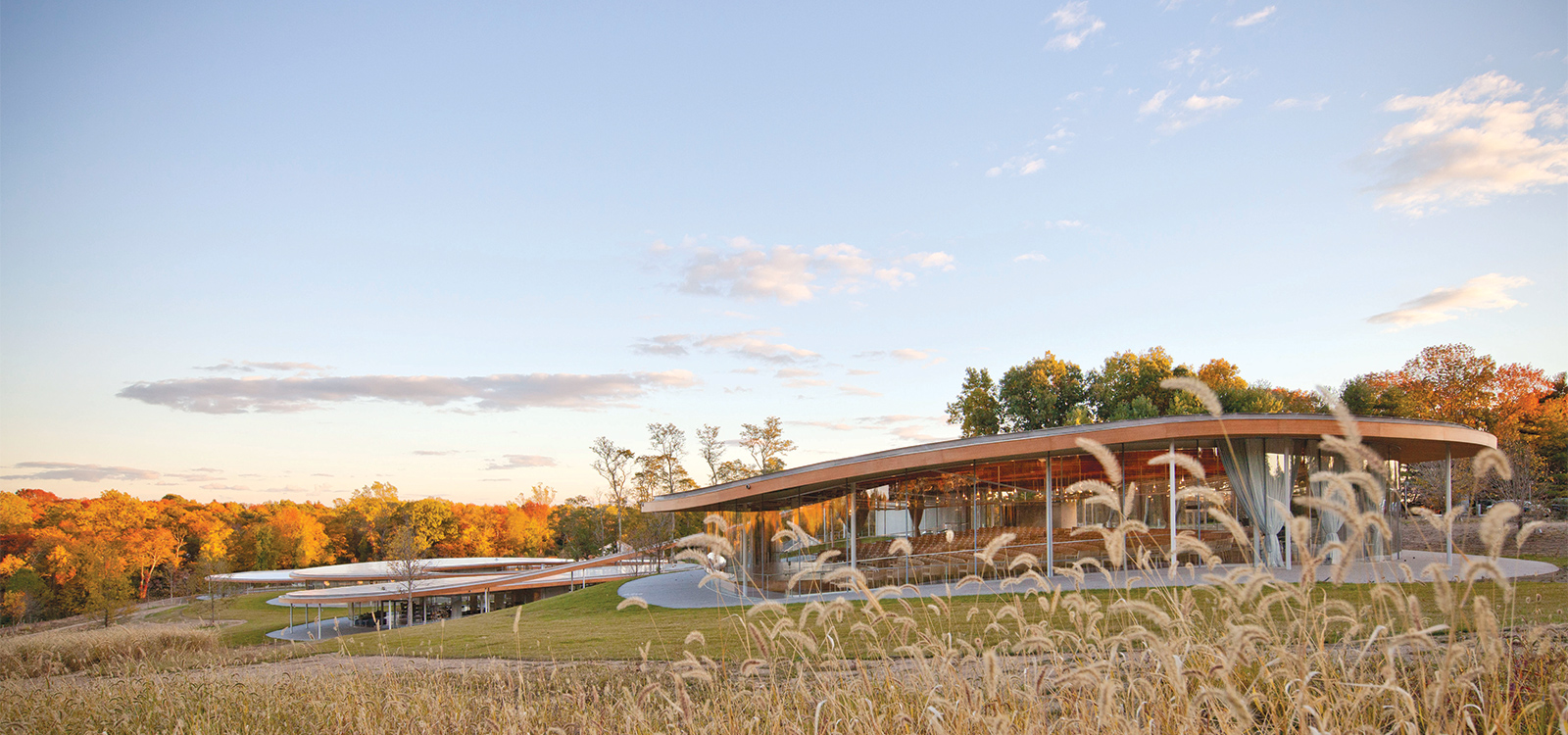
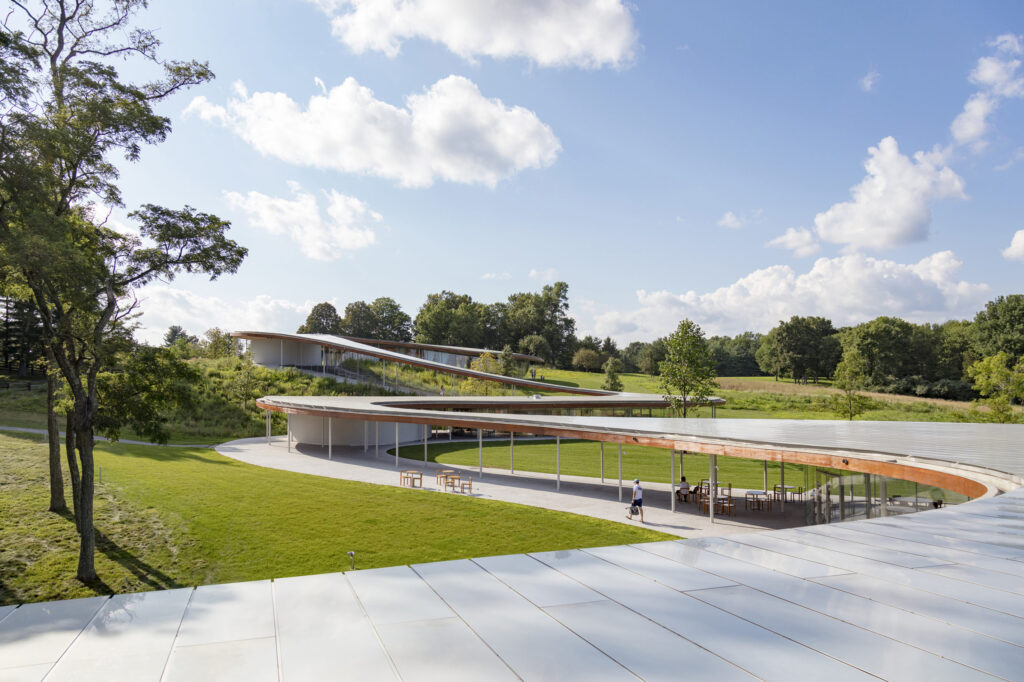
On that day, Sharon Prince, the visionary CEO and Founder of Grace Farms, converted privately owned land into a first-of-its-kind open space that was free and open to the public. Prince literally started with a “clean slate” — 80 acres that would eventually be turned into 10 biodiverse habitats in perpetuity. In 2010, immersed in the years-long design process, Prince selected Pritzker Prize-winning architects Kazuyo Sejima and Ryue Nishizawa of SANAA to design Grace Farms. From the design process emerged the River building, consisting of five transparent glass-enclosed volumes that winds its way through surrounding natural landscape of trees and meadows.
“I adopted the belief that architecture, when activated, can play a significant role in creating a more just and equitable world. One of the fundamental barriers to equity is being in the proximity to people and issues,” Prince said in an interview with Madame Architect. In addressing these issues, Prince adopted another unique approach and assembled a multidisciplinary team with expertise across five initiatives — nature, the arts, justice, community, and faith — to tackle complex challenges, including forced labor.
___________________
Redefining What’s Possible
The past 10 years are defined by groundbreaking new outcomes and global initiatives that align with our work in nature, the arts, justice, community, and faith.” – Sharon Prince
Prince’s social-entrepreneurial ethos to catalyzing and problem-solving has redefined what’s possible. Taking on the seemingly impossible has resulted in the following achievements that are now featured in the Peace Forest exhibit. Here are some highlights of the past decade:
Launching Design for Freedom, a global movement to eliminate forced and child labor in the building materials supply chain
Turing Grace Farms into a humanitarian hub during COVID-19, delivering 2 million critical PPE to close a state-wide gap, in addition to providing thousands of wholesome meals to those in need
Launching Grace Farms Tea & Coffee, a Certified B Corp that gives back 100% of its profits to support Design for Freedom
Establishing the Design for Freedom Summit that brings together over 550 leaders across the ecosystem of the built environment to address forced labor
Expanding Design for Freedom Pilot Projects to three continents
Unveiling With Every Fiber Pigment Stone Glass, which reveals the embodied suffering behind pigment, glass, and stone in the construction industry as well as new innovations within those materials that demonstrate that building ethically is possible
Achieving dual LEED certification, including LEED Certification Gold for Building Design and Construction (BD+C).
Establishing the arts as a central throughline in Grace Farms’ humanitarian and cultural initiatives. Prior to opening on October 9, 2015, Prince and Chelsea Thatcher, Founding Creative Director, invited artists such as the Paul Taylor Dance Company to “warm up” the space while still under construction. Since then, more than 250 acclaimed artists have performed including the London Philharmonic Orchestra in 2024, while others such as Meredith Monk have developed site-responsive work to share beyond Grace Farms.
Inviting global leaders including Nobel Peace Prize Laureate Dr. Denis Mukwege, and Indra Nooyi, the trailblazing former Chairman & CEO of PepsiCo, to inspire meaningful and open dialogue.
Producing the 45-minute film, Then and Now, about American civil rights leader Ruby Bridges, which reached 12,000 students, teachers, and community members.
___________________
2025 | Grace Farms Turns 10
On September 13, Grace Farms unveiled ParaPosition, a sculpture by artist Alicja Kwade, launching a new programming season that runs from September 2025 through May 2026. ParaPosition is made of slim interlocking steel frames supporting four boulders and a blue chair made of bronze, which draws viewers into the frame of this massive, yet fragile, universe. The chair beckons viewers to reflect on our relationship with the world and contemplate the fundamental nature of our existence.
ParaPosition, photo by Dean Kaufman
“Alicja Kwade is approaching themes about society and human flourishing in the same spirit as we are at Grace Farms Foundation — imploring us to expand our perspective by asking questions. At Grace Farms, we seek new outcomes on pressing humanitarian issues by breaking down silos and facilitating dialogue across sectors.” – Sharon Prince
The launch of this season, curated by Chelsea Thatcher, Chief Strategic Officer and Founding Creative Director, centers around the theme ‘We all build.’ “Each experience is set intentionally within a seasonal moment, to bring us closer to nature as we develop solutions to make the world a more just, sustainable, and peaceful place. None of these programs can be experienced in the same way again, either at Grace Farms or anywhere in the world,” said Thatcher.
Grace Farms’ Artist-in-Residence and GRAMMY-Winning Canadian cellist Arlen Hlusko performed throughout the day. (Photo by Melani Lust.)
Highlights of the day-long celebration included an outdoor classical music ensemble led by acclaimed cellist and Artist-in-Residence Arlen Hlusko, an artist talk with award-winning photographer James Florio, also an Artist-in-Residence, who unveiled a permanent photographic work for the Grace Farms Library, Haida Gwaii, 2025, and Hannah Rose Thomas, PhD, who unveiled a commissioned portrait of Nasreen Sheikh, a modern slavery survivor and social entrepreneur, in the new iteration of With Every Fiber:Pigment, Stone, Glass, as well as the opening of Dancing Trees in the Plaza. Kazuyo Sejima of SANAA returned to Grace Farms for the 10-year anniversary to introduce the new seating installation, which is meant to foster community and conversation, while harmonizing with nature and the landscape.
Chelsea Thatcher, Chief Strategic Officer and Founding Creative Director, left, and artist Hannah Rose Thomas, PhD, right, unveiled a commissioned life-size portrait of Nasreen Sheikh, a modern slavery survivor and social entrepreneur, in the new iteration of With Every Fiber:Pigment, Stone, Glass. The portrait was created using tempera made natural pigments. Thomas’ work has been exhibited at the UK Houses of Parliament, European Parliament, and Westminster Abbey. The exhibit features other new commissions responding to the Design for Freedom movement.
The memorable day culminated with a discussion about Grace Farms’ origins with Kazuyo Sejima, one of the Pritzker-prize winning architects of the River building, along with Prince, Chelsea Thatcher, and Toshihiro Oki, Grace Farms’ Architecture Advisor.
Preceding the conversation was a performance by Arlen Hlusko on cello. GRAMMY Award-winning violinist Joshua Bell closed the discussion, accompanied by Peter Dugan, pianist and host of NPR’s From the Top.
Award-winning violinist Joshua Bell received a standing ovation during his performance in the Sanctuary. (photo by Melani Lust)
The unveiling of Dancing Trees in the Plaza, a new site-specific seating installation designed by Kazuyo Sejima of SANAA. From left to right: Toshihiro Oki, Grace Farms Architecture Advisor, Kazuyo Sejima, Sharon Prince, CEO and Founder of Grace Farms, Chelsea Thatcher, Founding Creative Director, Grace Farms. (Photo by Melani Lust)
Haida Gwaii, 2025
Haida Gwaii, 2025, now on permanent display in Grace Farms’ Library, was unveiled on its 10th year anniversary.
Grace Farms’ Artist-in-Residence James Florio created a new photographic work, Haida Gwaii, 2025, now on permanent display in Grace Farms’ Library.
Florio was inspired by his trip to Taan Forest in Haida Gwaii, British Columbia, where Grace Farms procured the Western red cedar used for the half-mile fascia installed this past spring. The cedar was selected for its longevity, as well as its alignment with Design for Freedom principles, including prioritizing circularity. The Taan Forest is ethically and sustainably maintained by the Haida Enterprise Corporation (HaiCo), 100% owned by the Haida, the First Nations people.
In aligning with Design for Freedom and its emphasis on material transparency, in November 2024, Prince and Toshihiro Oki, Grace Farms’ Architecture Advisor, traveled to Taan Forest for a hands-on exploration of Western red cedar.They gained insight into how the new fascia would be sustainably and ethically sourced from Haida Gwaii, an archipelago off the coast of British Columbia. The timber is FSC certified and harvested in ways that meet The Haida Nation’s high cultural preservation standards.
“There is a Haida guiding principle that represents respect for each other and living things. It’s rooted in all of our culture. We take only what we need,” said Leticia Hill, CEO of HaiCo.
___________________
Grace Farms Tea & Coffee | Launch of Origin Stories
Grace Farms’ Origin Stories series opened with Adam Thatcher, Co-Founder and CEO of Grace Farms Teas & Coffee, who shared his journey behind this mission-driven social enterprise. He was joined in conversation by Christine Sanchez, Vice President of Retail at 270 Park, JPMorganChase, to discuss the innovative partnership between the two organizations.
The Ketiara Cooperative, led by founder and chairwoman Ibu Rahmah, left, and Adam Thatcher, CEO & Founder of Grace Farms Tea & Coffee.
As a Certified B Corp, Grace Farms Teas & Coffee prioritizes ethical sourcing, sustainability, and partnerships with women-owned collectives, with 100% of profits supporting the Foundation’s humanitarian work to end forced labor. Since Thatcher and Prince, also a Co-Founder, launched the Certified B Corp to support Design for Freedom in 2021, awareness about the ethically and sustainably made tea and coffee has grown exponentially. Its Wellness Teas are in 26 Whole Foods Market stores as of 2024, and the organization has expanded its corporate sponsorships with organizations including JPMorganChase, UBS, Sciame Construction, and Bloomberg. Grace Farms Tea & Coffee has also made another momentous leap: an outdoor café at JPMorganChase’s new headquarters in New York City is slated to open next year.
Relief Efforts to its Coffee Supplier in Indonesia
Grace Farms Tea & Coffee, a nonprofit-owned Certified B Corp™ and subsidiary of Grace Farms Foundation, provide relief efforts including generators as pictured in the truck.
Grace Farms Tea & Coffee, a nonprofit-ownedCertified B Corp™and subsidiary ofGrace Farms Foundation, announced the launch of a relief effort forSumatra Resilience & Rebuilding, an urgent humanitarian initiative supporting theKetiara Cooperative, a Fairtrade-certified, women-led coffee farming collective in the Gayo Highlands of Sumatra, Indonesia.
Over Thanksgiving weekend,Cyclone Senyar, a rare and destructive tropical cyclone, triggered catastrophic mudslides across northern Sumatra, causing the worst natural disaster to Sumatra since the tsunami of 2004. Many homes were destroyed, farms endured severe damage, and two vital bridges were washed away, isolating the city of Takengon and surrounding areas. The disaster severed access to food, clean water, electricity, and communication. The Ketiara Cooperative, led by founder and chairwoman Ibu Rahmah, is one of Grace Farms Tea & Coffee’s longest and most trusted sourcing partners, with more than 1,700 farmers, including 1,100 women.
In response to the crisis, Grace Farms Tea & Coffee has mobilized immediate humanitarian support, enabling the delivery ofgenerators,Starlink satellite communication devices,rice, andessential food suppliesby air to the most isolated communities.
Grace Farms Tea & Coffee will contribute$5 from every bag of its Single-Origin Indonesian coffee soldtoward ongoing recovery and rebuilding initiatives in the region. This purchase-based contribution helps provide generators, Starlink internet access, rice and other essential food supplies.
“The farmers of Ketiara are at the heart of our mission,”saidAdam Thatcher, CEO of Grace Farms Tea & Coffee.“Our relationship with Ibu Rahmah and her cooperative goes far beyond sourcing coffee. In moments like this, it is our responsibility to stand with them as partners and as friends.”
___________________
The Arts | New Perspectives
The arts and music have transformed Grace Farms’ space, generating new perspectives, enhancing our sense of beauty, and fostering the potential for individual and social transformation. From the London Philharmonic Orchestra’s (LPO) sold-out performance in 2024 to the standing-ovation performances of GRAMMY-Winning violinist Joshua Bell in 2025, each performance has the power to change us.
Also in 2025, Mon Rovîa presented a sold-out concert of peace and healing in a special program for Grace Farms, organized on the United Nations International Day of Tolerance.
Mon Rovîa reflects journeys of humanity through his Afro Appalachian music as a singer and songwriter, and from his own experiences moving from the Liberia during the country’s civil war to the United States. He was named as one of Spotify’s 2024 Juniper Artists to Watch, has been featured in the GRAMMY Museum’s New York City program series, and has sold out every headline show to date, including Bonnaroo, Austin City Limits, and Newport Folk Festival.
In addition, Grace Farms brought back Broadway Inspirational Voices, a diverse choir and service organization powered by Broadway artists who use music to inspire hope and change lives. The one-hour program featured a holiday repertoire developed for Grace Farms by Connecticut native Allen René Louis, Broadway Inspirational Voices Artistic Director and GRAMMY-nominated Creative Director and Producer.
Broadway Inspirational Voices returned to Grace Farms in December 2025 with a site-responsive program that connects us with the presence of the human voice to inspire the audience toward joy. The one-hour program featured a holiday repertoire developed for Grace Farms by Connecticut native Allen René Louis, Broadway Inspirational Voices Artistic Director and GRAMMY®-nominated Creative Director and Producer.
“A space for renowned musicians and performers to transform our perspectives.” — Chelsea Thatcher
Architecture & Design Film Festival
Hosted in collaboration with the Architecture & Design Film Festival, Grace Farms launched a weekend of films celebrating architecture’s impact on people and communities. It’s an opportunity to immerse oneself in a weekend of curated films showcasing stories of bold, visionary dreamers who put seemingly impossible ideas into action in the fields of architecture and design.
The opening night premiere was Strange & Familiar: Architecture on Fogo Island, which was followed by a dialogue between visionary Zita Cobb and Sharon Prince, alongside Kyle Bergman, Festival Director & Founder of Architecture & Design Film Festival, and Toshihiro Oki, Grace Farms Architecture Advisor.
___________________
Justice | Design for Freedom
Since the launch of Design for Freedom and its annual Summit, in 2020 and 2022, respectively, more students and universities have gotten involved in the global movement. Through partnerships with colleges and universities, Design for Freedom is developing a pipeline of future leaders who will use Design for Freedom principles in their work. Grace Farms established a partnership with the Association of Collegiate Schools of Architecture (ACSA) to launch a studentdesign competition for the 2024–2025 academic year. Over 300 students and faculty participated from schools including Boston Architectural College, California Polytechnic State University, Carnegie Mellon University, University of Illinois, Urbana-Champaign, and Yale University.
The distinguished jurors, who are also part of the Design for Freedom Working Group, selected first, second, and third place winners, along with honorable mentions, in two categories: Design Project and Material Research.
The competition recognized 10 exceptional projects that explored a variety of issues related to the exploration of how architects can work to eradicate forced and child labor from the built environment.
“We must engage the entire ecosystem of the built environment, including universities who are educating the next generation of leaders, to start shifting the marketplace. These projects demonstrate academic rigor and offer potential pathways to build more humanely. We are partnering with ACSA to nurture this vital intersection of architecture and justice,” said Prince.
Design for Freedom Summit
Sharon Prince opens the Design for Freedom Summit in March 2025. (Photo by Melani Lust)
Each year, Grace Farms invites leaders from across the ecosystem of the built environment to participate in the Design for Freedom Summit. Over 550 leaders from architecture, design, construction, and the manufacturing sector attended the sold-out Summit, including more than 75 students from 25 universities who gathered to advance the movement to eliminate forced labor in building materials.
Pilot Projects Announced
Three new Design for Freedom Pilot Projects were announced at the Summit, joining more than 12 projects across three continents. They include Battery Park Field House designed by WXY architecture + urban design in partnership with The Battery NYC, Hightower Group Manufacturing Headquarters in High Point, North Carolina, and the Grace Farms Rest House Project designed by Slade Architecture.
“Changing perceptions of public washrooms and public parks maintenance facilities is a perfect match for the Design for Freedom Toolkit and for inspiring the care of our public parks and gardens.” – Claire Weisz, Founding Partner, WXY.
With Every Fiber Exhibit
In addition to raising awareness about Design for Freedom through our tea and coffee, the With Every Fiber exhibit which opened in May 2024, invites the public to consider the nearly 28 million people who extract and make our building materials which go into our homes, schools, office buildings, and landscapes. The first iteration featured 20 preeminent designers, material suppliers, artists, cultural institutions, and construction industry leaders including Studio Cooke John Architecture + Design, Pentagram, Yale Center for Ecosystems + Architecture, and more. Each iteration focuses on new materials at risk of forced labor.
Also new to the exhibit is a Stone Space Frame pylon (center) designed by Webb Yates Engineers, who has been developing sustainable engineering solutions in the building industry for decades. The pylon is an example of how post-tensioned stone, which when quarried, processed, transported, and reused under the right conditions, is a highly sustainable material, and might replace steel as a trussing component. (Photo by Andrew Werner)
The latest iteration, unveiled on Grace Farms’ 10-Year Anniversary on October 11, highlighted pigment, stone, and glass.The stories of these materials are told through newly commissioned artworks including a portrait of modern slavery survivor and social entrepreneur Nasreen Sheikh by artist Hannah Rose Thomas, PhD, and John Sabraw, who uses pigments made in his studio from recycled mine drain runoff in the Ohio mountains. Since May 2024, over 45,000 people have visited the exhibit, offering a hopeful perspective for addressing forced labor, as well as serving as a platform for ongoing research around Design for Freedom principles including prioritizing circularity.
With Every Fiber Invited to La Biennale di Venezia
Grace Farms Foundation was invited to participate in the 19th International Architecture Exhibition of La Biennale di Venezia, titled Intelligens. Natural. Artificial. Collective., curated by Carlo Ratti.
This prestigious exhibition, which opened to the public on May 10, featured an adaptation of our With Every Fiber exhibit, presented by Sharon Prince, Chelsea Thatcher, and Nina Cooke John, Founder of Studio Cooke John. Her work, Shadow of a Face, a Harriet Tubman monument in New Jersey, is a Design for Freedom Pilot Project.
___________________
Community | Change is Built by Community
Lunch & Dinner with a Purpose
Amy Williams, CEO of Citizens of Humanity Group, Chelsea Thatcher, curator of the With Every Fiber exhibit, and Camilla Marcus, chef and founder of west~bourne and author of My Regenerative Kitchen, discussed how the essential pillars of food, clothing, and shelter are driving change toward a more sustainable and ethical future. The conversation was moderated by Karen Kariuki, Managing Director, Strategic Initiatives.
Indré Rockefeller, a climate communicator, entrepreneur, and Founder of The Circularity Project, a nonprofit dedicated to championing circular design in fashion, offered a thought-provoking conversation on sustainability, entrepreneurship, and the future of circularity. The events were set against the backdrop of Grace Farms’ 80 acres and featured a locally sourced, sustainable meal served in the Commons.
___________________
Nature | Awe & Wonder
Grace Farms was designed to contribute to the public’s quality of life by providing a peaceful respite that inspires the exploration of wilderness, wildlife, and open space.
To engage the public with hands-on learning experiences, Kimberly Kelly, Grace Farms’ Director of Horticulture, fosters inclusive and meaningful ways to connect the public to the natural world, through horticulture, ecology, and regenerative land-use practices through both formal and informal educational programs.
Kelly currently serves as a member of the Board of Directors of the Connecticut Master Gardener Association and is the President of the Board of Directors of the International Association of Butterfly Exhibitors and Suppliers.
Amazing Butterflies Event that was featured in the Court.
Grace Farms hosted the Butterfly Exhibit, which demonstrated the extraordinary metamorphosis of butterflies through an interactive indoor maze and traveling exhibit in Grace Farms’ indoor Court. Created by The Natural History Museum in London in collaboration with Minotaur Mazes, thousands of people experienced how a caterpillar transforms into a butterfly and takes flight. Grace Farms has become a natural habitat for our essential pollinators and wildlife.
Our certifications and memberships include:
Certified Wildlife Habitat Garden, through the National Wildlife Federation
Certified Monarch Waystation
Member of the Xerces Society Pollinator Protection Plan
Founding member of the New Canaan Pollinator Pathway
___________________
2026 | Upcoming Highlights
(Visit our event’s page for a full schedule of our 2025-2026 season.)
Grace Farms Lectures
The Grace Farms Lectures series bring together visionary leaders who have shaped our world, inviting them to share the wisdom they have learned through their distinguished careers. Each lecture is accompanied by a specially curated 60-minute concert performed by some of today’s most celebrated musicians. The pieces performed by these artists respond directly to the life’s work of each lecturer and the impact they continue to make.
This program is designed as an epic Grace Farms experience, with 60 minutes of music curated for each lecture by Artist-in-Residence Arlen Hlusko to enhance the messages of the lectures. An optional workshop connected to each topic also provides a way to engage with the lecture material in a tactile way.
To initiate the series on January 10, 2026, Sharon Prince, CEO and Founder of Grace Farms, will inspire participants to see the built environment through new eyes and recognize their own agency in creating spaces that communicate and catalyze good in the world. During this lecture Prince will share her remarkable journey of creating a boundary-defying environment that actively drives humanitarian outcomes and reshapes our approach to global challenges. Her thesis has already begun to redefine how we think about architecture’s role in creating a more just and equitable world.
On February 7, 2026, Founding Director of Yale Center for Faith & Culture and one of the most significant religious thinkers of our time, Dr. Miroslav Volf creates the opportunity to pause and explore the global need for grace, forgiveness and true generosity. For Volf, this is a step toward a world in which every person can wrestle with life’s most important questions and take hold of a life worthy of our humanity. Volf is the author of more than 20 books, including Exclusion & Embrace — which was named one of the best 100 religious books of the twentieth century.
A writer of “rare grace,” Dr. Robin Wall Kimmerer on March 7 will offer a powerful and poetic explorations of how human beings connect with nature and one another. She weaves together indigenous wisdom, science, and profound spiritual insight to reimagine our connection to the living world. Drawing from her background as both a botanist and a member of the Citizen Potawatomi Nation, Kimmerer invites everyone to understand ecological systems with gratitude, mutual respect, and interconnectedness, allowing us to recognize the entire natural world as worthy of care.
This special Music at Grace Farms program on January 11 brings one of the world’s most beloved musicians to our Sanctuary, where the resonance of Yo-Yo Ma’s cello and Solon Gordon’s expressive artistry will fill the glass-enclosed space with beauty and sound.
Set against the winter landscape, the performance invites guests to pause, listen deeply, and experience the power of music to connect us — to one another and to the world around us.
Yo-Yo Ma’s multi-faceted career is testament to his belief in culture’s power to generate trust and understanding. Whether performing new or familiar works for cello, bringing communities together to explore culture’s role in society, or engaging unexpected musical forms, Yo-Yo Ma strives to foster connections that stimulate the imagination and reinforce our humanity.
Additional featured performances include Arlen Hlusko, cello, in February, and Dianne Reeves with Romero Lubambo in March 2026.
(Hosted in collaboration with Architecture & Design Film Festival)
On January 30 and January 31, 2026, Grace Farms honors the pivotal moment when one person commits to designing and building for the benefit of humankind and the Earth. The films feature stories of bold, visionary dreamers who put seemingly impossible ideas into action in the fields of architecture and design.
Opening night of the film festival on January 30 features an evening film and conversation with inspiring themes that will echo throughout the next day. On Saturday, January 31, films and Q&As fill three spaces in the River building and Barns. Throughout the day there will be additional opportunities to join a guided winter walk organized with New York Botanical Garden, Yoga and Movement with Pilin Anice, and a design session with Slade Architecture.
Origin Stories | Nasreen Sheikh & Jennifer Stucko
In January and March, respectively, Nasreen Sheikh, the founder of the Empowerment Collective and Local Women’s Handicrafts, and Jennifer Stuckowho launched Prota Fiori to merge craftsmanship with sustainability, share their Origin Stories.
The annual Summit held in March convenes leaders of the architecture, construction, technology, manufacturing, finance, government, academic, and real estate sectors to advance the global movement toward a more ethical built environment.
Through the guidance of the Design for Freedom principles, participants explore solutions to identify and address forced labor, advance ethical decarbonization, and prioritize circularity through a human rights lens.
___________________
Impacts | 10 Year Highlights
As we all continue to build together, it’s worth looking at the accomplishments over the years to understand how this “space” brought us to this moment, reminding us of what’s possible when we build together, each lighting the way for the other.
2 million PPE donated and distrusted to close the state-wide gap during COVID-19
169,276 pounds of nutritious meals and pantry staples distributed to 67,897 individuals through the Grace Farms’ Food Relief program in 2020.
130,000 pounds of carbon sequestered from the atmosphere each year by more than 2,000 trees (over 50 species) on Grace Farms’ property
1 million visitors have experienced Grace Farms
84,000 + young people and students under the age of 26, or 28% of all visitors engaged with the With Every Fiber exhibit at the 19th International Architecture Exhibition of La Biennale di Venezia, curated byCarlo Ratti.
45,000 + people engaged in Design for Freedom presentations, speaking engagement, and events since its launch in 2020.
30,000 + people engaged With Every Fiber since opening in May 2024.
17,244 visitors encountered Temporal Shift, a temporary sculpture by artist Alyson Shotz sited at Grace Farms in 2021
12,000 students, teachers, community members reached with the Grace Farms-produced 45-minute-film, Then and Now, about American civil rights leader Ruby Bridges.
7,000 visitors to artist Julianne Swartz’s three-part installation Joy, still. in the River building at Grace Farms
5,400 + people have engaged in Earth Day since launching in 2016
5,000 + people participated in Grace Farms’ opening weekend celebration
4,000 + welcomed in 2023 to the launch Voices of Culture, a series that focused on acclaimed and diverse musicians.
70% Of Grace Farms’ acreage has been restored to pollinator-friendly native habitats
“We have created these exceptional experiences across various fields to capture the spirit of the transformative work we have undertaken and the future we continue to build in community with one another. We hope you leave feeling connected to a robust and diverse community, grounded in a shared vision of grace and peace. The possibilities to create a more humane and equitable future together remain as vast as our landscape.” — Sharon Prince
______________________________________
About Grace Farms
photo by Dean Kaufman
Grace Farms is a cultural and humanitarian center in New Canaan, Connecticut that brings people together across sectors to explore nature, arts, justice, community, and faith at the SANAA-designed River building and Barns on 80 acres of publicly accessible natural landscape. Since opening in 2015, Grace Farms has welcomed 1 million visitors from around the world to experience its unique integration of arts, architecture, nature, and purpose.
As a destination for arts and culture, Grace Farms presents innovative programming in music, visual and performing arts while fostering contemplation and connection through architecture and nature. Its humanitarian work includes leading the Design for Freedom movement to eliminate forced labor in the building materials supply chain and advancing initiatives to foster more grace and peace locally and globally.
The integration of cultural programming and humanitarian action reflects Grace Farms’ collaborative approach to generating new outcomes and meaningful change.
_____________
Membership
Grace Farms members can visit without advance registration and enjoy a 20% discount on paid programs, retail, and dining, invitations to members-only gatherings, complimentary events, and a welcome gift from Grace Farms Tea & Coffee.
Becoming a member helps us advance our mission to pursue a more peaceful world and supports the preservation of the River building and its surrounding 80 acres.
For more information, visit gracefarms.org/membership.
Visit our calendar of events to learn more about upcoming programs.
“Every day that we are gifted the opportunity to wake up on Earth, we build. What we choose to build — and how we design and build it — are questions that are explored at Grace Farms.” — Chelsea Thatcher, Founding Creative Director
To commemorate the opening of Grace Farms in October 2015, the foundation published And Souls Are Candles, an anthology of contemporary poems and theological prose, edited by Christian Wiman, an author, editor, and former Guggenheim Fellow. The title is a metaphor that suggests souls are like flames, each one hopeful, each one connecting to spread more light.
In one of the poems, And I Was Alive by 20th-century Russian poet Osip Mandelstam, the poet was praised for his ability to be “wonderstruck, even in a darkening, war-torn world, and suggests that hope can shine forth out of the strangest places,” according to an Atlantic Magazine article that referenced best-selling author Ayana Mathis’ thoughts on Mandelstam’s poetry.
The River building embedded in natural landscape invites people to experience the awe and wonder of nature through the seasons.
As the natural light wanes as the winter solstice approaches in mid-December — where we’ll experience the shortest day and longest night, Grace Farms has created programming to reflect during the season. Reflective of Mandelstam’s poem, which calls upon us to consider “What is being?”, Grace Farms is a contemplative space to consider some of life’s enduring questions.
While it’s a time to look inward, it’s also a season to look beyond to help those in need. Below are highlights of our Season of Light programs. Visit our events page to register for events.
Admission to Grace Farms is free: Tuesday-Saturday | 10 am – 5 pm Sunday | 12 – 5 pm Monday | Closed
_____________
Gifting for Good
At our annual Gifting for Good welcomes hundreds people of all ages each year to compile care packages for those in need in our local community.
Friday, December 5, 2025
4 – 5 pm, 6 – 7 pm
In the spirit of giving, gather with friends, family, and fellow community members to assemble care packages.
Cookie Decorating
Sunday, December 7, 2025
1 – 2 pm, 3 – 4 pm
Decorate delicious winter-inspired cookies with the entire family. Cookies will be provided by Pastry Chef Leah Jones.
Music at Grace Farms | Broadway Inspirational Voices Christmas Concert
Saturday, December 13, 3:30 pm – 4:30 pm
Broadway Inspirational Voices returns to Grace Farms with a site-responsive program that connects us with the presence of the human voice to inspire the audience toward joy. The one-hour program features a holiday repertoire developed for Grace Farms by Connecticut native Allen René Louis, Broadway Inspirational Voices Artistic Director and GRAMMY®-nominated Creative Director and Producer.
60 minute performance. No intermission. Doors open at 1 pm.
Tickets include entry to the Grace Farms Holiday Market, a special pop-up featuring a curated selection of meaningful gifts that give back. Browse art sets, toys and treats, cozy mugs, teas and coffees, inspiring books, and Grace Farms favorites like notecards and memberships. Discover handmade ornaments and embroidered works by Nasreen Sheikh and the Empowerment Collective, supporting dignified work for women artisans worldwide.
Sustainable Holiday Décor
Saturday, December 13, 2025
Saturday, 11 am – 12 pm
Make a one-of-a-kind holiday wreath from living plants and other natural materials with the Grace Farms Garden Team.
Nature Workshops by Kimberly Kelly invite adults of all experience to learn about the various cultural practices that rely on nature, including flower bouquets, the impact of seeds, permaculture, and holiday décor.
Seasonal Music
Drop into the Sanctuary during your visit to enjoy improvisational performances of seasonal music from local artists, suited for the whole family.
Select days, November and December 2025
Seasonal Music | Arden Altino
Sunday, December 28, 2:00 pm – 3:00 pm
_____________
Additional Seasonal Activities & Family Programming
Move with Grace Farms x lululemon
November 15, December 20, 2025
Monthly 10:30 am – 12 pm
Restore and ignite the energy needed to live a more balanced life during monthly movement classes developed in collaboration with local lululemon ambassadors.
Yoga and Movement with Pilin Anice
The Court, a multi-purpose space for recreation, youth activities, receptions, and arts performances, also serves as a contemplative space to experience yoga during all seasons.
Candlelight Yoga: Wednesday, December 3, 2025
3:30 – 5 pm
Experience movement and music in the light-filled Court with renowned mindfulness and wellness expert, Pilin Anice.
Weekly Children and Family Programs
Thursdays Ages 1 – 5
Studio Beginnings
Inspired by the River building and the surrounding landscapes, these mornings in the art studio encourage our youngest builders, designers, and artists to think, play, create, and experiment with texture, form, line, color, and space.
Open Arts Studio
Thursdays and Saturdays Ages 4 – 11
Open Arts Studio is a site-responsive creative exploration for younger audiences to engage in open-ended inquiry and reflect on the building, its shapes and designs, and its ideas.
Materials Studio
Tuesdays and Wednesdays Ages 4 – 11
Families are invited to learn about the unique properties of the different materials in With Every Fiber and through art making, imagine new applications for them.
Imagination Playground
Children can build skills, solve problems, and make friends in the Court using an innovative system of large-scale, lightweight blocks designed to encourage fun and learning through curiosity-driven play. For ages 8 and under with adult caregivers.
Bunny Book Group
Fridays Up to 5 yrs
Listen to stories from our curated collection of books and take part in an arts and crafts activity.
_____________
Exhibits
With Every Fiber: Pigment, Stone, Glass
photo by Andrew Werner
Grace Farms opened a new iteration of the With Every Fiber exhibit, which offers newly commissioned artworks and insights into both human dignity and exploitation in the building materials supply chain. A portion of With Every Fiber was adapted and included in the Intelligens CANON at the 19th International Architecture Exhibition of La Biennale di Venezia, curated by Carlo Ratti, open through November 2025.
Peace Forest
Explore Grace Farms’ visitor orientation space featuring a SANAA-made model of the River building, a permanent work by Thomas Demand, and watermedia of the site by Heather Jones.
_____________
About Grace Farms
photo by Dean Kaufman
Grace Farms is a cultural and humanitarian center in New Canaan, Connecticut that brings people together across sectors to explore nature, arts, justice, community, and faith at the SANAA-designed River building and Barns on 80 acres of publicly accessible natural landscape. Since opening in 2015, Grace Farms has welcomed 1 million visitors from around the world to experience its unique integration of arts, architecture, nature, and purpose.
As a destination for arts and culture, Grace Farms presents innovative programming in music, visual and performing arts while fostering contemplation and connection through architecture and nature. Its humanitarian work includes leading the Design for Freedom movement to eliminate forced labor in the building materials supply chain and advancing initiatives to foster more grace and peace locally and globally.
The integration of cultural programming and humanitarian action reflects Grace Farms’ collaborative approach to generating new outcomes and meaningful change.
_____________
Membership
Grace Farms members can visit without advance registration and enjoy a 20% discount on paid programs, retail, and dining, invitations to members-only gatherings, complimentary events, and a welcome gift from Grace Farms Tea & Coffee.
Becoming a member helps us advance our mission to pursue a more peaceful world and supports the preservation of the River building and its surrounding 80 acres.
For more information, visit gracefarms.org/membership.
Visit our calendar of events to learn more about upcoming programs.
“The new iteration of With Every Fiber is designed to help the public reimagine architecture with fair labor. It brings forward innovative solutions in stone, pigment, and glass — building materials that are typically at high-risk of forced and child labor — and highlights breakthrough approaches to ethical sourcing that will create a more humane built environment for all.” – Chelsea Thatcher
The forced and child labor embedded in our buildings, food, and clothing is largely hidden. To raise public awareness about this global humanitarian crisis, Grace Farms launched Design for Freedom in 2020 with over 60 leaders from the built environment. Design for Freedom has since grown into a global movement supported by over 100 industry leaders across sectors including the construction and financial sector. “First the food industry was called to be accountable to fair labor and supply chain transparency, then fashion, and now shelter is being called to account,” said Sharon Prince, CEO and Founder of Grace Farms.
For Prince, raising industry awareness has been a years-long endeavor, where each step elevated not only local and global awareness, but resulted in actionable outcomes such as activating Design for Freedom Pilot Projects across three continents and publishing groundbreaking and comprehensive reports such as the Design for Freedom International Guidance & Toolkit. Increasing awareness among the public, however, would require a more immersive and interactive approach to inspire people to understand and care about the materials that make up the built world around them.
There are nearly 28 million men, women, and children in forced labor, often working in inhumane conditions for little or no wages, according to the International Labour Organization. Prince refers to such labor practices as the “slavery discount,” which subsidizes ROIs and eliminates fair competition. The first iteration of With Every Fiber exhibit launched in May 2024 brought together 20 preeminent designers, material suppliers, artists, cultural institutions, and construction industry leaders, to create a dynamic environment in which people can pause and consider the hands making our building materials. The exhibit is curated by Chelsea Thatcher, Grace Farms’ Founding Creative Director, and designed by architect Nina Cooke John, one of the first architects in the U.S. to commit to embarking on a Design for Freedom Pilot Project.
This next iteration, which opened on Grace Farms’ 10th Anniversary on October 11, focuses on Pigment, Stone, and Glass — materials at high risk of forced labor. As with the initial launch of With Every Fiber in May 2024, the exhibit reveals the embodied suffering behind the extraction and processing of global building materials and how Design for Freedom aims to eliminate forced and child labor. Since its launch, over 100 global leaders across sectors have committed to Design for Freedom.
New to the exhibit are commissioned works by John Sabraw, artist and professor at Ohio University; Nina Cooke John, principal of Studio Cooke John Architecture & Design; and artist Hannah Rose Thomas, PhD., who unveiled a life-size portrait of social entrepreneur and survivor of modern slavery Nasreen Sheikh. Webb Yates Engineers’ sustainable prototype for truss work will demonstrate an engineering solution that replaces unethically sourced carbon-producing steel with stone. The London Philharmonic Orchestra, which has a long partnership with Grace Farms recorded Woven in Tears, composed by Evan Wiliams, is also featured in the exhibit.
Lithologic, by John Sabraw, is one of five new pieces featured in With Every Fiber (courtesy of John Sabraw)
“With Every Fiber highlights how creative vision has the power to transform our built environment,” said Thatcher. “The artists and creators featured here have reimagined how we work with stone, pigment, and glass. They demonstrate innovative approaches to ethical sourcing and prove that fair labor practices in the construction industry are within our reach.”
The commissioned work brings forth the issue of forced and child labor told through artists and their medium. Artist and environmentalist Sabraw’s mixed media work, Lithologic (2024) is composed of iron oxide pigments derived from the remediation of acid mine drainage pollution near Truetown, Ohio, as well as Appalachian coal. The work explores the topographies created from human extraction of natural resources and their paradox, which Sabraw sees as feats of human ingenuity and engineering, and emblematic of human consumption. These topographies form a hidden network most people have no idea exist, but each and every one of us plays a part in. Sabraw works in conjunction with paint company Gamblin Artists Colors to create artists pigments.
Also new to the exhibit is a Stone Space Frame pylon designed by Webb Yates Engineers, which has been developing sustainable engineering solutions in the building industry for decades. The pylon is an example of how post-tensioned stone, which, when quarried, processed, transported, and reused under the right conditions, is a highly sustainable material and could replace steel as a trussing component. The pylon features bars made up of four types of stone connected by thin steel rods: reclaimed stone, Jodhpur Sandstone, Vietnamese Stone (Pleiku Black), and Angolan Black Stone. Each stone was selected because of its potential for ethical sourcing. This pylon technology, which could reduce the steel and carbon used in construction by 75%, can be applied to many projects, such as bridges, roofs, factories, stadiums, and buildings. This is the first U.S. commission of Stone Space Frame.
Exhibit designer Nina Cooke John has contributed a new glass installation exploring the meanings of found materials, compiled and layered through the art of collage. Through dense layering of strips of reused glass that graduate to areas of sparing use, the work gives a new way of looking at glass as a product, prompting questions about how the construction industry is designing and sourcing this material. By incorporating recognizable historic glass windows and door frames, the work grounds itself in the lived spaces of daily life while raising awareness about forced labor and child labor in the global glass and sand industries.
Artist and human rights activist Rose Thomas’ life-size portrait of social entrepreneur and modern slavery survivor Nasreen Sheikh was created with tempera from natural pigments. Thomas’s work has been exhibited at the UK Houses of Parliament, European Parliament, and Westminster Abbey.
A frequent collaborator with Grace Farms, The London Philharmonic has recorded a new composition for the exhibit by composer and conductor Evan Williams, which responds to Rose Thomas’ portrait of Nasreen Sheikh. Woven in Tears incorporates different instrument sounds and melody lengths to represent individual threads creating a tapestry. The piece features glisses, plucking, and other techniques from the string players and pianist to evoke sounds similar to the fibers of strings threading each other.
A stone pylon by Steve Webb, similar the one in With Every Fiber, shown here at the Royal Academy (courtesy of Webb Yates)
Tapping gestures are used to create the mechanical noise that would be heard in a sweatshop. The piece later transforms to evoke the peaceful sounds of the 100-year-old loom that Sheikh acquired for her first business, using her skills and sustainable practices to empower herself and other women in her region. The 18-minute piece will be played in the exhibit throughout the show’s run.
With Every Fiber also incorporates Design for Freedom’s principles into its design, including prioritizing circularity. The exhibit itself became a site for research and the development of new methods of exhibit design and material tracking. The new installation of the exhibit repurposes materials throughout.
A portion of With Every Fiber was adapted and included in the Intelligens CANON at the 19th International Architecture Exhibition of La Biennale di Venezia, curated by Carlo Ratti, on view through November 2025.
For more information about the exhibit, we invite the public to learn more through Bloomberg Connects, which is accessible in the exhibit. In addition, the launch of the next iteration included the release of our inaugural With Every Word newspaper.” A new iteration of Peace Forest, inspired by the unique character of Grace Farms’ River building, Barns and 80 acres of nature, was also unveiled with new watermedia works by Heather Jones.
Grace Farms is a cultural and humanitarian center in New Canaan, Connecticut that brings people together across sectors to explore nature, arts, justice, community, and faith at the SANAA-designed River building and Barns on 80 acres of publicly accessible natural landscape. Since opening in 2015, Grace Farms has welcomed 1 million visitors from around the world to experience its unique integration of arts, architecture, nature, and purpose.
As a destination for arts and culture, Grace Farms presents innovative programming in music, visual and performing arts while fostering contemplation and connection through architecture and nature. Its humanitarian work includes leading the Design for Freedom movement to eliminate forced labor in the building materials supply chain and advancing initiatives to foster more grace and peace locally and globally.
The integration of cultural programming and humanitarian action reflects Grace Farms’ collaborative approach to generating new outcomes and meaningful change.
Membership
Grace Farms Membership offers deeper connection with the surrounding landscape and community, while supporting our mission to create more grace and peace the world, which includes the work of the Design for Freedom movement to eliminate forced labor in the building materials supply chain as well as the ongoing preservation of the River building and its surrounding 80 acres.
Members enjoy discounts on retail, dining, and programs, and dining, a gift from Grace Farms Tea & Coffee, and early or complimentary access to select programs.
Visit our calendar of events to learn more about upcoming programs.
On November 1, Grace Farms will host a special event with Olympic gold medalist Kerri Walsh Jennings and major league volleyball players, where they will explore the limitless potential of a champion’s mindset. Earlier in the year, in recognition of International Women’s Day, Grace Farms welcomed for the first time Kerri Walsh Jennings, Women’s Sports Foundation CEO Danette Leighton, and Monarch Collective Co-Founder Jasmine Robinson for an inspiring conversation, Beyond the Game | The Stories, Impact, and Future of Women in Sports. Walsh Jennings also led volleyball clinics for 50 middle and high school girls as a part of the day’s events, along with coaches from Northeast Volleyball Club, based in Norwalk.
Walsh Jennings, one of the most decorated beach volleyball players in history, provided first-hand accounts of perseverance and triumph, alongside perspectives on institutional change from Leighton and Robinson, who are driving investments and opportunities in women’s sports at unprecedented levels. The panel was moderated by Karen Kariuki, Grace Farms’ Managing Director of Strategic Initiatives.
The powerful discussion explored the remarkable progress of women’s sports, the challenges female athletes continue to face, and the exciting future ahead for women in athletics. It also recognized the powerful and clear connection between women’s athletics and leadership. Notably, 94% of female C-suite executives played sports, according to a study by Ernst & Young/espnW and volleyball is now the #1 team sport for high school girls in the country.
“Through sports, girls don’t just learn skills and how to play the game — they are developing confidence, resilience, and leadership skills that will serve them throughout their lives. — Kerri Walsh Jennings
Below is the conversation, slightly edited for clarity, which offers a preview of the upcoming event in November.
______________________________
(l-r) Danette Leighton, CEO of the Women’s Sports Foundation, Sharon Prince, CEO and Founder of Grace Farms, Kerri Walsh Jennings, Jasmine Robinson, Co-Founder of Monarch Collective, and Karen Kariuki, Director of Strategic Initiatives of Grace Farms following their panel. (photo by Jacek Dolata)
Karen Kariuki
Kerri, how did your journey begin?
Kerri Walsh Jennings
My parents signed me up to be a ball girl when I was 10 years old at Stanford University; it changed my life. From that moment on, I imagined myself on that court. I played throughout middle school, high school, and seven years later I’m playing at Stanford. It was my first big dream come true.
Sports gave me so much because I have become who I am today. So, I just want to just applaud you all for what you’re doing. Every time you level up, it feels like you’re failing because there’s a restart. When you level up, you’re inherently pushing your newest potential, which is uncomfortable.
“When you level up, you’re inherently pushing your newest potential, which is uncomfortable.” — Kerri Walsh Jennings
Karen Kariuki
Kerri, you are a five-time Olympian, and as some have said the winningness beach volleyball player of all time. Now, as a 46-year-old woman with still dreams, can you just talk about your them and where they originated for being an Olympian?
Kerri Walsh Jennings
I feel like the best is yet to come. My life just keeps unfolding because I’m curious about what’s next and I am so excited by the potential I have within myself. Winning a lot, we all know on this panel, wants to make you win more because winning is so beautiful. For me, winning could be the end result. But mostly, it’s the feeling of improvement; it’s a feeling of enjoying the way up. If you hate the journey, the destination is not going to be worth it. And so, my goal is to be happy in the waiting, to be happy in the building and to align myself, which is the secret to my success with people who are better than me, smarter than me, who see the best in me.
Karen Kariuki
That combination of winning, of striving, of surrounding your success with excellence, that seems a lot in alignment with Women’s Sports Foundation, which just celebrated its 50th anniversary [October 2024]. Danette, can you talk about what that anniversary means to you?
Danette Leighton
Fifty-one years ago, we were founded by Billy [Jean King], two years after the passing of Title IX, which I will say over and over again, this moment in women’s sports is only because of that piece of legislation. You now have five generations that have lived and had the ability to play sports, and it doesn’t matter if you ever get to Kerri’s level. We just want girls to play sports and we want them to play sports as long as possible.
I’ve been the CEO for three years, but I spent my whole career on the business side of sports working in both collegiate and professional sports. And so I came into this role wanting to make sure that people understood the importance that sports is not an extracurricular for girls and women. It’s a must have because of the leadership skills that are driven for girls that play sports. You’ll probably find some common denominators between all of us. I was never at a level like Kerri or anything close, but playing sports taught me all the intangibles. That’s what the Women’s Sports Foundation tries to prove every day: the leadership intangibles. 94% of C-suite women played sports, with over half of then playing in college.
“94% of C-suite women played sports, with over half of then playing in college.”— Danette Leighton
Over 71% of women from their twenties to their eighties show the intangibles of sport have made them the leaders of today. We did a research report last year that showed that those 20 to 80-year-olds are managers are higher. We’ve been doing this for 51 years and fighting to protect that legislation, but to also to prove the model on why it’s so important for girls and women to play sports.
Karen Kariuki
Jasmine, The Monarch Collective is an investment fund exclusively focused on investing in women’s sports. The motto is: play the game, change the game, grow the game. Can you tell us more about it?
Jasmine Robinson
The Monarch Collective, the first fund focused exclusively on investing in women’s sports, raised $250 million to invest around women’s sports teams leagues, and the related rights, with the conviction that women’s sports are going to continue to grow rapidly. Women’s sports are going to surpass $1 billion dollars and it’s still less than 1% of the entire sports ecosystem. I think there are probably a lot of us in this room who could believe that someday in our lifetimes that women’s sports could be as large as men’s sports. Even if it might be 5% of the size of men’s sports, that’s incredible growth to come.
“Women’s sports are going to surpass $1 billion dollars and it’s still less than 1% of the entire sports ecosystem.”— Jasmine Robinson
Karen Kariuki
Danette, you referenced Title IX, the landmark legislation that was passed in 1972 to really drive equity in women’s sports. Could you talk about the biggest changes that remain?
Danette Leighton
We care about everything from the youth level: it’s the access in the pipeline to make sure girls within their schools or within their community can play sports. Then we obviously care from a high school and collegiate standpoint, and then we care at the top of the ecosystem, which is obviously college. We also look at as elite as well. I will tell you that I wish I could say the work is over.
The youth side is the pipeline and the access point for all these girls that have this great opportunity to be just like the boys are, to play these amazing sports, to learn all the intangibles. Then you also want to aspire them to potentially go to [play sports] in college.
We’re very worried about what’s happening in college right now, and I think you need to really pay attention to it because I hate the term ‘non-revenue’ generating sport, and that is how every women’s sports is defined in college athletics. The overall economic landscape of college athletics will ultimately potentially create less opportunities for women to play sports in college.
In addition, we’re always very worried about the youth level because most girls start their playing in their schools. So Title IX is a part of our education system, which is one of the most sought after parts of our model across other countries.
“Winning could be the end result. But mostly, it’s the feeling of improvement; it’s a feeling of enjoying the way up.” — Kerri Walsh Jennings
Karen Kariuki
Kerri, can you take us behind the scenes and share a story about your time in the Olympics?
In the Olympic Village, which is the coolest place to be, it’s this big private campus and you have food from every country. And I loved seeing greatness that comes in all shapes and sizes, all colors, all creeds. And that to me is the beauty of the Olympics. I feel like everyone on this stage is good at letting it rip by flexing that muscle of being courageous and pushing your potential and trying new things. All these things make you better. So it’s been a great journey and I truly do hope the best is coming.
“… we believe gender equity isn’t just an aspiration — it is essential to our mission of advancing good in the world.” — Karen Kariuki
Karen Kariuki
One of the things that you talked about in the clinic are these qualities that get fostered as young athletes that translate into success later in life. Can you each comment on that, Danette?
Danette Leighton
I call them intangibles, grit, resilience, competitiveness. One of the best and greatest gifts I ever learned from playing sports was learning how to lose because when you know how to lose, how to negotiate, how to win, and how to be told ‘no’ 7,000 times. As a CEO of nonprofit, you can imagine how many times I get told ‘no.’
It also teaches you that it takes a team to do the work. So when you become a leader in business, you want to put your best athletes in the best position. I learned the intangibles playing a team sport, not in the classroom. I know it was the intangibles that made me who I am today.
Karen Kariuki
What is the relationship between the C-Suite and sports?
Danette Leighton
So, 94% of C-suite women played sports and over half of them played in college. In our research, we wanted to look at this from women from their 20’s to their 80’s. So, we did a research project called Play to Lead. You have to think about where they are in their career journey; 71% of them were already starting as a manager, director, vice president. So the pattern of their trajectory was already there, and it was all tied back to them playing youth sports only. That’s why it’s really important. You need to aspire, play as long as possible because it matters. I was never a top athlete, ever.
Karen Kariuki
Jasmine, can you comment on this?
Jasmine Robinson
The other set of skills that come from participation is around how to collaborate and work with different types of people who bring different skill sets to the table to channel them toward a common goal. Bringing representative groups of people together to innovate and get creative really helps to push the boundaries and drive growth.
Karen Kariuki
Kerri, tell us something that we wouldn’t know about this space that is propelling women’s sports forward?
Kerri Walsh Jennings
When I was growing up in the game, people would say, ‘Kerri you’re one of the best female athletes ever.’ And I didn’t like it. It didn’t feel good. I hate when we label because it limits.
Now, I’m so proud to be one of the best female athletes that’s ever lived. And I say that very humbly. And thank goodness for Billie Jean King and Title IX. Every door I’ve ever wanted to go through has been opened. All you babies in this room, every door will be open. And that’s a beautiful gift. Now I have this new appreciation for being a strong, empowered female leading the way in sports, opening the doors to bringing more investors, more franchise into my sport.
“Through sports, girls don’t just learn skills and how to play the game — they are developing confidence, resilience, and leadership skills that will serve them throughout their lives.” — Kerri Walsh Jennings
Kerri Walsh Jennings also led volleyball clinics for 50 middle and high school girls as a part of the day’s events, along with coaches from Northeast Volleyball Club, based in Norwalk. (photo by Jacek Dolata)
Karen Kariuki
Kerri, one of the things that you’re doing in addition to all the other hats you wear, you’re the founder of the nonprofit p1440, and you’re also launching a league. Can you talk about these initiatives?
Kerri Walsh Jennings
p1440 is largely focused on the youth. The clinic we had today, our company in beach volleyball and indoor volleyball, holds clinics and tournaments and the opportunities to train. The sport itself is the heart of us, but it also teaches about how to deal with anxiety and mental health issues and how to really own your voice. And that’s what the sport gave me. So we have a nonprofit side and a for-profit side, and we’re really developing these beautiful leaders of tomorrow through the sport of volleyball.
And then the new venture we’re working on is called Major League Volleyball. And basically, there’s three other pro leagues that exist right now. We see an opportunity within professional women’s indoor volleyball that no one, respectfully speaking of the three that exist, are thinking [like] we want to be like the NBA or NFL. Where we bring the best in the world here to compete in America. We have the best coaches and best players globally. They all come here, have a great career, and then they go off to Olympic teams. And so that’s where we see Blue Ocean. Right now, we’re talking to franchise owners.
Everyone is saying, we are dying to be in your sport, and we just want the right engine to align with. In my opinion, things that make big dreams possible is having the audacity to dream big.
… things that make big dreams possible is having the audacity to dream big. — Kerri Walsh Jennings
Karen Kariuki
Why the name for your nonprofit?
Kerri Walsh Jennings
We wanted to create platforms off of which the athletes can share their voices, where they can launch their careers and develop themselves. And there are only 1,440 minutes in the day. And if you can live in the moment with all your heart and really prioritize living your minutes mindfully, life is awesome.
Karen Kariuki
Can you all comment on the opportunities and the key levers we need for growth?
Danette Leighton
I think you’re seeing the vast potential. I’ve always said what’s interesting about women’s sports is that it’s like a startup that was never really invested in. You’ve had 51 years of this product ripening. You also have all these adjacent parts of women’s sports. There’s also the lack of the merchandising side of the business and the lack of actual what’s available for being a fan of women’s sports. So, there’s potential growth that hasn’t even been tapped.
There are 55,000 girls and women serving organizations in this country that are nonprofits, but we get 1.8% of the philanthropic giving in this country. So, there’s so many places to be in, and our hope is that more will invest.
Kerri Walsh Jennings
I heard this quote, “There’s great danger in being too rational in life.” If you keep rationalizing all the time, you’re going to be stuck in the middle. That’s like mediocrity. And so, my hope is for those people who are looking to invest in women’s sports, it’s kind of back what I said earlier: We got to be audacious.
Jasmine Robinson
I think just the way the women’s sports ecosystem is evolving: You need to have a little bit of this lean-forward mentality. I think when we were making our first investment in the NWSL team in Boston and the expansion fee was $53 million, people were thinking, that’s pretty expensive. That seems really risky. I think you overpaid. Fast forward to a little over a year later and the next expansion team sells for $110 million. This is not to say that things are always going to continue neatly doubling like that. The secret sauce is to really get involved and be able to be a part of building the most premium teams and opportunities within women’s sports.
(l-r) Krishna Desai, Former Dir. Strategy and Investments, NFL; Karen Kariuki; Sharon Prince; Jennifer Langton, MBA, Former Sr. VP, NFL; Kerri Walsh Jennings; Marci Goolsby, Director of Sports Medicine, WNBA (Women’s National Basketball Association) & her daughter; Danette Leighton; Amy Brooks, Pres. of New Business Ventures, National Basketball Association (NBA); & Jasmine Robinson. (photo by Jacek Dolata)
Karen Kariuki
Kerri, you had shared something about forward leaning with the girls in one of the clinics today. Can you talk about that?
Kerri Walsh Jennings
Every Olympic medal is the Goddess Nike which represents the goddess of victory. What I love so much about the Goddess Nike is that it was said she was always in forward motion, which to me is so powerful. So, on the medals, she’s taking a step forward. And I think that’s just an invitation for all of us, no matter where we are in our lives. If we’re here trying to change the world and really nurture where we’re going, that forever-forward mentality is important. Then the ride to the top of the Big Dipper is exciting.
And stay curious and engaged. As someone who pursues excellence, and I want to embody sustained excellence, I know that’s what separates gold from anything else – it’s the way you show up daily, not just once in a while. And that’s what allows for greatness.
“It’s the way you show up daily, not just once in a while. And that’s what allows for greatness.” — Kerri Walsh Jennings
Karen Kariuki
We have time for just one more question. Could you each close with what is your hope for the future of women’s sports.
Jasmine Robinson
I hope for collaboration and the way we can bring different pieces of the ecosystem together, different stakeholders together, different types of people together to really advance and grow women’s sports. I think that’s the way that we can really supercharge the growth going forward.
Danette Leighton
I think my hope is that it’s going to take every generation. So, I am a mother of a daughter, so for me, she played sports, was never was a great athlete like her mother, but she’s a STEM kid and she’s getting a genetics genomics degree at the University of Wisconsin. She’s going to go lead in a different way. And sports was a big part of that journey for her. She learned the intangibles.
My hope is that every generation will take it to the next level.
Kerri Walsh Jennings
My hope is for the generation to play for the love of the game. And I say that because I believe we’re so outcome focused. You have to know your north star and where you want to go. But I feel like if you’re so outcome focused, then you lose the journey and you feel like you have to be perfect, otherwise you’re not going to get that college scholarship. I didn’t think about a college scholarship until I was 14 or 15.
What I hope for all of us is that whatever we’re doing, we do it for the love of it.
Karen Kariuki
Kerri, Danette. Jasmine, what a total dream to be up here with you. Thank you to everybody for coming on this extraordinary International Women’s Day.
“Things that make big dreams possible is having the audacity to dream big.” — Walsh Jennings
______________________________
About Grace Farms Foundation
The River building at Grace Farms is embedded in nature. Nearly 80 acres of natural and diverse landscapes surround the award-winning River. (photo by Sahar Coston-Hardy)
Grace Farms is a cultural and humanitarian center in New Canaan, Connecticut that brings people together across sectors to explore nature, arts, justice, community, and faith at the SANAA-designed River building and Barns on 80 acres of publicly accessible natural landscape. Since opening in 2015, Grace Farms has welcomed 1 million visitors from around the world to experience its unique integration of arts, architecture, nature, and purpose.
As a destination for arts and culture, Grace Farms presents innovative programming in music, visual and performing arts while fostering contemplation and connection through architecture and nature. Its humanitarian work includes leading the Design for Freedom movement to eliminate forced labor in the building materials supply chain and advancing initiatives to foster more grace and peace locally and globally.
The integration of cultural programming and humanitarian action reflects Grace Farms’ collaborative approach to generating new outcomes and meaningful change.
Membership
Grace Farms members can visit without advance registration and enjoy a 20% discount on paid programs, retail, and dining, invitations to members-only gatherings, complimentary events, and a welcome gift from Grace Farms Tea & Coffee.
Becoming a member helps us advance our mission to pursue a more peaceful world and supports the preservation of the River building and its surrounding 80 acres.
For more information, visit gracefarms.org/membership.
Visit our calendar of events to learn more about upcoming programs.