On November 1, Grace Farms will host a special event with Olympic gold medalist Kerri Walsh Jennings and major league volleyball players, where they will explore the limitless potential of a champion’s mindset. Earlier in the year, in recognition of International Women’s Day, Grace Farms welcomed for the first time Kerri Walsh Jennings, Women’s Sports Foundation CEO Danette Leighton, and Monarch Collective Co-Founder Jasmine Robinson for an inspiring conversation, Beyond the Game | The Stories, Impact, and Future of Women in Sports. Walsh Jennings also led volleyball clinics for 50 middle and high school girls as a part of the day’s events, along with coaches from Northeast Volleyball Club, based in Norwalk.
Walsh Jennings, one of the most decorated beach volleyball players in history, provided first-hand accounts of perseverance and triumph, alongside perspectives on institutional change from Leighton and Robinson, who are driving investments and opportunities in women’s sports at unprecedented levels. The panel was moderated by Karen Kariuki, Grace Farms’ Managing Director of Strategic Initiatives.
The powerful discussion explored the remarkable progress of women’s sports, the challenges female athletes continue to face, and the exciting future ahead for women in athletics. It also recognized the powerful and clear connection between women’s athletics and leadership. Notably, 94% of female C-suite executives played sports, according to a study by Ernst & Young/espnW and volleyball is now the #1 team sport for high school girls in the country.
“Through sports, girls don’t just learn skills and how to play the game — they are developing confidence, resilience, and leadership skills that will serve them throughout their lives. — Kerri Walsh Jennings
Below is the conversation, slightly edited for clarity, which offers a preview of the upcoming event in November.
______________________________

(l-r) Danette Leighton, CEO of the Women’s Sports Foundation, Sharon Prince, CEO and Founder of Grace Farms, Kerri Walsh Jennings, Jasmine Robinson, Co-Founder of Monarch Collective, and Karen Kariuki, Director of Strategic Initiatives of Grace Farms following their panel. (photo by Jacek Dolata)
Karen Kariuki
Kerri, how did your journey begin?
Kerri Walsh Jennings
My parents signed me up to be a ball girl when I was 10 years old at Stanford University; it changed my life. From that moment on, I imagined myself on that court. I played throughout middle school, high school, and seven years later I’m playing at Stanford. It was my first big dream come true.
Sports gave me so much because I have become who I am today. So, I just want to just applaud you all for what you’re doing. Every time you level up, it feels like you’re failing because there’s a restart. When you level up, you’re inherently pushing your newest potential, which is uncomfortable.
“When you level up, you’re inherently pushing your newest potential, which is uncomfortable.” — Kerri Walsh Jennings
Karen Kariuki
Kerri, you are a five-time Olympian, and as some have said the winningness beach volleyball player of all time. Now, as a 46-year-old woman with still dreams, can you just talk about your them and where they originated for being an Olympian?
Kerri Walsh Jennings
I feel like the best is yet to come. My life just keeps unfolding because I’m curious about what’s next and I am so excited by the potential I have within myself. Winning a lot, we all know on this panel, wants to make you win more because winning is so beautiful. For me, winning could be the end result. But mostly, it’s the feeling of improvement; it’s a feeling of enjoying the way up. If you hate the journey, the destination is not going to be worth it. And so, my goal is to be happy in the waiting, to be happy in the building and to align myself, which is the secret to my success with people who are better than me, smarter than me, who see the best in me.
Karen Kariuki
That combination of winning, of striving, of surrounding your success with excellence, that seems a lot in alignment with Women’s Sports Foundation, which just celebrated its 50th anniversary [October 2024]. Danette, can you talk about what that anniversary means to you?
Danette Leighton
Fifty-one years ago, we were founded by Billy [Jean King], two years after the passing of Title IX, which I will say over and over again, this moment in women’s sports is only because of that piece of legislation. You now have five generations that have lived and had the ability to play sports, and it doesn’t matter if you ever get to Kerri’s level. We just want girls to play sports and we want them to play sports as long as possible.
I’ve been the CEO for three years, but I spent my whole career on the business side of sports working in both collegiate and professional sports. And so I came into this role wanting to make sure that people understood the importance that sports is not an extracurricular for girls and women. It’s a must have because of the leadership skills that are driven for girls that play sports. You’ll probably find some common denominators between all of us. I was never at a level like Kerri or anything close, but playing sports taught me all the intangibles. That’s what the Women’s Sports Foundation tries to prove every day: the leadership intangibles. 94% of C-suite women played sports, with over half of then playing in college.
“94% of C-suite women played sports, with over half of then playing in college.” — Danette Leighton
Over 71% of women from their twenties to their eighties show the intangibles of sport have made them the leaders of today. We did a research report last year that showed that those 20 to 80-year-olds are managers are higher. We’ve been doing this for 51 years and fighting to protect that legislation, but to also to prove the model on why it’s so important for girls and women to play sports.
Karen Kariuki
Jasmine, The Monarch Collective is an investment fund exclusively focused on investing in women’s sports. The motto is: play the game, change the game, grow the game. Can you tell us more about it?
Jasmine Robinson
The Monarch Collective, the first fund focused exclusively on investing in women’s sports, raised $250 million to invest around women’s sports teams leagues, and the related rights, with the conviction that women’s sports are going to continue to grow rapidly. Women’s sports are going to surpass $1 billion dollars and it’s still less than 1% of the entire sports ecosystem. I think there are probably a lot of us in this room who could believe that someday in our lifetimes that women’s sports could be as large as men’s sports. Even if it might be 5% of the size of men’s sports, that’s incredible growth to come.
“Women’s sports are going to surpass $1 billion dollars and it’s still less than 1% of the entire sports ecosystem.” — Jasmine Robinson
Karen Kariuki
Danette, you referenced Title IX, the landmark legislation that was passed in 1972 to really drive equity in women’s sports. Could you talk about the biggest changes that remain?
Danette Leighton
We care about everything from the youth level: it’s the access in the pipeline to make sure girls within their schools or within their community can play sports. Then we obviously care from a high school and collegiate standpoint, and then we care at the top of the ecosystem, which is obviously college. We also look at as elite as well. I will tell you that I wish I could say the work is over.
The youth side is the pipeline and the access point for all these girls that have this great opportunity to be just like the boys are, to play these amazing sports, to learn all the intangibles. Then you also want to aspire them to potentially go to [play sports] in college.
We’re very worried about what’s happening in college right now, and I think you need to really pay attention to it because I hate the term ‘non-revenue’ generating sport, and that is how every women’s sports is defined in college athletics. The overall economic landscape of college athletics will ultimately potentially create less opportunities for women to play sports in college.
In addition, we’re always very worried about the youth level because most girls start their playing in their schools. So Title IX is a part of our education system, which is one of the most sought after parts of our model across other countries.
“Winning could be the end result. But mostly, it’s the feeling of improvement; it’s a feeling of enjoying the way up.” — Kerri Walsh Jennings
Karen Kariuki
Kerri, can you take us behind the scenes and share a story about your time in the Olympics?
In the Olympic Village, which is the coolest place to be, it’s this big private campus and you have food from every country. And I loved seeing greatness that comes in all shapes and sizes, all colors, all creeds. And that to me is the beauty of the Olympics. I feel like everyone on this stage is good at letting it rip by flexing that muscle of being courageous and pushing your potential and trying new things. All these things make you better. So it’s been a great journey and I truly do hope the best is coming.
“… we believe gender equity isn’t just an aspiration — it is essential to our mission of advancing good in the world.” — Karen Kariuki
Karen Kariuki
One of the things that you talked about in the clinic are these qualities that get fostered as young athletes that translate into success later in life. Can you each comment on that, Danette?
Danette Leighton
I call them intangibles, grit, resilience, competitiveness. One of the best and greatest gifts I ever learned from playing sports was learning how to lose because when you know how to lose, how to negotiate, how to win, and how to be told ‘no’ 7,000 times. As a CEO of nonprofit, you can imagine how many times I get told ‘no.’
It also teaches you that it takes a team to do the work. So when you become a leader in business, you want to put your best athletes in the best position. I learned the intangibles playing a team sport, not in the classroom. I know it was the intangibles that made me who I am today.
Karen Kariuki
What is the relationship between the C-Suite and sports?
Danette Leighton
So, 94% of C-suite women played sports and over half of them played in college. In our research, we wanted to look at this from women from their 20’s to their 80’s. So, we did a research project called Play to Lead. You have to think about where they are in their career journey; 71% of them were already starting as a manager, director, vice president. So the pattern of their trajectory was already there, and it was all tied back to them playing youth sports only. That’s why it’s really important. You need to aspire, play as long as possible because it matters. I was never a top athlete, ever.
Karen Kariuki
Jasmine, can you comment on this?
Jasmine Robinson
The other set of skills that come from participation is around how to collaborate and work with different types of people who bring different skill sets to the table to channel them toward a common goal. Bringing representative groups of people together to innovate and get creative really helps to push the boundaries and drive growth.
Karen Kariuki
Kerri, tell us something that we wouldn’t know about this space that is propelling women’s sports forward?
Kerri Walsh Jennings
When I was growing up in the game, people would say, ‘Kerri you’re one of the best female athletes ever.’ And I didn’t like it. It didn’t feel good. I hate when we label because it limits.
Now, I’m so proud to be one of the best female athletes that’s ever lived. And I say that very humbly. And thank goodness for Billie Jean King and Title IX. Every door I’ve ever wanted to go through has been opened. All you babies in this room, every door will be open. And that’s a beautiful gift. Now I have this new appreciation for being a strong, empowered female leading the way in sports, opening the doors to bringing more investors, more franchise into my sport.
“Through sports, girls don’t just learn skills and how to play the game — they are developing confidence, resilience, and leadership skills that will serve them throughout their lives.” — Kerri Walsh Jennings
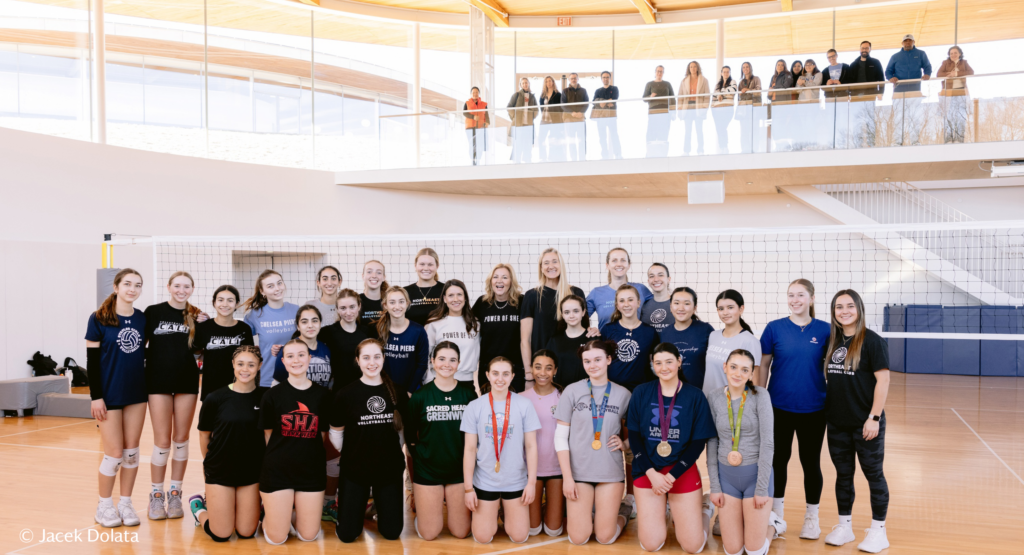
Kerri Walsh Jennings also led volleyball clinics for 50 middle and high school girls as a part of the day’s events, along with coaches from Northeast Volleyball Club, based in Norwalk. (photo by Jacek Dolata)
Karen Kariuki
Kerri, one of the things that you’re doing in addition to all the other hats you wear, you’re the founder of the nonprofit p1440, and you’re also launching a league. Can you talk about these initiatives?
Kerri Walsh Jennings
p1440 is largely focused on the youth. The clinic we had today, our company in beach volleyball and indoor volleyball, holds clinics and tournaments and the opportunities to train. The sport itself is the heart of us, but it also teaches about how to deal with anxiety and mental health issues and how to really own your voice. And that’s what the sport gave me. So we have a nonprofit side and a for-profit side, and we’re really developing these beautiful leaders of tomorrow through the sport of volleyball.
And then the new venture we’re working on is called Major League Volleyball. And basically, there’s three other pro leagues that exist right now. We see an opportunity within professional women’s indoor volleyball that no one, respectfully speaking of the three that exist, are thinking [like] we want to be like the NBA or NFL. Where we bring the best in the world here to compete in America. We have the best coaches and best players globally. They all come here, have a great career, and then they go off to Olympic teams. And so that’s where we see Blue Ocean. Right now, we’re talking to franchise owners.
Everyone is saying, we are dying to be in your sport, and we just want the right engine to align with. In my opinion, things that make big dreams possible is having the audacity to dream big.
… things that make big dreams possible is having the audacity to dream big. — Kerri Walsh Jennings
Karen Kariuki
Why the name for your nonprofit?
Kerri Walsh Jennings
We wanted to create platforms off of which the athletes can share their voices, where they can launch their careers and develop themselves. And there are only 1,440 minutes in the day. And if you can live in the moment with all your heart and really prioritize living your minutes mindfully, life is awesome.
Karen Kariuki
Can you all comment on the opportunities and the key levers we need for growth?
Danette Leighton
I think you’re seeing the vast potential. I’ve always said what’s interesting about women’s sports is that it’s like a startup that was never really invested in. You’ve had 51 years of this product ripening. You also have all these adjacent parts of women’s sports. There’s also the lack of the merchandising side of the business and the lack of actual what’s available for being a fan of women’s sports. So, there’s potential growth that hasn’t even been tapped.
There are 55,000 girls and women serving organizations in this country that are nonprofits, but we get 1.8% of the philanthropic giving in this country. So, there’s so many places to be in, and our hope is that more will invest.
Kerri Walsh Jennings
I heard this quote, “There’s great danger in being too rational in life.” If you keep rationalizing all the time, you’re going to be stuck in the middle. That’s like mediocrity. And so, my hope is for those people who are looking to invest in women’s sports, it’s kind of back what I said earlier: We got to be audacious.
Jasmine Robinson
I think just the way the women’s sports ecosystem is evolving: You need to have a little bit of this lean-forward mentality. I think when we were making our first investment in the NWSL team in Boston and the expansion fee was $53 million, people were thinking, that’s pretty expensive. That seems really risky. I think you overpaid. Fast forward to a little over a year later and the next expansion team sells for $110 million. This is not to say that things are always going to continue neatly doubling like that. The secret sauce is to really get involved and be able to be a part of building the most premium teams and opportunities within women’s sports.

(l-r) Krishna Desai, Former Dir. Strategy and Investments, NFL; Karen Kariuki; Sharon Prince; Jennifer Langton, MBA, Former Sr. VP, NFL; Kerri Walsh Jennings; Marci Goolsby, Director of Sports Medicine, WNBA (Women’s National Basketball Association) & her daughter; Danette Leighton; Amy Brooks, Pres. of New Business Ventures, National Basketball Association (NBA); & Jasmine Robinson. (photo by Jacek Dolata)
Karen Kariuki
Kerri, you had shared something about forward leaning with the girls in one of the clinics today. Can you talk about that?
Kerri Walsh Jennings
Every Olympic medal is the Goddess Nike which represents the goddess of victory. What I love so much about the Goddess Nike is that it was said she was always in forward motion, which to me is so powerful. So, on the medals, she’s taking a step forward. And I think that’s just an invitation for all of us, no matter where we are in our lives. If we’re here trying to change the world and really nurture where we’re going, that forever-forward mentality is important. Then the ride to the top of the Big Dipper is exciting.
And stay curious and engaged. As someone who pursues excellence, and I want to embody sustained excellence, I know that’s what separates gold from anything else – it’s the way you show up daily, not just once in a while. And that’s what allows for greatness.
“It’s the way you show up daily, not just once in a while. And that’s what allows for greatness.” — Kerri Walsh Jennings
Karen Kariuki
We have time for just one more question. Could you each close with what is your hope for the future of women’s sports.
Jasmine Robinson
I hope for collaboration and the way we can bring different pieces of the ecosystem together, different stakeholders together, different types of people together to really advance and grow women’s sports. I think that’s the way that we can really supercharge the growth going forward.
Danette Leighton
I think my hope is that it’s going to take every generation. So, I am a mother of a daughter, so for me, she played sports, was never was a great athlete like her mother, but she’s a STEM kid and she’s getting a genetics genomics degree at the University of Wisconsin. She’s going to go lead in a different way. And sports was a big part of that journey for her. She learned the intangibles.
My hope is that every generation will take it to the next level.
Kerri Walsh Jennings
My hope is for the generation to play for the love of the game. And I say that because I believe we’re so outcome focused. You have to know your north star and where you want to go. But I feel like if you’re so outcome focused, then you lose the journey and you feel like you have to be perfect, otherwise you’re not going to get that college scholarship. I didn’t think about a college scholarship until I was 14 or 15.
What I hope for all of us is that whatever we’re doing, we do it for the love of it.
Karen Kariuki
Kerri, Danette. Jasmine, what a total dream to be up here with you. Thank you to everybody for coming on this extraordinary International Women’s Day.
“Things that make big dreams possible is having the audacity to dream big.” — Walsh Jennings
______________________________
About Grace Farms Foundation
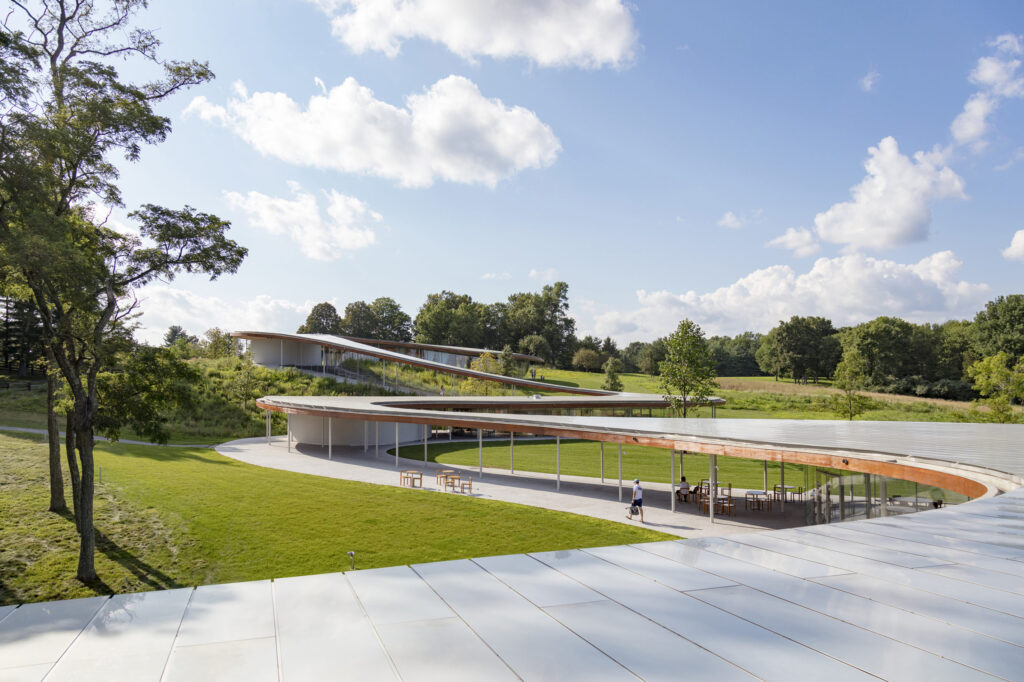
The River building at Grace Farms is embedded in nature. Nearly 80 acres of natural and diverse landscapes surround the award-winning River. (photo by Sahar Coston-Hardy)
Grace Farms is a cultural and humanitarian center in New Canaan, Connecticut that brings people together across sectors to explore nature, arts, justice, community, and faith at the SANAA-designed River building and Barns on 80 acres of publicly accessible natural landscape. Since opening in 2015, Grace Farms has welcomed 1 million visitors from around the world to experience its unique integration of arts, architecture, nature, and purpose.
As a destination for arts and culture, Grace Farms presents innovative programming in music, visual and performing arts while fostering contemplation and connection through architecture and nature. Its humanitarian work includes leading the Design for Freedom movement to eliminate forced labor in the building materials supply chain and advancing initiatives to foster more grace and peace locally and globally.
The integration of cultural programming and humanitarian action reflects Grace Farms’ collaborative approach to generating new outcomes and meaningful change.
Membership
Grace Farms members can visit without advance registration and enjoy a 20% discount on paid programs, retail, and dining, invitations to members-only gatherings, complimentary events, and a welcome gift from Grace Farms Tea & Coffee.
Becoming a member helps us advance our mission to pursue a more peaceful world and supports the preservation of the River building and its surrounding 80 acres.
For more information, visit gracefarms.org/membership.
Visit our calendar of events to learn more about upcoming programs.
Sign-up for our newsletter
Follow us
@gracefarmsct #gracefarms