Our 10th annual Earth Day Celebration on April 25 explores this question through family-friendly activities and programs
What does the earth ask of us? Visionary author, botanist, and Citizen Potawatomi Nation member, Dr. Robin Wall Kimmerer asked that profound question before a sold-out audience of 700 during her Grace Farms Lecture with Concert in March. “An educated person knows their own gifts and how to give them to the world,” she added.
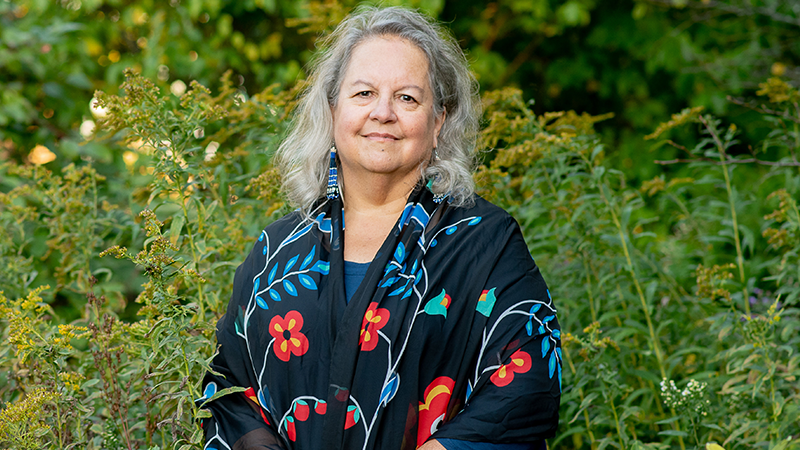
Dr. Robin Wall Kimmerer, whose award-winning books can be found in our Library.
Drawing from Indigenous wisdom and a lifetime of scientific study, Dr. Kimmerer invites us into establishing a deeper relationship with the living world, one rooted in gratitude, reciprocity, and care. “It’s moving beyond sustainability to where we care for the Earth and in return the Earth cares for its inhabitants,” said Kim Kelly, Grace Farms Director of Horticulture. It’s based a design system of reciprocity, where restoration, regeneration and resilience are prioritized, added Kelly. The system referred to as “permaculture,” short for permanent agriculture, is a way of designing human environments, from farms to communities, that are self-sustaining, resilient, and regenerative, rather than extractive.
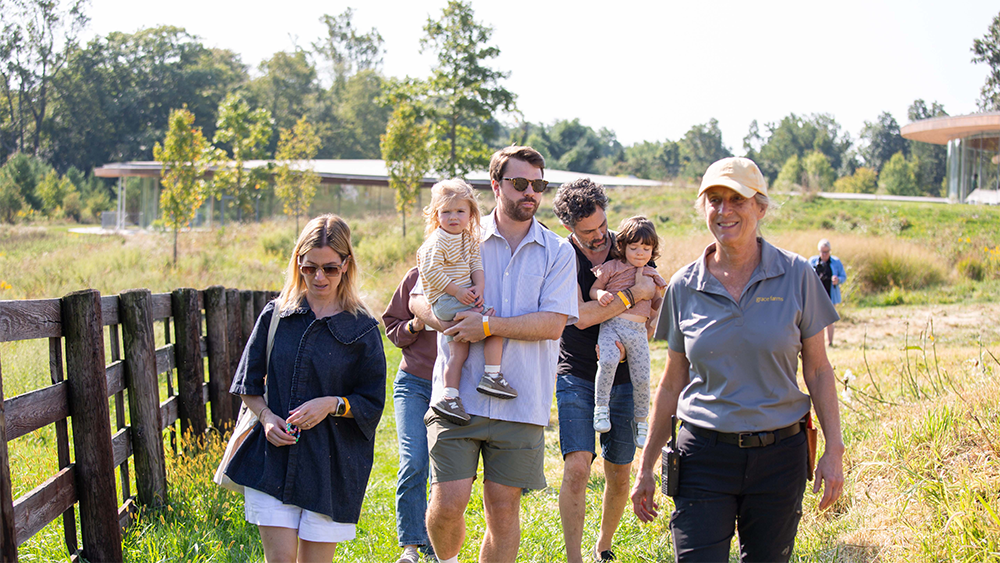
Kim Kelly, Grace Farms Director of Horticulture, during a nature tour at Grace Farms.
Not long after Earth Day was first celebrated on April 22, 1970, the permaculture movement emerged as a philosophy focused on revitalizing land and enhancing biodiversity. Rooted in concepts of permanent agriculture from the early 1940s, permaculture has since become central to global regenerative land care practices.
Popularized by Bill Mollison and David Holmgren, an Australian biologist and ecologist, respectively, their work is grounded in working with, rather than against nature. It is based on the idea that “the natural world holds the key to stable and productive systems,” as explained in The Guardian. This includes planting diverse sets of crops, using perennial species, and creating conditions for soil regeneration.
Since its founding in October 2015, Grace Farms has applied restorative and regenerative practices to transform the former equestrian facility into a natural preserve with 10 biodiverse habitats, including open meadows, woodlands, vital wetlands, and ponds. Meadow restoration has focused on planting thousands of native plants and grasses. These efforts strengthen interconnected ecosystems that support water and nutrient cycles. Grace Farms is a Certified Wildlife Habitat Garden, Certified Monarch Waystation, a member of the Xerces Society Pollinator Protection Plan, as well as a founding member of the New Canaan chapter of the Pollinator Pathway.
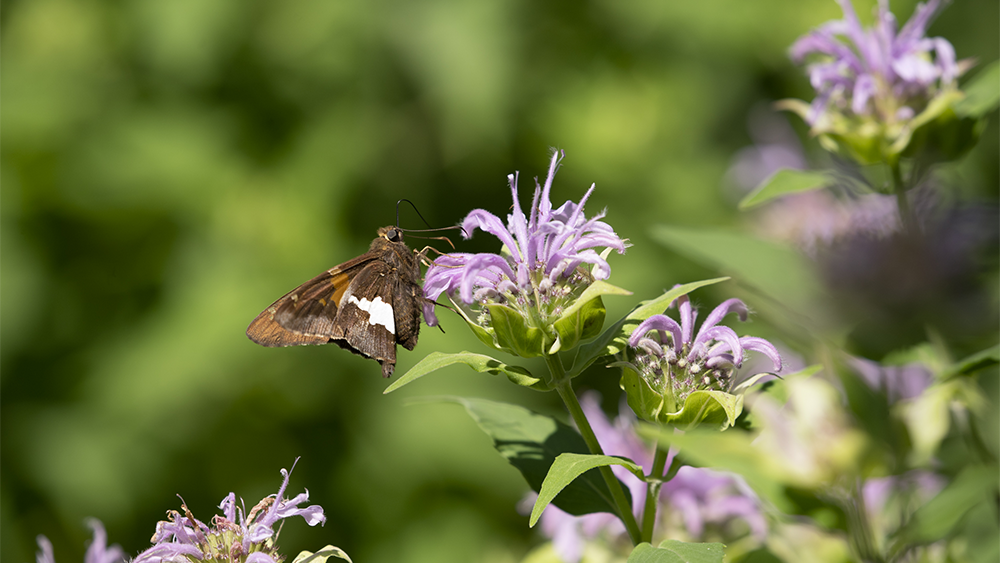
Nearly 80 acres at Grace Farms serves as a living classroom to learn about biodiversity, pollinators, and the practices used to care for the environment.
“Our stewardship efforts have turned Grace Farms into a model of biodiversity, where the public can learn hands-on through our educational programs,” said Kelly, also the President of the International Association of Butterfly and Exhibitors & Suppliers (IABES). “Our practices focus on feeding the soil, sequestering and adding carbon back to the soil with biomass as a large part of our practices.”
Stewardship in Action

Coneflowers or Echinacea are a magnet for pollinators including bees and butterflies.
- 3 million + various species of native grasses populated our meadow after sowing 18 pounds of native grasses and pollinator plants in 2024
- 2,000 + trees representing 50 different species support biodiversity
- 140 + species of birds identified, including the American kestrel, North America’s smallest falcon
- 70% of mowed lawn converted to meadows
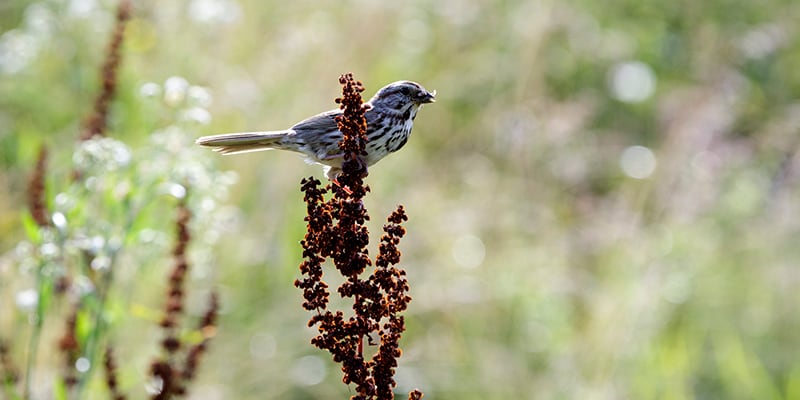
Restoring biodiversity at Grace Farms has created thriving habitats for pollinators and wildlife. Here is a song sparrow in the meadows.
Benefits of Permaculture
The benefits of permaculture are notable. In a 2024 Communications Earth & Environment article, the authors examined nine farms utilizing permaculture-based agriculture in Central Europe. Here are some of their findings: species richness of vascular plants, earthworms, and birds were 457%, 77%, and 197% higher, respectively. Researchers concluded that permaculture is an effective tool for redesigning farming systems toward environmental sustainability. In addition, the same study found 27% higher soil carbon levels on permaculture sites than on control fields. “The process of transferring and storing CO2 from the atmosphere into the soil as part of the soil organic matter, through plants or other organic solids … has substantial and technically feasible potential to stabilize the global climate system.”
Permaculture began as a response to changing modern agricultural practices — industrial monoculture practices that deplete and degrade soil quality. The 12 permaculture design principles outlined in Modern Farmer such as valuing diversity and renewable resources can also be applied on any scale, from home gardens to urban rooftop farms.
The 1,450-square foot organic Garden at Grace Farms implements the design and growing practices based on permaculture or restorative, regenerative and resilient principles, prioritizing variety and adhering to the philosophy of planting the right plant in the right place.
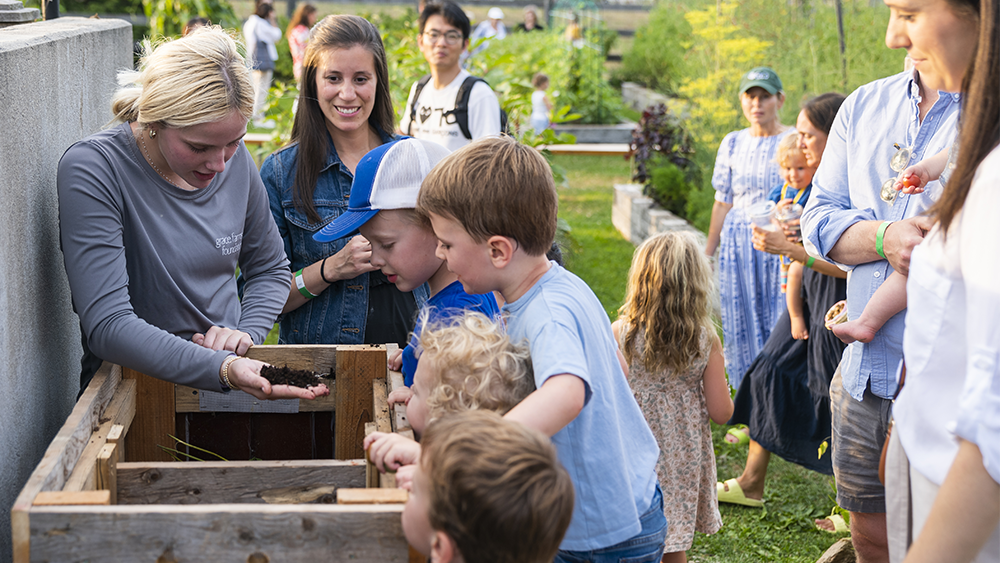
Our large organic garden, besides serving as a source for food for nonprofits, act as a living classroom when people of all ages and backgrounds can learn about soil health and caring for plants.
“These are our goals as students and stewards of the land,” Kelly said. “We should look at permaculture as a way to give back to the Earth that sustains us and the planet itself.”
Preserving and enhancing soil health is fundamental to sustaining life on Earth. Liberty Hyde Bailey, an American botanist, educator, and “Father of American Horticulture,” said in The State and the Farmer (1908) that “every well-managed soil should grow richer rather than poorer; and, speaking broadly, the farm should have within itself the power of perpetuating itself.”
While permaculture may be considered “new” by some, these practices as Bailey noted, have been used for decades. Perhaps, the economic and human toll from climate change is raising awareness about restorative, regenerative and resilient principles. Climate change is displacing people who are already living on the fringes of society, making them vulnerable to human trafficking and forced labor as individuals and families look for work.
What You Can Do
We can get overwhelmed about the Earth’s woes, wondering if our contribution is enough to help a warming planet, its dwindling resources, food scarcity, and more. Dr. Doug Tallamy, a renowned entomologist, wildlife ecologist, and professor at the University of Delaware, suggests rather than focus on all the problems, “focus on the piece of the earth you can influence.”
Here are a few ways to contribute and make a difference:
- Plant native species to increase biodiversity, including drought-resistant native plants
- Practice no-till gardening, which protects fungal networks (mycorrhizae) that helps plants absorb nutrients and support microbes that cycle carbon and nitrogen
- Plant pollinator gardens for bees, butterflies and other pollinators
- Avoid pesticides and herbicides
- Cultivate a mindset of reciprocity with the Earth
These basic practices have enhanced the biodiversity of Grace Farms. For instance, as mentioned earlier, restoring native meadows and habitats brought back the American kestrel to the area, one of the smallest falcons in North America, which helps control crop pests. In addition, ongoing efforts include removing invasive species such as mugwort and the common reed, which degrade ecosystems and harm biodiversity. The removal makes room for native species to grow.
Earth Day Celebration

There are acres to explore at Grace Farms, including 10 habitats such as the Cattail Pond, Cattail Pond a peaceful respite for visitors and a home to wildlife including turtles, frogs, birds, and insects, all important for biodiversity.
On April 25, join us as we celebrate Earth Day
10:00 am – 5:00 pm
This fun-filled day offers hands-on activities, art engagements inspired by nature, and endless opportunities for interactive learning. Responding to the work of Potawatomi botanist and author, Dr. Robin Wall Kimmerer, who delivers a Grace Farms Lecture in March, as well as our season’s theme, We all build, Earth Day invites you to explore how architecture and connection to the natural world can inspire communities to build and thrive together.
Learn more about our full schedule of family-friendly experiences hosted throughout the River building and Barns, and surrounding landscape:
10 am – 12 pm

From experienced to novice birdwatchers, the birdwatching tour will inspire and perhaps surprise even the most experienced birdwatcher.
Birdwatching
Court Mezzanine
Over 144 different bird species have been sighted at Grace Farms! Join an expert birder to see and learn about the different species that call Grace Farms home.
10 am – 4 pm
Open Arts Studio | Landscape Collage
Arts Studio
Taking inspiration from the Plaza’s new seating, Dancing Trees by Kazuyo Sejima & Associates, and the freshly sprouting lawn, design an outdoor space incorporating structures, plants, color, texture, and wildlife.
11 am – 4 pm

Magnifying Small Wonders and Seed Bar
East Barn Hall
Explore the unique characteristics of seeds up close using digital scope and microscopes, then create a mix to take home, using seeds harvested onsite.
12 pm & 3 pm
Animal Embassy
West Barn Hall
Join Animal Embassy to learn about their role as animal rescuers as well as their program, Heroes of the Animal Kingdom — and discover some incredible facts about a variety of animals!
1 & 4 pm
Beneficial Bugs with Educator Patrice Anibal
Library
2 pm
Nature Talk with Horticulture Specialist Michael Poulin
Education Path
3 – 5 pm

Mocktails with Tea Expert Frank Kwei
Pavilion
Take a break from exploring to sip a delicious tea-based mocktail with Tea Expert Frank Kwei! Surrounded by 360-degree views of the landscape, enjoy a special mocktail inspired by this year’s Earth Day themes.
Available All Day
Nature Resources in the Library
Walking trails
With Every Fiber Exhibit in the West Barn
Family-Friendly Games in the Court
Birdwatch Bingo
Letter Sticks
Map
Additional Nature Spring and Summer events:
Throughout the year, people are invited to explore nature and how to care for the Earth through hands-on workshops led by our Horticulture and Education Teams.
Pop-up Talk | Noticing Nature: For the Birds
Sunday, April 26, 1:00 pm – 1:30 pm
Pop-up Talk | Water, Water Everywhere
Saturday, May 2, 11:00 am – 11:30 am
Learning with Nature | Tomato Loves Basil
Saturday, June 20, 10:30 am – 12:00 pm
Tuesday, July 7, 14, 21, 28, 10:00 am – 12:00 pm
Learning with Nature | Edimental Fruit Trees
Saturday, July 18, 10:30 am – 12:00 pm
Tuesday, August 4, 11, 25, 10:00 am – 12:00 pm
Learning with Nature | Monarch Migration
Saturday, August 22, 10:30 am – 12:30 pm
About Grace Farms
Grace Farms is a cultural and humanitarian center in New Canaan, Connecticut that brings people together across sectors to explore nature, arts, justice, community, and faith at the SANAA-designed River building and Barns on 80 acres of publicly accessible natural landscape. Since opening in 2015, Grace Farms has welcomed 1 million visitors from around the world to experience its unique integration of arts, architecture, nature, and purpose.
As a destination for arts and culture, Grace Farms presents innovative programming in music, visual and performing arts while fostering contemplation and connection through architecture and nature. Its humanitarian work includes leading the Design for Freedom movement to eliminate forced labor in the building materials supply chain and advancing initiatives to foster more grace and peace locally and globally.
The integration of cultural programming and humanitarian action reflects Grace Farms’ collaborative approach to generating new outcomes and meaningful change.
Membership
Grace Farms members enjoy early access to program registration, a 20% discount on paid programs, retail, and dining, and so much more.
Becoming a member helps us advance our mission to pursue a more peaceful world and supports the preservation of the River building and its surrounding 80 acres.
For more information, visit gracefarms.org/membership.
Visit our calendar of events to learn more about upcoming programs.
Sign-up for our newsletter
Follow us
@gracefarmsct #gracefarms