The Design for Freedom movement reached a new milestone on March 26, as Grace Farms hosted its fifth annual Design for Freedom Summit, convening leaders from architecture, construction, technology, manufacturing, academia, and government to advance the global push toward a more ethical built environment. The day-long Summit brought together voices from across sectors to tackle some of the built environment’s most pressing challenges, including U.S. foreign policy and how it can be used to help end forced labor, ethical sourcing for data centers, material circularity in construction, the narratives of monuments in underrepresented communities, and ethical decarbonization.
Reflecting the movement’s growing reach, Grace Farms announced four new Design for Freedom Pilot Projects, including two international projects. Grace Farms also recognized student leaders who won the 2026 ACSA Design for Freedom Competition for architecture students. More than 550 leaders attended this year’s sold-out Summit, as well as students from 21 colleges and universities nationally.
Featured speakers included Sharon Prince, CEO and Founder of Grace Farms; Ambassador Cindy Dyer (ret.), Former U.S. Ambassador-at-Large to Monitor and Combat Trafficking in Persons; Dave Wildman, Global Head of Data Centers of Infrastructure & Workplace Sustainability at Bloomberg; Jha D Amazi, Principal, MASS Design Group; architects Toshiko Mori and Kai-Uwe Bergmann, Partner, BIG.
“Five years ago, we asked a simple but urgent question: what if the buildings we design and inhabit were built with the full dignity of every person who harvests, mines, and processes the materials that make them possible? Today, that question is a global movement. This is our moment. The construction industry is now positioned to become a global leader in supply chain transparency and human rights.” – Sharon Prince
Below is Prince’s opening Summit address in its entirety.
____________________
Hello, and welcome to the Fifth Annual Design for Freedom Summit. Five years!
You’re bringing the sunshine, that’s for sure. All right. Five years ago, we posed a simple but urgent question: What if the buildings we design and inhabit are actually built with the full dignity, with those that harvest, that mine and process the very materials that are within them?every person who harvests, mines, and processes the materials within them?
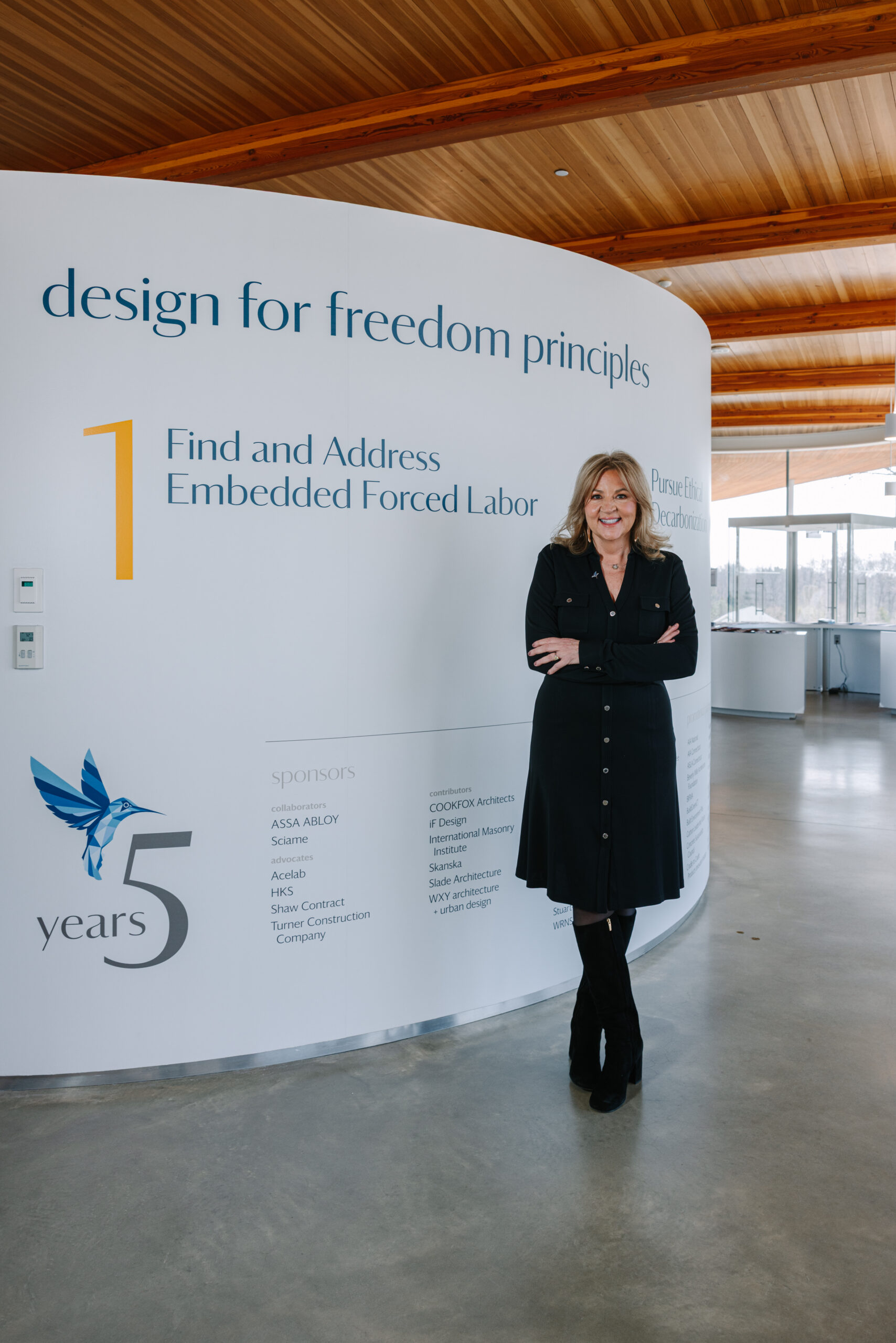
Sharon Prince, CEO and Founder of Grace Farms, at the entrance of the River building’s Sanctuary. (Photo by Melani Lust)
So today, because of you and thousands of others, that question has become a global movement.
In the life of a movement, five years is a foundation. It is the time required for the reports, the research, the presentations that ground us. But for the 28 million people trapped in forced labor around the world — working in inhumane conditions to produce the very materials of our built environment — five years is a lifetime.
We refused to stay at a standstill. We are creating a radical paradigm shift to remove exploitation from the building materials supply chain and ignite institutional responses. We said what we would do, and we are doing it together.
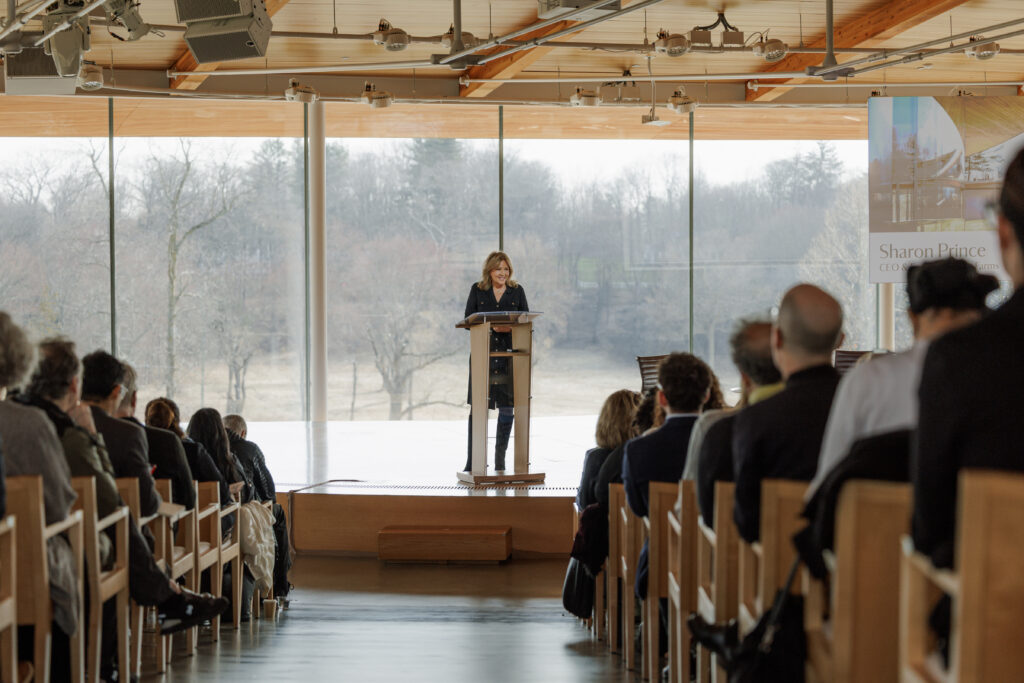
Sharon Prince welcomes over 550 global leaders across sectors, including students and universities, to the sold-out Design for Freedom Summit. (Photo by Melani Lust)
When I look around this room, I am looking at leaders, designers, manufacturers, and innovators gathered from across the globe. One thing is clear: This movement is accelerating.
Well over 50,000 people have directly engaged with Design for Freedom through presentations, outreach, and global events. And then add in the ripple effect. Since Grace Farms opened 10 years ago, one million people have crossed over the words “Grace and Peace” etched into the Plaza walkway — which is both a welcome and an invitation.
Chelsea Thatcher, Chief Strategic Officer & Founding Creative Director, Grace Farms, left, discusses the innovative approaches to ethical sourcing with the contributors to the With Every Fiber exhibit. (Photo by Melani Lust)
And now, global leadership matters. Corporate engagement, where it matters because it is both a human rights and business issue, has increased exponentially. We have 20 corporate sponsors today, including the largest firms in the built environment, Skanska, Turner, Sciame, Assa Abloy, Shaw and leaders of industry presenting that can sway the marketplace — Bloomberg, Google, Saint-Gobain, Durst, and iMasons. 25 Promotional Partners. Thank you all. Fast Company came on board as our lead media sponsor along with Architectural Record, Metropolis, Architype and Oculus at the table. Grace Farms Tea & Coffee has created an ethically and sustainably sourced coffee blend for JPMorganChase, now served to their 10,000 employees. And soon we’re going to be opening a Grace Farms Tea & Coffee public café at the base of their new Manhattan headquarters! Incredible, right? You’re going to see that happen like the next few months.
We’ve also launched a dozen Pilot Projects on three continents. More will be announced today with AEC teams and owners on board. Perhaps one even on another continent.
Incredible, right? You’re going to see that happen like in the next few months. And all these things, these numbers really don’t capture it all.
We are witnessing a compounding effect. Here, we make a commitment and then figure out how to do it. People and companies like yourselves are doing the same. And all these things, these numbers really don’t capture at all. They’re really talking about it; but also taking the baton and running with it.
Architects are demanding transparency. Construction firms are working to normalize fair labor inputs. Manufacturers are pivoting and changing their practices. Students are entering the workforce armed with really important hard questions. Simultaneously, policymakers are escalating modern-day slavery legislation and corporate accountability. Every stakeholder in this complex value chain holds power—but our most essential task is empowering rightsholders. To correct the severe power imbalances in global supply chains — the voices of workers, farmers, and local communities must be at the center.
We have reached a definitive inflection point. Geopolitics has thrust supply chains into a spotlight we couldn’t have imagined five years ago. Just last week, forced labor moved to the forefront of global trade negotiations, even as democracy and human rights are threatened.
‘Plausible deniability’ cannot be used as a backstop anymore.
The materials of our trade—steel, concrete, timber, and glass—are now a part of the global conversation on critical minerals and global dependencies. And with the explosion and growth of AI, data centers are being scaled at a staggering pace, consuming these same materials in massive quantities.
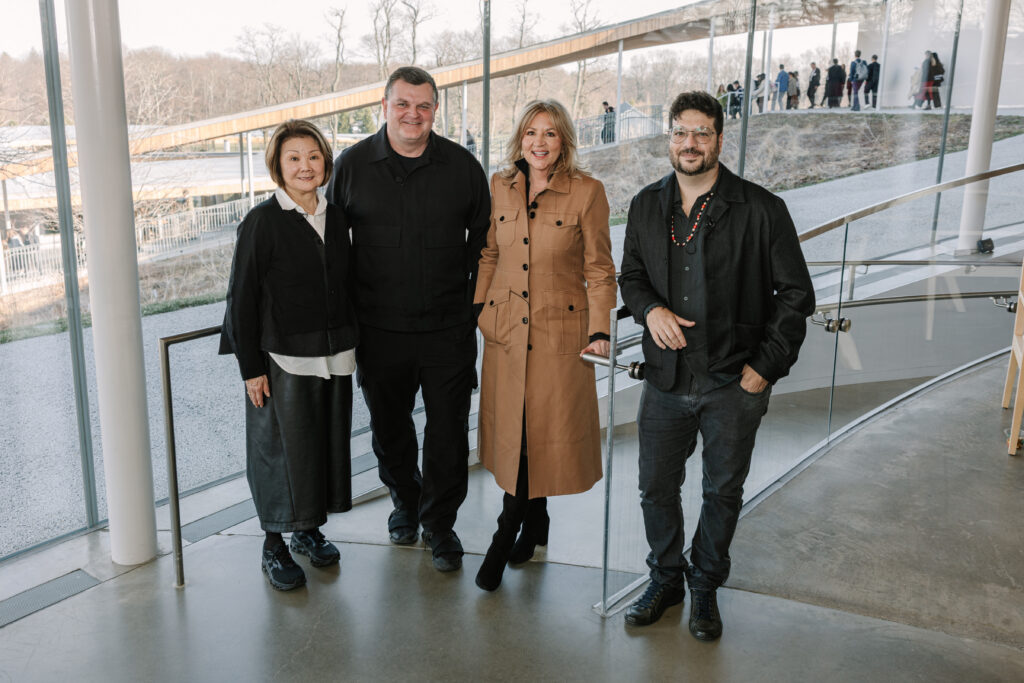
Toshiko Mori, Principal, Toshiko Mori Architect PLLC; Professor, Harvard University Graduate School of Design, Kai-Uwe Bergmann, Partner, BIG, Sharon Prince, CEO & Founder, Grace Farms, and Gustavo Ferroni, Program Manager, The Freedom Fund. On their panel they discussed the cultural context and risk in the global timber supply chain. (Photo by Melani Lust)
This is our moment. The construction industry—traditionally considered a laggard—can become a global leader in supply chain transparency and human rights. While our sector is often considered the least modernized, it also stands to benefit the most from the AI revolution. But to truly benefit and really yield potential, we must first pour a foundation of dignity.
Design for Freedom is a movement focused on the materials that shape the largest, highest at-risk industrialized sector on Earth. And from the start, we chose a deliberate, multi-pronged approach because radical transformation requires both a top-down and bottom-up approach.
It’s also a rarity for Design for Freedom to be accelerated from within the industry and it is clearly aligned with leading sustainability associations, which you’ll see here this afternoon. So you can see Design for Freedom is a herculean effort, but it can also make an enormous impact due to the sheer weight of the construction sector at 13% of global GDP. Slavery doesn’t reverse on its own and it does need intervention.
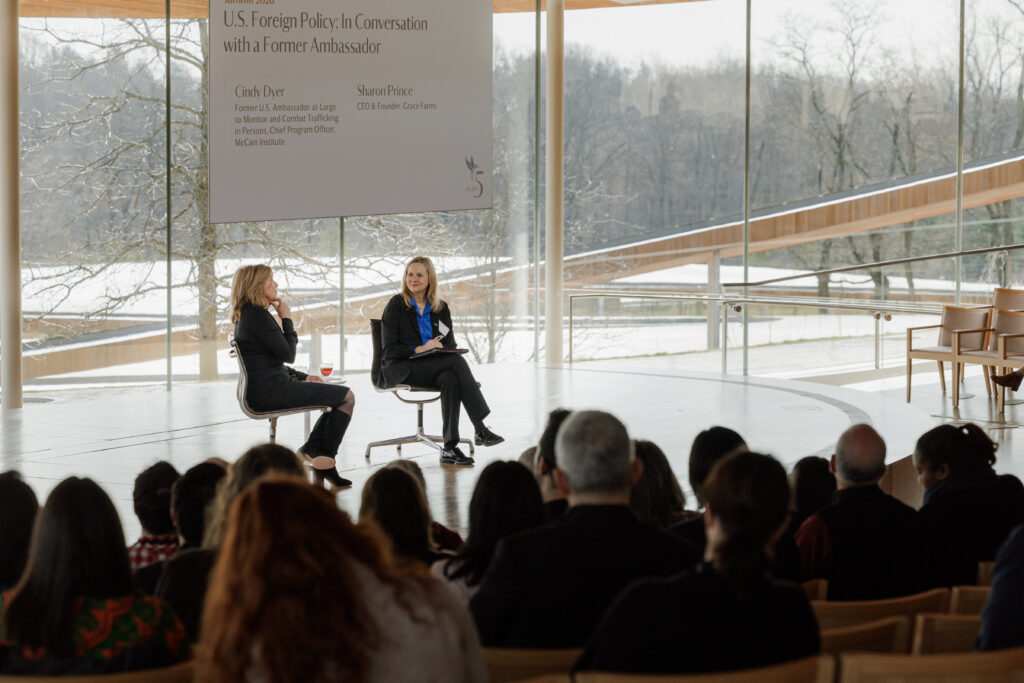
Sharon Prince, CEO & Founder, Grace Farms, in conversation with Cindy Dyer, Former U.S. Ambassador-at-Large to Monitor and Combat Trafficking in Persons; Chief Program Officer, McCain Institute. (Photo by Melani Lust)
Today, we invite more of your expertise and due diligence. We are normalizing conversations about fair market pricing in an industry known for its thin margins. People often ask, “Is this going to cost more?” Instead, we ask, “Are you willing to accept the slavery discount?”
So, we are chipping away to map supply chains and create transparency. We are prioritizing and documenting circularity that truncates the supply chain at the extractives, where it’s the highest risk of exploitation. An automatic lever. I feel like it’s double. You can really serve immediately the planet and also serve humanity at the same time.
Many of you are using the Design for Freedom Interoperability Chart that can guide usage of many tech platforms available to us today. And there’s more that are proliferating. Acelab added Design for Freedom Principles to its new Materials Hub for our sector. Design for Freedom is a partner in the World Economic Forum’s (WEF) Global Data Partnership Against Forced Labor. And there is yielding also new ways to consider federated data. We’re going to talk about that later.
And speaking of technology, we cannot address the future of forced labor in the built environment without talking about the explosion of AI.
AI a double-edged sword. On one edge, artificial intelligence offers us unprecedented tools for supply chain transparency to identify risk patterns, trace materials and illuminate dark corners of global commerce in ways we could not have imagined even a few years ago.
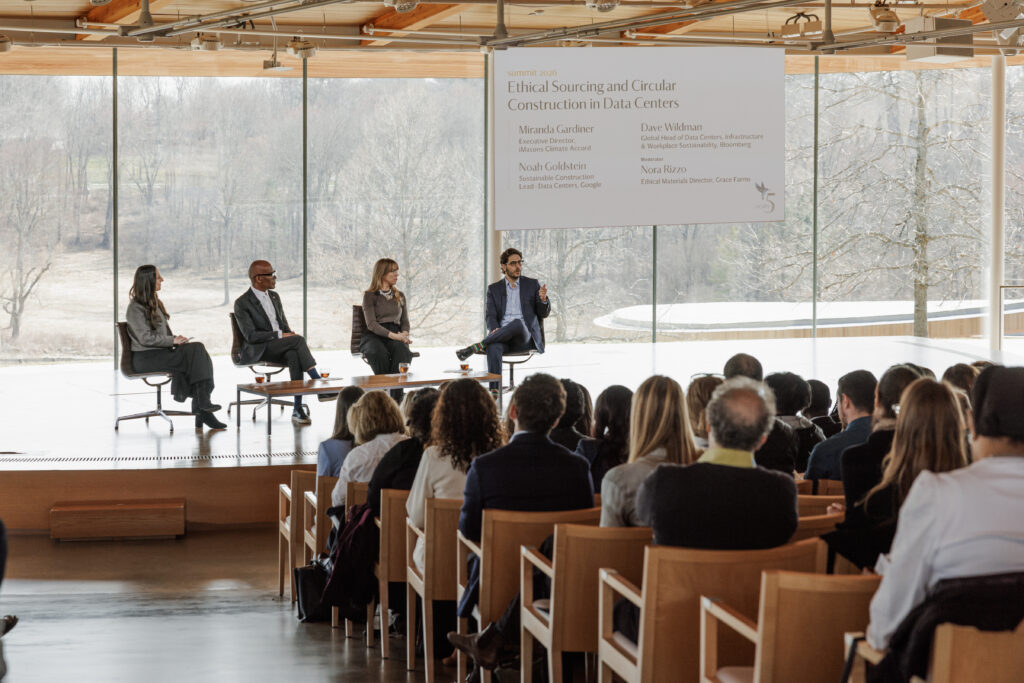
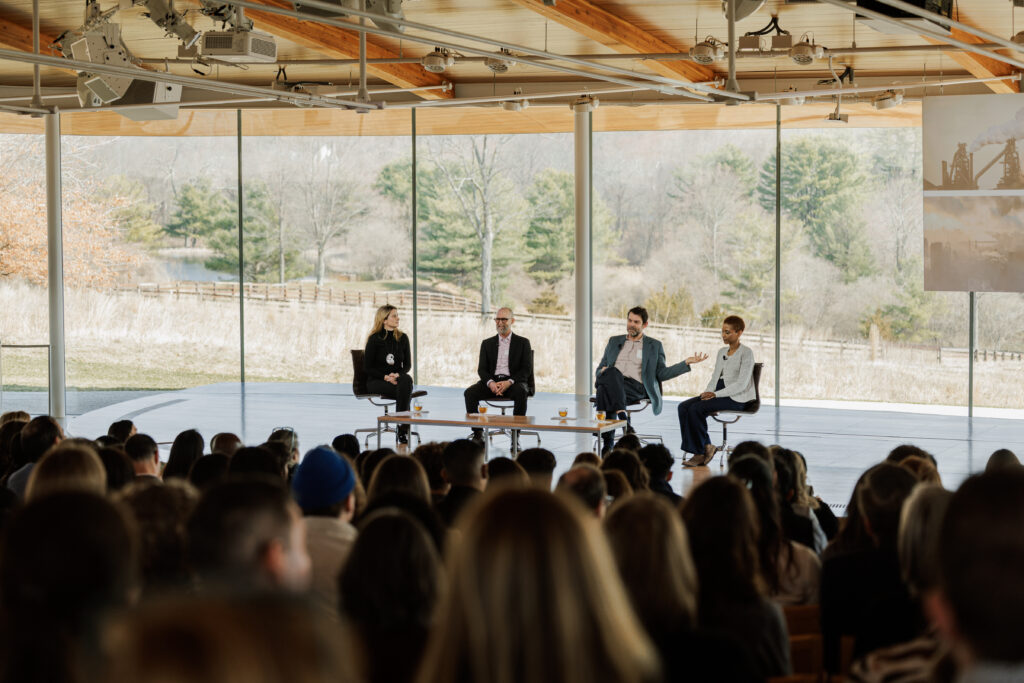
Nora Rizzo, Ethical Materials Director, Grace Farms, Moderator, Dave Wildman, Global Head of Data Centers, Infrastructure & Workplace Sustainability, Bloomberg, Miranda Gardiner, Executive Director, iMasons Climate Accord, and Noah Goldstein, Sustainable Construction Lead – Data Centers, Google, discuss ethical sourcing and circular construction in data centers. (Photo by Melani Lust)
But here’s the other edge: the servers and data centers powering this AI revolution are themselves being built at hyperscale, right now, without adequate material inspection. AI-related categories contributed to roughly 39% of total GDP growth in 2025 alone. New mines are coming online to supply the copper, cobalt, and lithium these facilities demand. Urban mining is quickly shifting from a nascent concept to a critical industrial strategy driven by resource scarcity and instability in global supply chains. As of 2025, only about 16% of raw materials used in major economies are secondary, recycled. I am super excited about the partnership with Saint-Gobain, Durst, and Infinite Recycled Technologies. It is literally taking the architectural glass from landfills and putting it into insulation products.
We must stay focused, and we must do this to invest in ethical and sustainable solutions during this new sector’s birth and boom cycle. This is why today’s program and next year’s Summit will specifically address both mining and data centers because we must get this right as we build our future. And we must move from literally taking extracted material mindset to a model of land and cultural reverence.
As Professor and author Robin Wall Kimmerer, who lectured here at Grace Farms earlier this month, reminds us, “all flourishing is mutual.” There are many professors and students here today, about 100 from 25 universities. Where are you? I want to see if they made it. There you are. So you have literally brought your class, I think for the last five years, and so tremendous. You can see how there’s a compounding effect. And we’ve deliberately put into our plan next-generation leadership for Design for Freedom
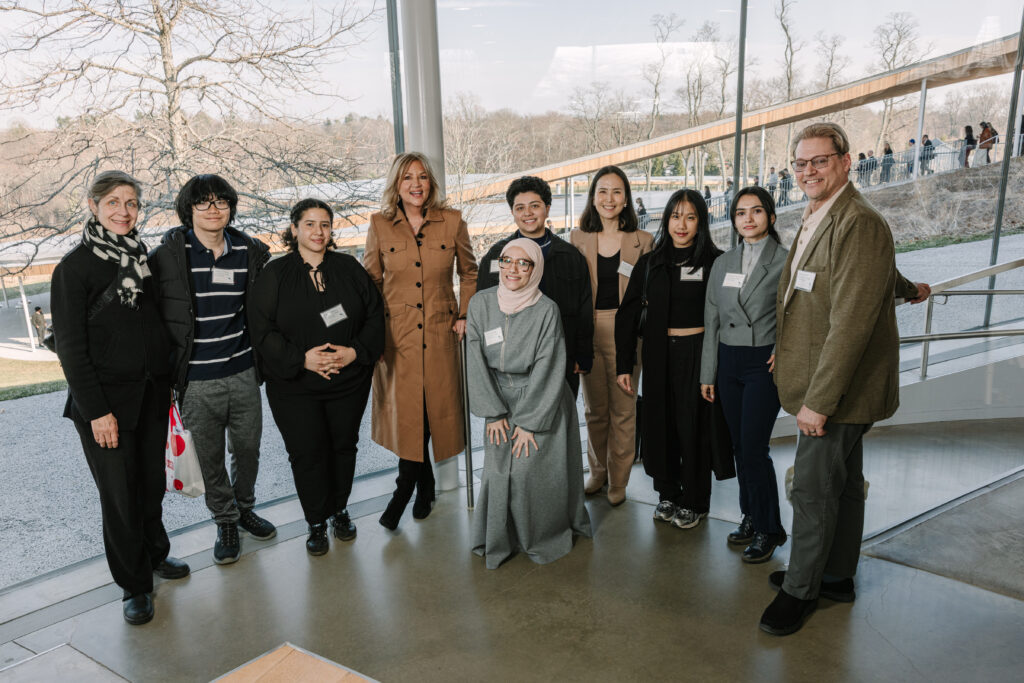
Students from the New York Institute of Technology (NYIT) with Sharon Prince, center, and Illya Azaroff, Professor at New York City College of Technology and President of the AIA American Institute of Architects, far right. (Photo by Melani Lust)
As we look ahead to the next five years, our race to Design for Freedom will meet the technology race head on. We aim to upend AI right where we have the ability to do so. AI cannot flourish without the datacenters, the servers, the infrastructure you are building. So, when 46 miles of deep foundation piles and 26 million pounds of structural steel are specified and procured, we are advocating for your pressure points to be clear. Think about that power. We must build without using the slavery discount, without exploitation built into the next generation of AI or the next generation of workers.
Even more broadly, for every building to tell a story of dignity, I hope you will figure out the next step you will take, the next partnership, the next building, and the next research project that will help steer the built environment towards human dignity and respect.
Thank you for being here. Thank you for taking up the baton. Thank you for being part of this movement.
Now let’s get to work.
About Grace Farms
Grace Farms is a cultural and humanitarian center in New Canaan, Connecticut that brings people together across sectors to explore nature, arts, justice, community, and faith at the SANAA-designed River building and Barns on 80 acres of publicly accessible natural landscape. Since opening in 2015, Grace Farms has welcomed 1 million visitors from around the world to experience its unique integration of arts, architecture, nature, and purpose.
As a destination for arts and culture, Grace Farms presents innovative programming in music, visual and performing arts while fostering contemplation and connection through architecture and nature. Its humanitarian work includes leading the Design for Freedom movement to eliminate forced labor in the building materials supply chain and advancing initiatives to foster more grace and peace locally and globally.
The integration of cultural programming and humanitarian action reflects Grace Farms’ collaborative approach to generating new outcomes and meaningful change.
Membership
Grace Farms members can visit without advance registration and enjoy a 20% discount on paid programs, retail, and dining, invitations to members-only gatherings, complimentary events, and a welcome gift from Grace Farms Tea & Coffee.
Becoming a member helps us advance our mission to pursue a more peaceful world and supports the preservation of the River building and its surrounding 80 acres.
For more information, visit gracefarms.org/membership.
Visit our calendar of events to learn more about upcoming programs.
Sign-up for our newsletter
Follow us
@gracefarmsct #gracefarms