Climate Week NYC, which occurs every year in New York City during the second week of the U.N. General Assembly, brings together global leaders from business, tech, politics, academia, nonprofits and civil society, to propose bold action to address climate change. The increased risks to human health and safety from extreme weather is forcing people from their homes in search of work and more habitable environments. This migration makes them more vulnerable to forced labor and trafficking.
Grace Farms’ Design for Freedom recognizes the interrelatedness of climate change and forced labor. The built environment accounts for nearly 40% of global greenhouse gas emissions and consumes a third of global energy, according to Building Materials and the Climate: Constructing a New Future, a report by UNEP, Yale Center for Ecosystems + Architecture, and the Global Alliance for Buildings and Construction (GlobalABC).
Ethical decarbonization, a new industry-wide term that emerged from Design for Freedom’s work, acknowledges the direct and inseparable relationship between the carbon in our building materials linked to climate change and the suffering of forced labor in extracting and manufacturing building materials.
Sharon Prince, CEO and Founder of Grace Farms, will attend Climate Week’s important discussions, especially as it relates to the built environment and the finance sector and their roles in climate change. On July 15, Prince was part of a prestigious panel that addressed the crucial role the financial industry can play in creating a more ethical, sustainable, and even innovative future. Besides Prince, panelists included representatives from Patagonia, Tony’s Chocolonely, Verité, Freedom Fund, IBM, and Nasreen Sheikh, modern slavery survivor and Founder of the Empowerment Collective and Local Women’s Handicrafts. The in-person event was held at the United Nations Headquarters in New York.
Below are Prince’s full remarks:


Sharon Prince addresses the prestigious panel along with Nasreen Sheikh, Founder of the Empowerment Collective and Local Women’s Handicrafts; Wendy Savage, Senior Director, Social Impact & Transparency at Patagonia; Declan Croucher, Senior Director, Advisory & Chief Commercial Officer at Verité; Erin Phelps, Senior Adviser to the CEO at the Freedom Fund, and Aidaly Sosa Walker, Tony’s Chocolonely VP of Marketing USA & CA.
The financial industry is critical to creating a more ethical, sustainable, and even innovative future. Let’s stop accepting the ‘slavery discount.’ Let’s create a future where the buildings we build tell a story of dignity, not exploitation. — Sharon Prince
Good afternoon, I’m Sharon Prince, CEO and Founder of Grace Farms, a cultural and humanitarian center in New Canaan, Connecticut. We bring people together in a hopeful space on 80 acres free and open to the public, partly to address some of the most pressing humanitarian issues of our time, including modern slavery and human rights abuses.

Tony’s Chocolonely VP of Marketing USA & CA, Aidaly Sosa Walker, with Sharon Prince, CEO and Founder of Grace Farms. They were both part of a prestigious panel that addressed the crucial role the financial industry can play in creating a more ethical, sustainable, and innovative future. It was held at the United Nations Headquarters in New York.
Our work through leading the Design for Freedom movement focuses on one of the most overlooked areas of exploitation in the global economy: the building materials supply chain. While the construction sector is addressing environmental sustainability, it has been given a labor transparency pass on its colossal supply chain.
“Are our buildings ethically sourced, as well as sustainably designed?”
The central question we ask is: “Are our buildings ethically sourced, as well as sustainably designed?” Today, it is nearly impossible to claim a construction project is free of forced or child labor—because the vast global supply chain behind building materials is opaque, fragmented, and largely unchecked for worker exploitation.
Forced labor is embedded at the very beginning of the construction process—in the extraction and production of materials like steel, timber, copper, concrete, and solar panels. Addressing job site labor is only half the equation.
Grace Farms is playing a key convening role across sectors, including the financial sector—partnering with those with lived experience, like my fellow panelist Nasreen Sheikh. Just as the food and fashion industries were called to account, shelter—our third human essential—must now be next.

Sharon Prince, CEO and Founder of Grace Farms, with Nasreen Sheikh, modern slavery survivor and Founder of the Empowerment Collective and Local Women’s Handicrafts, outside the United Nations’ plaza in New York City.
Our relationship with FAST goes back more than eight years and in many ways, FAST was created at Grace Farms. We partnered with the UN University and the Permanent Mission of Liechtenstein to co-host a convening to disrupt financial ties to human trafficking which led to the proposal of 25 specific recommendations that were published in a UNU workshop report. This work followed a convening and report “Fighting Human Trafficking in Conflict: 10 Ideas for Action by the United Nations Security Council,” leading to the passage of UN Security Council Resolution 2331. Both were co-hosted at Grace Farms with a multi-sectoral approach.
As conflict increases globally, hundreds of billions will be spent on reconstruction. We have a choice: either we finance and rebuild with transparency and legality—or brutal exploitation will accelerate.
The uncomfortable truth is that modern slavery is sustained and even exacerbated by our existing financial systems.
The uncomfortable truth is that modern slavery is sustained and even exacerbated by our existing financial systems. There is currently no agreement of decision-critical human rights metrics for the investment sector. It is therefore often difficult for investors to introduce and monitor human rights measures and impact.
Even so, most construction projects are financed in some manner creating a tremendous opportunity for the financial sector to de-risk exploitation, normalize fair labor inputs, and accelerate innovation at the same time. The financial sector, particularly sustainable and digital financing, holds a unique position of influence to determine which projects are financed. The use of big data and other innovative technologies can drive fair labor inputs which we demonstrate in our interoperability chart aligning with the phases of a construction project.
When speaking with industry leaders about sourcing ethically, they often ask, “Will this cost me more or delay my project?” My question is, “Are you okay with accepting the slavery discount?” Because right now, the exploitation of workers is effectively subsidizing our returns on investment.
Globally, forced labor is estimated to generate $63 billion annually by exploiting 28 million people.
The scale is staggering. Globally, forced labor is estimated to generate $63 billion annually by exploiting 28 million people. Construction, worth $13 trillion annually, is the largest consumer of raw materials. The global construction materials market was valued at $1.32 trillion in 2023 and is expected to grow to $1.73 trillion by 2030. That scale is our greatest challenge—and our greatest opportunity to shift the marketplace.
The Design for Freedom movement is organized around three core principles:
- Find and Address Embedded Forced Labor – Know where your materials come from and how they are made.
- Pursue Ethical Decarbonization – Align sustainability with human rights, so that we’re not trading one form of harm for another.
- Prioritize Circularity – Shorten supply chains, which reduces the risk of exploitation at the extractives.
Our Design for Freedom Report issued in 2020 identified a dozen building materials at high risk for forced labor, including steel, copper, timber, solar panels, concrete, rubber, textiles and electronics. Many of these materials come from remote regions with weak protections and corruption, where workers have little voice in their labor conditions.
Our new Design for Freedom International Guidance & Toolkit, soon to also be released in Vietnamese, offers practical tools aligned with UN Guiding Principles and OECD frameworks.
Our Design for Freedom Working Group includes nearly 100 leaders across the ecosystem of the built environment. We’ve launched pilot projects with burgeoning teams—owners, architects, construction firms—actively working to address embedded labor risk from the demand and supply side, including large scale suppliers — Assa Abloy and Shaw Floors. Two ongoing projects examples are the University of Virginia’s Karsh School of Democracy to The Brij 1million sq. foot project in New Delhi. This is where the financial sector can step in—applying new data and tech to projects in real time.
We’ve also partnered with AceLab to integrate Design for Freedom principles into their AI-powered Materials Hub—helping architects prioritize delivery, sustainability and human rights requirements in procurement. AI is being trained on real project data from leaders like SHoP, BIG and Bloomberg to create an industry-specific ethical framework.
We advise investors to require fair labor audits of high-risk materials and to include ethical labor standards in the Owner’s Project Requirements (OPR). Product certifications like FSC and PEFC wood added core (fair) labor requirements to their environmental chain of custody audits—thus providing a double benefit to the increase in pricing to owners.
Construction is responsible for 50% of global resource extraction, 40% of solid waste and 37% of global carbon emissions.
Embracing circularity in construction directly reduces environmental and worker exploitation risks. Construction is responsible for 50% of global resource extraction, 40% of solid waste and 37% of global carbon emissions. By identifying and reusing existing building materials, we cut emissions and protect labor rights. Some building materials—like interior textiles—overlap with sectors where transparency has already advanced.
Grace Farms Tea & Coffee, a Certified B Corp, and the only premium tea brand in the U.S. certified by Fair Trade International donates 100% of profits to support Design for Freedom. We now distribute in 26 Whole Foods and serve corporate partners like Google and JPMorgan. With more profits, we can invest in more research – we seeded a DFF project with Stanford University to scientifically determine labor’s fingerprint in concrete.
Construction has thin margins and is one of the least modernized sectors in which innovation continues to be stymied. When you drive costs lower without examining materials, you raise human cost and limit innovation. Take one example – solar panels. When prices are artificially depressed through exploitative labor, market incentives for research and development disappear.
Every building tells a story of humanity—either of dignity or exploitation.
By incorporating ethical labor standards into investment decisions, we can ensure that every building, every material, and every project reflects the dignity of workers.
The financial industry is critical to creating a more ethical, sustainable, and even innovative future. Let’s stop accepting the “slavery discount.” Let’s create a future where the buildings we build tell a story of dignity, not exploitation.
Thank you.
To watch the panel discussion: https://lnkd.in/eucvjaT9
(feature photo, United Nations)
_____________________
More about Sharon Prince
Learn more about Prince and why Fast Company named this CEO to its list of the Most Creative People in Business 2022: For Cleaning up Construction.
_____________________
About Grace Farms
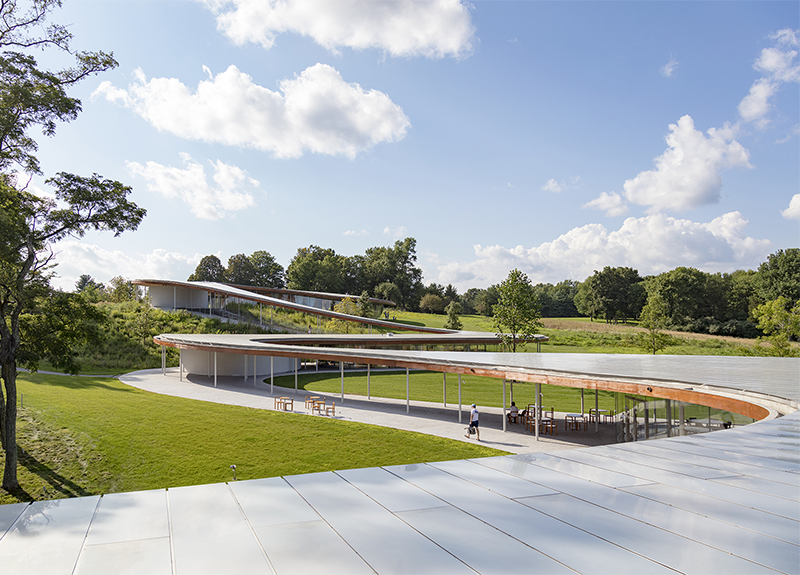
Grace Farms is a cultural and humanitarian center located in New Canaan, CT.
We bring together people across sectors to explore nature, arts, justice, community, and faith at the SANAA-designed River building on 80 acres of publicly accessible, preserved natural landscape.
Grace Farms, with its open architecture, breaks down barriers between people and sectors and invites conversation, curiosity, and proximities. This collaborative approach to comprehensively address humanitarian issues and generate new outcomes is reflected across all of our initiatives and the place of Grace Farms.
Membership
Grace Farms members can visit without advance registration and enjoy a 20% discount on paid programs, retail, and dining, invitations to members-only gatherings, complimentary events, and a welcome gift from Grace Farms Tea & Coffee.
Becoming a member helps us advance our mission to pursue a more peaceful world and supports the preservation of the River building and its surrounding 80 acres.
For more information, visit gracefarms.org/membership.
Visit our calendar of events to learn more about upcoming programs.
Sign-up for our newsletter
Follow us
@gracefarmsct #gracefarms