“Alicja enlarges our sense of the world and our place in it.” — Chelsea Thatcher
Grace Farms, known for its boundary-defying culture, invites artists and leaders across sectors to push boundaries that often result in unprecedented outcomes including Grace Farms’ Design for Freedom, a global movement to eliminate forced and child labor from the built environment.
As part of its 10th Anniversary Season, sponsored by JPMorganChase, that opened on September 13, Grace Farms unveiled a new permanent sculpture, ParaPosition, 2024 by Alicja Kwade. Kwade, who started a residency in Rome two days prior, joined Chief Strategic Officer and Founding Creative Director, Chelsea Thatcher, at Grace Farms for a conversation about her inspiration and the sculpture’s dialogue with our site and mission. The conversation was followed by a special reception. (Feature photo by Melani Lust)
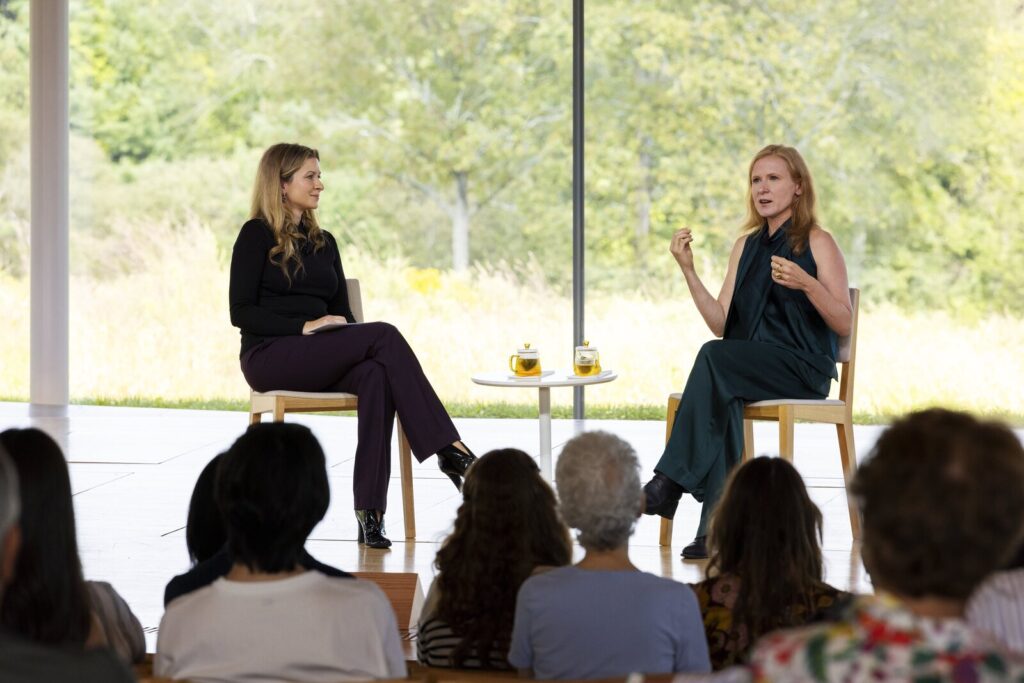
Chief Strategic Officer and Founding Creative Director, Chelsea Thatcher, joined artist Alicja Kwade on stage in the Sanctuary for a conversation about her inspiration for ParaPosition. Photo by Dean Kaufman
“Alicja Kwade is approaching themes about society and human flourishing in the same spirit as we are at Grace Farms Foundation — imploring us to expand our perspective by asking questions,” said Sharon Prince, Grace Farms CEO and Founder. At Grace Farms, we seek new outcomes on pressing humanitarian issues by breaking down silos and facilitating dialogue across sectors.”
The permanent work of this Berlin-based artist – internationally known for sculpture, expansive public installation, film, and photography – joins an illustrious group of artists and performers from the world’s finest London Philharmonic Orchestra (LPO) to Meredith Monk, who “has mapped a world that never quite existed in the history of the arts, says The New Yorker. Every artist, musician, and performer invited to Grace Farms has offered new perspectives and left their indelible mark.
Thatcher has been responsible for mapping the artistic and cultural vision at Grace Farms. “Heading into our tenth year, I continue to see this as a unique opportunity to be part of building Grace Farms into a vision for grace and peace in the world. … And I believe culture can be a strong force in the connections, community, and communication that are so critical to that end,” Thatcher said in a recent interview with Bedford & New Canaan Magazine.
Besides LPO and Monk, Thatcher has brought other world-class performances to Grace Farms including NYC Ballet, Gallim Dance – a contemporary dance company that celebrates human connection, Alvin Ailey American Dance Theater, and Carrie Mae Weems, “perhaps our best contemporary photographer … rewriting the rules on image-making, says The New York Times. Thatcher also curates Grace Farms’ long-term exhibits including Peace Forest, an immersive installation inspired by nature, highlighting how the landscape, architecture, and people at Grace Farms are part of the Foundation’s mission, while With Every Fiber “aims to inspire understanding and care about the materials that make up the built world around us and highlight the possibility for innovation in the space,” Thatcher says.
“I’m trying to see what reality is for me, and what it is for us all.” — Alicja Kwade, ArtReview
While Weems is rewriting the rules on image-making, Kwade is challenging our perception of our place in the universe. “Ms. Kwade, 40, has become known in recent years for her sculptures that seem to test or bend the laws of physics and that explore broader questions about the nature of reality and our position within the universe, according to a 2019 New York Times article.
When visitors encounter ParaPosition at Grace Farms, the sculpture will likely evoke questions about our place on this planet, as well as implore us to expand our perspective, as Prince suggests. Comprised of interlocking steel frames supporting two boulders and an inverted chair made of bronze, ParaPosition’s array of metal and stone draws viewers into the frame of this massive, yet fragile, universe. The substantial stones, with their immense weight, appear to defy gravity in an almost weightless balancing act. The chair beckons viewers to reflect on our relationship with the world and contemplate the fundamental nature of our existence.
“From the moment I release the work from my studio, I’m not there to tell people what to think. It should do something. It should touch you in some way. If it’s just pure beauty, that’s okay.” — Alicja Kwade, Cultured Magazine
Kwade’s installations have been featured at major U.S. museums, including the Metropolitan Museum of Art (The Met) in New York, the Hirshhorn Museum and Sculpture Garden in Washington, D.C., and the List Center at MIT in Cambridge, Massachusetts. ParaPosition joins other site-specific public art installations on permanent display at Grace Farms, including Beatriz Milhazes’s Moon Love Dreaming (2016), Teresita Fernández’s Double Glass River (2015), and Thomas Demand’s Farm 56 & Farm 88 (2015).
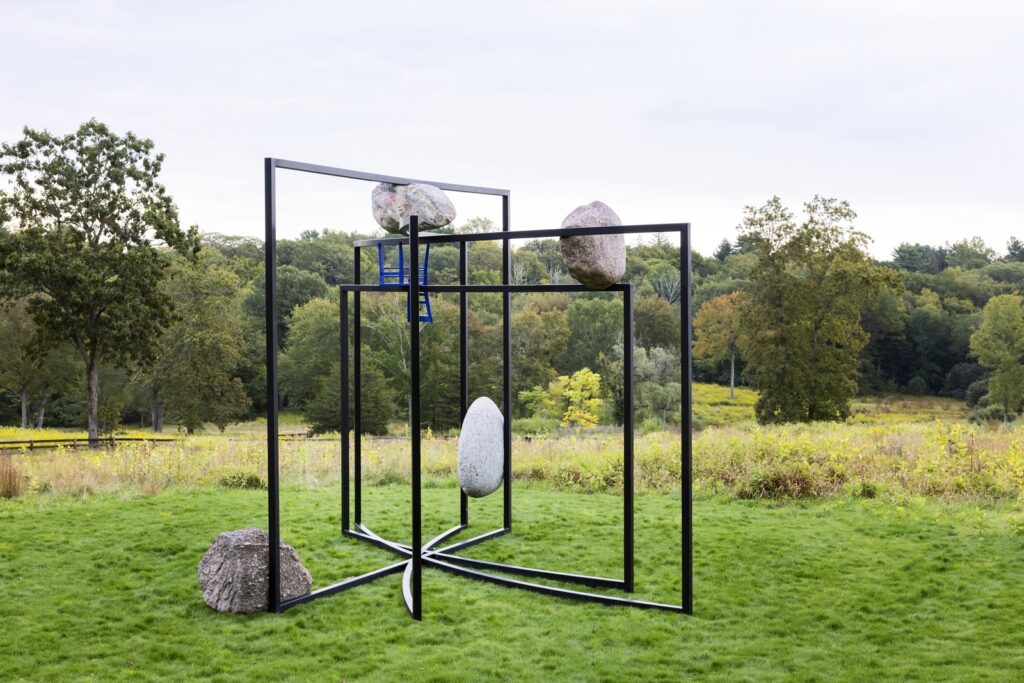
ParaPosition in Grace Farms’ North Field that overlook the expansive meadows and woodlands. Photo by Dean Kaufman
ParaPosition, situated in the north field of Grace Farms — is the highest point of the preserved landscape that overlooks the Sanctuary, acres of natural woodlands and meadows. The glass-enclosed Sanctuary, used for panel discussions, lectures, world-class musical performances, and more, allows for a 360-degree view of Grace Farms nearly 80-acre preserve.
“Alicja’s work packs a wallop. She pushes materials to a limit, working with engineers to the edge of ‘you can’t do that’ and challenging the system … to understand reality.” — Pedro Alonzo, curator
Below are excerpts from their discussion, edited for clarity:
Chelsea Thatcher
One of the aspects that you’ll see here for us sitting in here is the design that Sharon made so that you could have different activities, different audiences experiencing different things, but yet all connected through the glass. So, we’ll be able to see children spreading those wildflower seeds as we start our conversation in here.
Can you explain your initial vision for ParaPosition?
Alicja Kwade
I developed ParaPosition from a series I started about seven years ago.
And I kind of literally tried to work against gravitation, to do the impossible: to bring up things we know as being down. It was also about thinking of the universe, what surrounds us, what flies above us, and where our feet are grounded. I developed it for my mid-career show in the Netherlands, but I was very glad it found a new home.
Because an art piece itself, of course it’s very much differently seen in different environment but still it’s an art piece on its own and I’m very glad how different again it appears in this landscape here.
Chelsea Thatcher
ParaPosition is situated at the highest point of the property, which is open to the sky and cosmos. Our Director of Horticulture, [Kim Kelly and Emily [Altman, Director of Arts Operations, Publications and Exhibits have created an environment where it also feels intimate. You can see butterflies and dragonflies up close yet also have vast views into the landscape.
Can you tell us a little about some of the questions embedded in the sculpture?
Alicja Kwade
Those questions are embedded in myself … It’s more about my thinking and what is driving me — about why things are as they seem to be, what our place is on this planet, and how we navigate within this given system.
I don’t take things for granted. I don’t take them for as normal. For me it’s a constant question: What is my role here? Why I’m here? Why do I believe I am “me”? Why are my feet on the ground?
These questions drive me. And yes, they are in the sculpture.
We are in this “para position” — para comes from an old Greek term, which means we not one line. We are in this very difficult human position that we are here, but we have no clue why and we will possibly never find out.
Chelsea Thatcher
Part of the ethos of Grace Farms is to be a place where you can reflect on those questions. What is a good life? What does it mean to be human? And so we’re so thankful that the sculpture will facilitate that for the public.
And now if we zoom in because you brought us out to sort of the cosmos and the big questions, if we zoom in back to those specific materials a little bit, stone, steel and the bronze. Is there anything else you want to say about stone and sort of the natural material, perhaps even the journey of these stones?
‘“I’m fascinated with the borders between science and suspicion. All the in-betweens … I’m trying to see what reality is for me, and what it is for us all.” — Alicja Kwade, Art Review
Alicja Kwade
I mean they had quite a long journey and this journey started about 10,000 years ago. They’ve been taken from the north of Europe to where I am based in Berlin. So we have a beautiful name for them in German, we call them “flinger,” which means something like a found object because they’re not belonging to this landscape. They’ve been kind of traveling with the glacier 10,000 years ago … And the farmers, they were really finding these rocks on their fields.
where we knew that it was such a match because Sharon started the Design for freedom movement, which is centered on ethical procurement and transparent procurement asking the questions, where do my building materials come from? Where does my coffee come from? Where do my clothes come from? And so when we asked you where your stones come from or steel came from, you had all the answers.
Chelsea Thatcher
Where we knew that it was such a match because Sharon started the Design for freedom movement, which is centered on ethical procurement and transparent procurement asking the questions, where do my building materials come from? Where does my coffee come from? Where do my clothes come from? And so when we asked you where your stones or steel came from, you had all the answers.
Chelsea Thatcher
Is there a significance for how the steel elements fit together?
Alicja Kwade
So I needed something to support them and I tried to do as less as possible. And so this is really developed with the engineer. So it’s kind of the max, minimum you have to do to support those heavy weights. But of course it’s also a formal sculpture and I’m designing how they interfere, how they look like in this case it seems to me it’s like a rotational system which kind of stands still. But it looks like there’s a movement in it.
You recently wrapped up a solo exhibition at Pace with incredible sculptures and last year opened LinienLand at Storm King. Do you think about where your works will live when you’re imagining them?
Alicja Kwade
I have some visions let’s say, but those visions sometimes are quite far away. It very much depends if it’s a commission for a specific place. So of course, then I know where it goes, where it’s going to be installed, what foundation you need. But mostly, I don’t know. A sculpture for me, it’s like a singular creature. So it has to live on its own anyways. It has to function no matter where it is. But as I said before, it’s always a surprise when you see it in a different environment because it becomes something else. It’s not becoming something else, but it just physically looks very different depending in which context, but also the landscape.
Chelsea Thatcher
Do you have any reflections about now seeing ParaPosition from inside here on the [Sanctuary] stage and outside?
Alicja Kwade
What I love about it when you approach the grounds here that you just see the stones kind of above the grass a little bit … I see it is like a stone and there’s a glass, but the stone is flying. I very much love this moment and I’m very glad that it’s a little bit uphill. So when you’re close to this sculpture, you’re able to see the sky through it. So you release those stones almost like in between the clouds kind of floating around … It’s like a surprise because I know the piece, but whenever I am always bit nervous when I see it’s the first time installed because you’re not sure how it’s going to be because it’s different each time.
Chelsea Thatcher
So the theme for this 10-year season is “We all build,” and within this theme is really a celebration of creativity and imagination that’s really radiating inside each of us. And also the concept of we all build connects to the commitment to see an idea through. So I would love to hear, what is it for you, what does it take for ParaPosition to grow from an idea into manifestation?
Alicja Kwade
First of all, it needs many, many people, which is probably not visible in the first moment.
I see my role mostly about convincing. I have to convince people because it’s quite a lot. It’s heavy, you have to carry it, you have to ship, you have to store it. So it’s not something which is so beloved in the first moment. But it’s important to get everybody’s enthusiasm and to group these people and to build an idea, to share this enthusiasm, to make those things happen. And I think it’s important for everything you do in life.
“Few artists aim to make sense of the subjectivity and complexity of time and space quite like the Polish-born, complexity of time and space quite like the Polish-born, Berlin-based artist Alicja Kwade … Her practice, in a literal and figurative sense, is a sense to understand time as a ruler and shaper of our lives and of our world.” — the slowdown
Chelsea Thatcher
Can you talk more about the research process and the elements of curiosity and discovery that might sort of probe you along the way?
Alicja Kwade
I kind of try to look how people are looking on the world and I try to figure out how would they try to get answers … And I think most people know that there is no answers. But I just try to look deeply how philosophers scientists are trying to get there, are trying to get deeper and deeper in, trying to develop more questions from some little answers. And this is what I do. So I would read about things I have no clue about quantum physics, philosophy, all these kind of things …
You started a residency in Rome and you are here at Grace Farms. So can you share just a little bit about your week?
Alicja Kwade
I’m kind of famous for doing 1,000 things in the meantime and I’m driving people crazy about it. So yeah, I just moved to Rome because I have this residency which is going to be for 10 months apparently. And I’m preparing another show in Milano, Italy next week. And then I do another show in Rome in weeks. I am always doing quite a lot of things … I need to do 1,000 things to have one outcome somehow.
Chelsea Thatcher
Is there anything as we’re closing here that you’d like to share with the audience about creativity, about imagination?
For me, creativity or creation, it’s almost everywhere. It’s just something which is only for artists. So whatever you do, I think in life it is full of creativity and it’s full of creation. I think it’s just sometimes hard to see it probably. And I know that not everybody is so privileged to be able to show that and to make its living with that. But I think truly that if you believe in something and you try to be positive about it and you try to gather people together, it is good. And it mostly works out. So I think that there’s more creativity in each job than we see in the first moment. But we are creative animals. This is what makes us human. This is something deeply in human nature and this is probably what makes us so difficult on this planet … I truly believe it’s very much implanted in everyone.
______________________
About Grace Farms
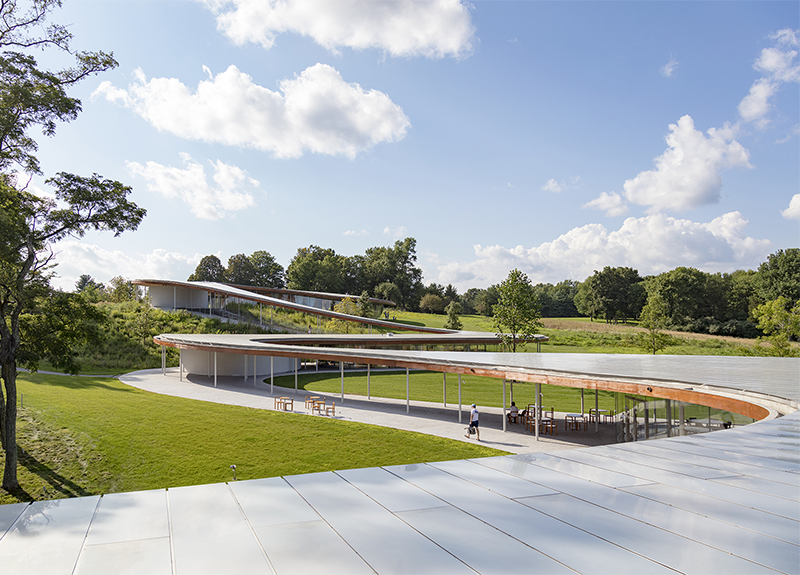
Grace Farms is a cultural and humanitarian center in New Canaan, Connecticut that brings people together across sectors to explore nature, arts, justice, community, and faith at the SANAA-designed River building and Barns on 80 acres of publicly accessible natural landscape. Since opening in 2015, Grace Farms has welcomed 1 million visitors from around the world to experience its unique integration of arts, architecture, nature, and purpose.
As a destination for arts and culture, Grace Farms presents innovative programming in music, visual and performing arts while fostering contemplation and connection through architecture and nature. Its humanitarian work includes leading the Design for Freedom movement to eliminate forced labor in the building materials supply chain and advancing initiatives to foster more grace and peace locally and globally.
The integration of cultural programming and humanitarian action reflects Grace Farms’ collaborative approach to generating new outcomes and meaningful change.
Membership
Grace Farms members can visit without advance registration and enjoy a 20% discount on paid programs, retail, and dining, invitations to members-only gatherings, complimentary events, and a welcome gift from Grace Farms Tea & Coffee.
Becoming a member helps us advance our mission to pursue a more peaceful world and supports the preservation of the River building and its surrounding 80 acres.
For more information, visit gracefarms.org/membership.
Visit our calendar of events to learn more about upcoming programs.
Sign-up for our newsletter
Follow us
@gracefarmsct #gracefarms