
Sharon Prince, CEO & Founder of Grace Farms, Francine Houben, Creative Director and Founding Partner of Mecanoo, and Dorte Mandrup, Founder and Creative Director of Dorte Mandrup Arkitekter, shared perspectives about connecting with people and nature through architecture. The panel was moderated by Julia Gamolina, Founder of Madame Architect. The panel was introduced by Karen Kariuki, Grace Farms Managing Director, Strategic Initiatives, who referenced William Wordsworth’s poem “The Tables Turned. “Come forth into the light of things and let nature be your teacher.”
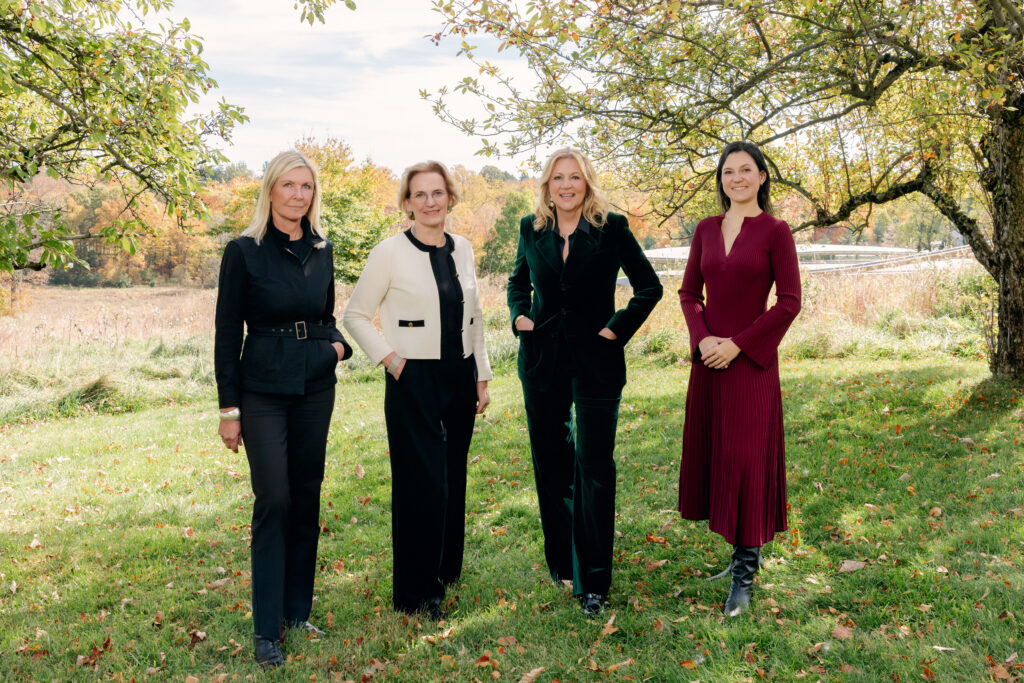
Left to right: Dorte Mandrup, Francine Houben, Sharon Prince, and Julia Gamolina. Photo by Melani Lust
Below is their Q&A conversation, edited for clarity.
Julia Gamolina: Sharon, when you first imagined the River building, which is really embedded here rather than kind of imposed the land, what did you want the relationship between the architecture and the landscape to feel like and what did you want it not to do?
Sharon Prince: I love the question of what you don’t want it to do, which is rarely posed. I did mention that we didn’t ask for a River building. I didn’t want the [River] building to be stagnant. I wanted some of the aspects of the building to be mimicked in nature. This meant creating an ambulatory space where you’re constantly moving, seeing new perspectives, evoking curiosity — that’s important in terms of also having a freedom to discover. In nature, you always have that freedom. At Grace Farms, there’s no front door, so you have the freedom to choose.
I didn’t want the [River] building to be stagnant. This meant creating an ambulatory space where you’re constantly moving, seeing new perspectives, evoking curiosity — that’s important in terms of also having a freedom to discover. In nature, you always have that freedom.” — Sharon Prince
Julia Gamolina: Dorte, how do you decide how much presence a building should have in a landscape?
Dorte Mandrup: We need to acknowledge that when we do build, we do interfere. In that sense, the interference has to be based on what’s already there or enhancing what’s already there. A building should feel like it has a natural purpose. We try to find this balance between what’s there and what’s new and what’s going to be created. It’s also very important that there’s not a duality between nature and culture. We are very much shaped by the nature that we’re in, as well as the culture. There’s a very fluent barrier between the two.
Julia Gamolina: Can you give a specific example where you though you found just the right balance?
Dorte Mandrup: Luliset (Ilulissat, Greenland) is an amazing landscape. There’s a need to bring culture out into nature to make people understand that this is worthwhile keeping. Greenland has the oldest bedrock of the earth; there’s a sense of time here. There’s also the sense that the Inuit culture is not permanent; it’s a nomadic culture. So, everything the Inuit have been doing is to never leave anything behind; there’s tools that have a lightweight sense to them.
We thought that the building is in a way more like a skeleton of an animal or it’s like a skeleton of a tool that has a time span that’s much less than the infinite landscape. In that sense, there is a sense of respect or humbleness because it’s not that our building would disappear in a hundred years, hopefully not, but it looks like it’s kind of temporary.
Julia Gamolina: Francine, how do you translate something as normal and powerful as a natural environment into architecture without simply just imitating what’s around?
Francine Houben: I was born in the south of the Netherlands where there were hills. So, people tell me that I always try to create hills. One of my books is Dutch Mountains. My buildings are Dutch mountains, my personal interpretation. The one in Delft (Netherlands) is a Dutch mountain where Weiwuying in Kaohsiung, [Taiwan], is also kind of Dutch, a new landscape. In Abu Dhabi, also very flat there, we created a kind of mountain of rocks as an experience to go inside the building. It’s an inside, outside feeling. In Delft or in Abu Dhabi we created buildings almost like a landscape or something in between. That’s why I started many years ago to do landscaping as part of Mecanoo’s philosophy (people, place, purpose, poetry).
Julia Gamolina: Sharon, Grace Farms was designed not simply to exist in the landscape to shelter us from the elements. It was also designed to be a place for gathering, for performance, for art, for music. How do you think about architecture as something that can produce culture?
Sharon Prince: Part of the idea for Grace Farms is to create new outcomes and new works and be inspired to do so. You have artists in residence; we have new works that are emerging all the time. And even on this stage when we talk about music and sound, this is the only fully glass- enclosed performing art space in the world. In January, I told Yo-Yo Ma this before coming out on stage. I said, “You better tell me if I’m wrong because I’m going to say this for the first time!” We also started to have a group of musicians who love to be here because as we are sitting here, we can see nature. It really creates a new experience for the musician. The artists are creating new experiences and then we’re putting people in proximity to issues where we want and invite people to be engaged and to have agency, too. That’s very important. The way we describe ourselves is both a cultural and a humanitarian center together, which I think is producing quite a bit.
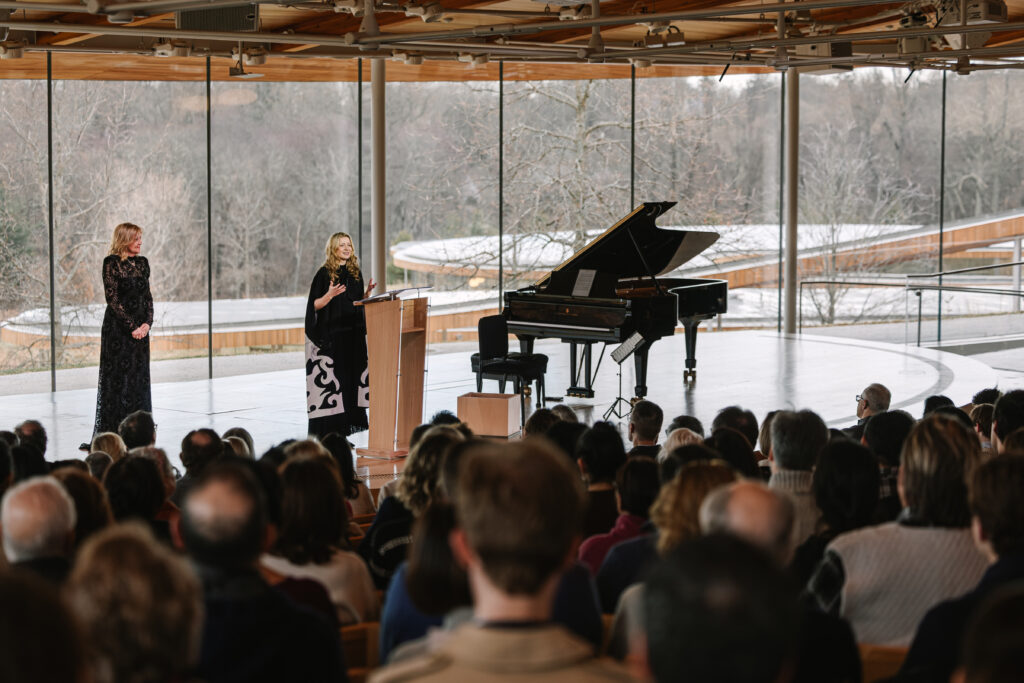
Sharon Prince, left, and Chelsea Thatcher, Vice Chair, Board of Directors, Founding Creative Director at Grace Farms, introduced Yo-Yo Ma, who performed a recital with pianist Solon Gordon in the Sanctuary, the only glass-enclosed indoor amphitheater in the world. The sold-out performance was held in January, 2026.
Julia Gamolina: Francine, you have four principles that guide your work, people, place, purpose, and poetry. What makes architecture particularly poetic to you? And do you think it’s something that we can design for or do you think it’s something that organically happens in a building once people start to use it?
Francine Houben: The poetry was added to the people, place and purpose philosophy because people though the work is very poetic. What I try to do with the work is one part storytelling, but with a personal interpretation. I also really like when people come into one of our buildings — we do many public buildings, often paid by public money — because I want the public to feel that it’s made for them. I don’t know if you’ve been to the New York Public Library, but people really feel this is a presence to the New York people, and it looks different than the one we did in Washington D.C. With the Martin Luther Jr. King Memorial Library, the people really feel the poetry.
Julia Gamolina: Sharon, I think we would all describe Grace Farms as a very poetic place.
Sharon Prince: We opened with a book called and souls are candles. It was a book of poetry instead of a typical architectural book that interweaves nature, arts, justice, community, faith. And we opened every meeting [with a poem] because we were so different. Our team is also so different; poetry was the way that everyone had an entry point into a conversation. And, with poetry, it simplifies the complex or makes you think. And there’s so many wonderful things about poetry that can be very much alive in these kinds of spaces.
Julia Gamolina: Dorte, your background is in sculpture and ceramics. Where is the boundary between architecture as an art form and architecture as something that’s made for human use?
Dorte Mandrup: I don’t think there’s a boundary in that sense. The most exciting thing about architecture is that we actually are caring for human life. I think that art is caring for human life as well. In talking about poetry, there’s a recognizability in somebody recognizing you as a human being: we are alive, we die, we lose people. There’s a whole basic setting around being alive. If you recognize that or create a frame around that, and you’re an artist, you might be able to question things. As an architect, you need to do this in a generous and positive way.
The most exciting thing about architecture is that we actually are caring for human life. I think that art is caring for human life as well. — Dorte Mandrup
Julia Gamolina: Sharon, you mentioned Design for Freedom earlier which asks us to consider another dimension: the human lives behind those materials and the real cost of them. What changed for you when you began asking not only what materials were made of, but who made it and under what conditions?
Sharon Prince: I first want to say that I just love construction, the whole process. As an entrepreneur, I never built a building. But when you build as an entrepreneur, you also create as an artist. In fact, our theme this year is ‘We all build.’ So, everyone builds in a number of ways. There are a couple things I noticed, how sculptural this building is. Also, what was compelling to me is the number of materials. There’s an incredible amount of materials and to create something so light on the land. I never saw a building rendering, only models. So that’s how we worked for two years. That allowed us to work on achieving this 35-page program, all the goals and the vision that we were trying to create and proximities and so forth.
It wasn’t until two years later after we opened that I was on a jury examining another project over in Afghanistan, a girls’ school made from bricks. I thought those bricks were probably made by children. Then I thought about my own materials, I didn’t know where they came from. [We were] talking about food and clothing [being made with forced labor] and we had not thought about shelter. So that’s when anyone who worked on Grace Farms had no choice but to come on board [with Design for Freedom]. Part of the selection process was to really have a team aligned in terms of our values. They jumped on right away and now we have the Working Group, which of course, you are on.
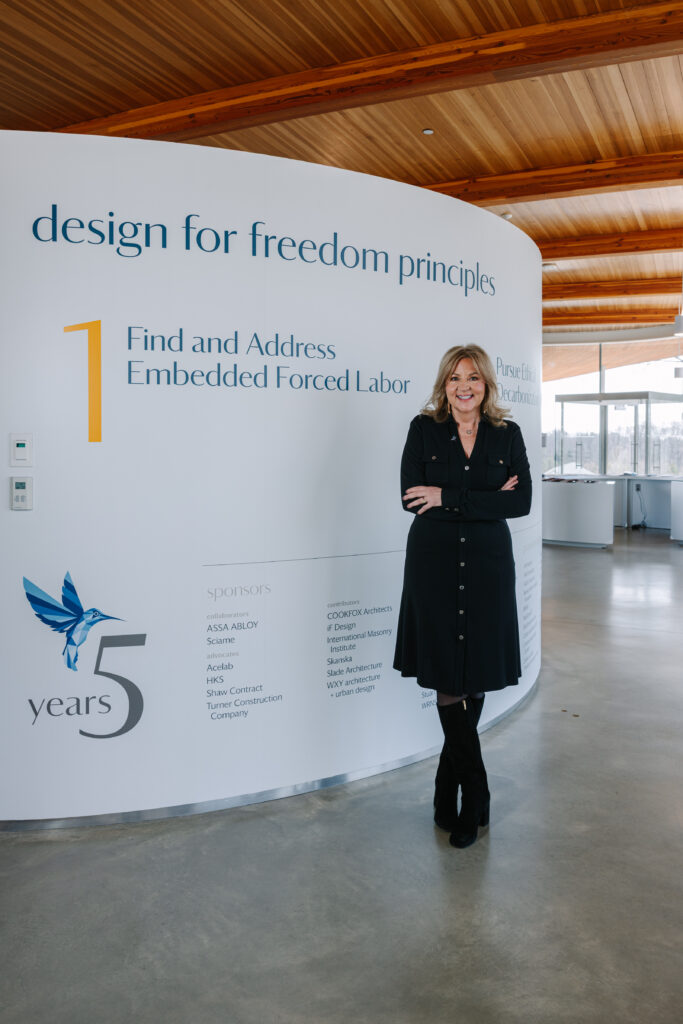
The Design for Freedom Summit brings together world leaders across sectors to address forced and child labor in the building materials supply chain. Photo by Melani Lust
The idea then was to really think about how we can use the full ecosystem of the built environment all at once. Not one of us could change this gargantuan supply chain, but we are making progress. Not only is the whole industry on notice, but now we’re creating institutional responses and everything about us is always about outcomes. We have Pilot Projects around the world, and you can see with our With Every Fiber exhibit what we’re doing. There’s an endless amount of curiosity about where our materials come from; there’s an insatiable amount of knowledge to learn and apply. All of us have an opportunity to engage.
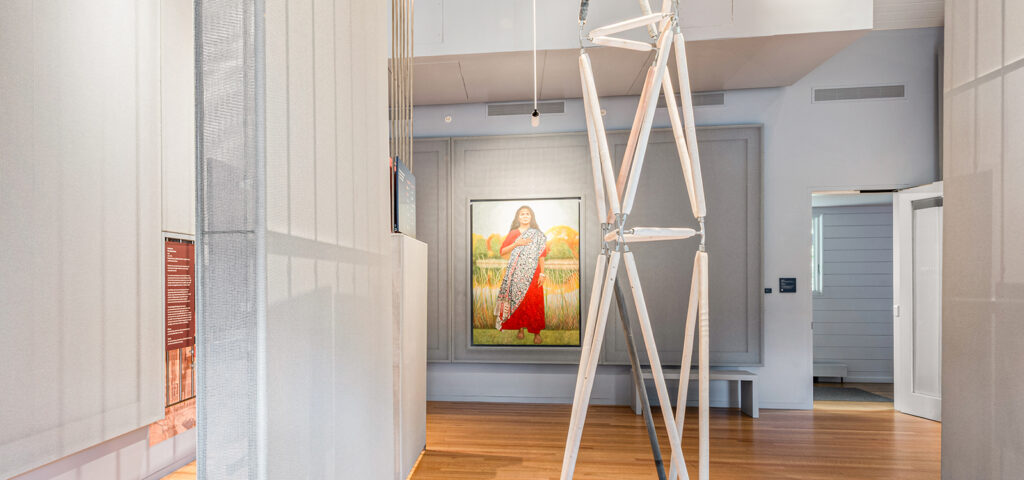
With Every Fiber: Pigment, Stone, Glass, curated by Chelsea Thatcher, Vice Chair, Board of Directors, Founding Creative Director at Grace Farms, demonstrates innovative approaches to ethical sourcing and proves that fair labor practices in the construction industry are within our reach. The stories of these materials are told through a number of newly commissioned artworks in this iteration including a portrait of Nasreen Sheikh, painted by artist Hannah Rose Thomas, PhD and a sustainable prototype for stone truss work demonstrating engineering solutions, designed by Steve Webb, of Webb/Yates, and fabricated by the Stone Masonry Company. Photo by Andrew Werner.
Julia Gamolina: Sharon, you’re touching on something that’s important to me with Madame Architect. To architects, Francine and Dorte, how does that expanded definition of responsibility change an architect’s outlook and role?
Francine Houben:I totally agree with this and there was not enough attention to that. Even the workers on site, they often don’t get enough attention. We also have to think about working on these high-rise buildings with the wind. Is it safe to produce it? We also need to emphasize the craftsmanship of people because we are losing that, and how they are paid. That’s crucial.
Sharon Prince: It’s human dignity, right? So, I photographed every worker on the site. I thought I was making it an honorable environment, too. It is important to honor the artisans and to procure locally and be a part of the community when you’re building.
Dorte Mandrup: The focus on supply chain is important and was an eye opener for me. We work with everything certified, but we all know that there’s something beyond that we cannot control. And I do think that lately I understood that driving an electrical car might imply that you have children working in mines to get the cobalt.
Dorte Mandrup: At least being conscious enough, even though you might not be able to control it, is extremely important. I think it could be added into the tools that we already use. At least in Scandinavia, we are forced to use certain tools to prove our CO2 footprint and you can discuss whether they’re good enough, but I think that supply chain should be the next layer of digital tools.
Sharon Prince: Here’s some good news. We’ve been working for five or six years with the U.S. Green Building Council that issue LEED certifications. We’re the only place in Connecticut that has a dual certification for both how we build and how we operate. And by working together, they’ve now added Design for Freedom principles to their next version five. We worked with AceLab, which is a new technical platform that creates a highway between architects and the manufacturers, and they added Design for Freedom and the principles. And we have our toolkit which identifies certifications. But it’s not all of it. There’s so much more we can do. We’re integrating with leaders and not only certifiers, but other important ways because there’s thousands of materials. There’s no way everyone is going to know where all the materials come from, but we can look at a certain selection with every project and that’s what people are doing.
Julia Gamolina: Francine, staying on the theme of responsibility, you mentioned you work on public architecture that is very often funded by that public. You worked across libraries, housing, and public space infrastructure. Has it changed what you think is most important for architecture to do?
Francine Houben: Of course, you learn every year. I have been working for four decades on the issue of sustainability. And I hope the U.S. will also continue with that.
Sharon Prince: Yes, we’re behind for sure. Europe is farther ahead.
Julia Gamolina: Beyond the four principles, what is your approach to making everyone feel like your architecture is for them?
Francine Houben: I think to be aware that even for instance, if we do libraries, it’s not that I try to make different libraries in one library, different atmospheres, because some people they want to be more impressed, but other people are very shy to enter a library because they feel ashamed that they don’t speak the language that well. So, I really try to make different areas for different kinds of people. For me, that’s very crucial. And my theme from last year, loneliness. I’m very much aware of that. For the youngest generation, loneliness all over the world is a big issue. So, I try especially with public buildings to get a collective feeling, where you’re less lonely and you can sit together. If you ask me what are you doing now? I want to research how I can also help with residential housing, to help with the theme of loneliness.
Julia Gamolina: I have one more follow up question for you. It’s very interesting that you said that within one library, there’s all these different libraries. How do you then create a cohesive whole so that people know that they’re in a space that’s specific to them?
Francine Houben: If you’re on Fifth Avenue (in New York City) there the two libraries. The Stephen Schwartzman Building (flagship building of the New York Public Library) was designed like there was a rich intellectual man with gray hair with all the books around him. All rooms are the same. And that’s not how libraries work; that’s also not how you protect books anymore. So maybe create the opposite of when that library was designed.
Julia Gamolina: Dorte, I would love to hear about your work in places where indigenous communities have been there long before architecture was introduced. How does working with these communities change and influence what you ultimately design?
Julia Gamolina: Anything that especially surprised you or was fascinating?
Dorte Mandrup: What is impressive is the culture’s ability to survive in an extreme climate that nobody else would be able to, because there’s so much knowledge. It’s not about just being a tough guy. It’s about really knowing how to survive. And I think there’s a lot of knowledge here that is getting lost very quickly that is valuable for the rest of the world, too.
Francine Houben: We did Jacob’s Pillow (Berkshire Hills of Western Massachusetts), not so far from here. And we were working with indigenous philosophy and with indigenous people. For me, it was almost like coming home when they explained that architecture should touch all the senses. I always think of north, east, south, west, what is the meaning of that? Where’s the wind coming from? Also thinking what they call seventh generation, which in a way is talking about sustainability.
Sharon Prince: I was going to add too about the Haida people. I learned so much by going to the island that is right off the coast of British Columbia, who have been taking care of the land for millennia. Toshi (Toshihiro Oki, Architecture Advisor, Grace Farms) and I went — you’ll see in our Library two images that were taken on analog film. You can literally feel like you’re touching this old growth, moss-covered forest. It’s stunning and the knowledge they have to take care of the forest is incredible and very visible. But what was really interesting to me as I was leaving, there was a gentleman who’s a bear hunter on the island and I said, “I’m going to go back and we’re going to tell your story for a hundred years because now your beautiful red cedar is now a part of Grace Farms. What would you want me to tell everybody?” And he said, “One of the greatest values that we hold is sharing. We like to share what we have until people take too much.” I was like, “Oh my goodness, that’s all I need to know.” It was incredible.
Haida Gwaii, 2025, featured in our Library. Photos of the trip were taken by James Florio, Grace Farms’ Artist in Residence.
Julia Gamolina: There are two more themes I’d love to touch on before we begin to close. The first is that all three of you are founders. Starting something requires a shift from having a vision and implementing it to then becoming a steward of that vision and building a culture around you that carries that vision over time. Sharon, what’s so interesting about you is that you experience Grace Farms not just as a completed work, but across days and seasons and years. You’re really a steward of this architecture over time. How has that changed how you see the building since it was designed and opened?
Starting something requires a shift from having a vision and implementing it to then becoming a steward of that vision and building a culture around you that carries that vision on over time.” — Julia Gamolina
Sharon Prince: One is when we opened, Sejima (Sejima Kazuyo, SANAA) said we should not take a picture because it’s all about the landscape and the landscape is not mature. I said, “No, we still have to take some photos.” But what you see now is 11 years later and it is flourishing. It is much more mature. You could see over a short time of what nature does, which is so fascinating and beautiful. That’s one. And then the light, because a key part of this experience is to have this hopeful light filled space. And so, this opportunity to have this conversation is always held during the day, and our music is held at sunset. The backdrop changes; nature becomes part of the performance and enhances that experience.
Julia Gamolina: Francine, for your four principles, people, place, purpose, poetry. How do you impart those four principles on the next generation in your studio?
Francine Houben: I’ve written several books and in a way I wrote them for my own staff. The language of Mecanoo isn’t based on a certain architectural language. Of course, you can say it’s poetic or it’s humanist architecture, but I wanted to follow the four principles (people, place, purpose, poetry). It’s much more a philosophy and an attitude to society. I always say I want to be a visionary but also at the same time serve the world. So how to combine that as an attitude. It’s the attitude and the culture in your office, very important. And even if I would not be there anymore, we continue.
The language of Mecanoo isn’t based on a certain architectural language. Of course, you can say it’s poetic or it’s humanist architecture, but I wanted to follow the four principles (people, place, purpose, poetry) … I always say I want to be visionary but also at the same time serve the world. — Francine Houben
Julia Gamolina: Dorte, how do you create a culture where a personal vision becomes collective?
Dorte Mandrup: So how do you carry on without being very personally present? Again, it has to do with values, but also, it has to do with the work method that I really try to discuss and embed into the office, which really has to do with being extremely thorough. You need to be thorough in everything you do. It’s a boring notion, but everything you do and understanding both the technical implications of what you do and understanding where you are. That’s one principle. And then I think there’s also something about integrity that is extremely important to me. We are in a business where you need to keep integrity, otherwise it’s very difficult, respect and curiosity. Then I think people will develop what they think is important in a certain time [even if] I might not personally be there.
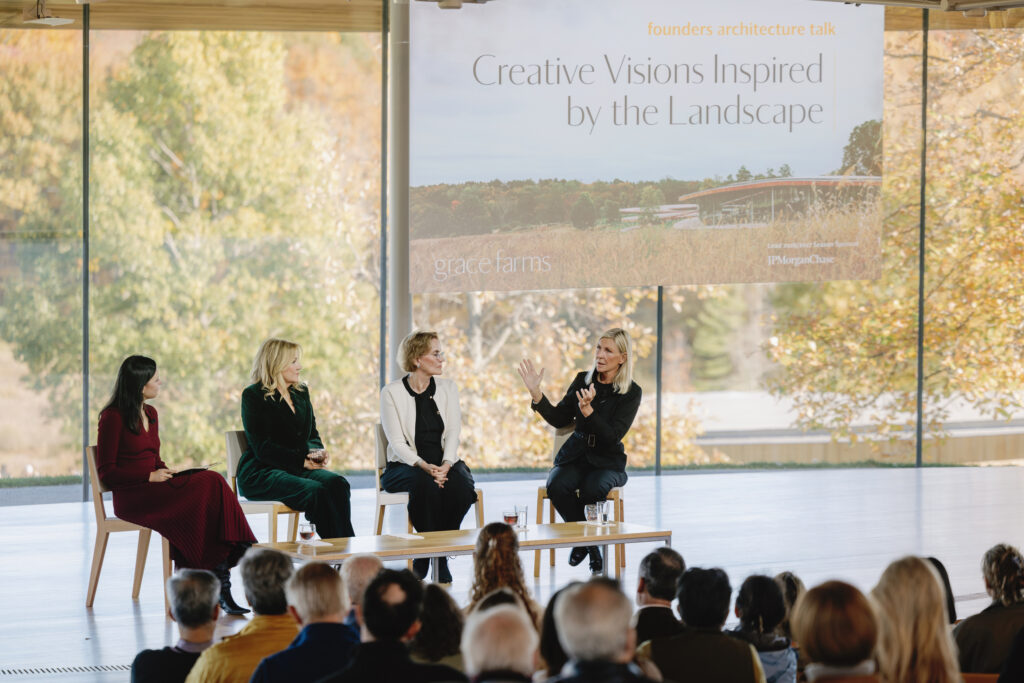
Left to right: Julia Gamolina, Founder of Madame Architect, Sharon Prince, CEO & Founder of Grace Farms, Francine Houben, Creative Director and Founding Partner of Mecanoo, and Dorte Mandrup, Founder and Creative Director of Dorte Mandrup Arkitekter, shared their perspectives about connecting people and nature through architecture. Photo by Melani Lust.
Julia Gamolina: I have one final question for all three of you. We’ve been talking about buildings in relation to people, landscape, and time. We’re currently surrounded by a landscape that’s literally changing before our eyes. It’s been very poetic, but I’d like to end by looking even further ahead. When someone encounters the architecture that you created, say a hundred years from now, what do you hope it tells them about what we valued in 2026?
Francine Houben: Timeless architecture.
Dorte Mandrup: It’s very ambitious to hope this, but I do hope that there is a kind of essential quality to what we do that talks to people’s life in general, no matter where you are technically. If you experience a certain quality of being seen or understood somehow, that would be amazing.
Francine Houben: It’s the timeless beauty. As an example, I happen to know Charles and Ray Eames from a long time ago. And the work is still very popular. You can see that it was designed around the 50s. It’s still beautiful and it’s so loved by everybody. So that’s what I mean with timeless beauty.
Sharon Prince: In the walkway as you come in, if you haven’t seen it, it says, ‘grace and peace.’ It’s intentional so 100 years from now people know when they cross that threshold that the purpose is to create more grace and peace in the world. I expect it will still be relevant 100 or 200 years from now. The values will stay the same, the work will change. Hopefully, we’ll make more progress on these issues that we’re addressing, whether it’s gender equity, racial equity, as well as Design for Freedom. So, hopefully the DNA of the space just keeps increasing over time. And the understanding is when you come here, you might try to be your better self. If you’re nicer to your friends and family, that’s still a win. Or if you take on some of the issues, we hope people will use their agency. That will also matter.
_____________________
About Grace Farms
Grace Farms is a cultural and humanitarian center in New Canaan, Connecticut that brings people together across sectors to explore nature, arts, justice, community, and faith at the SANAA-designed River building and Barns on 80 acres of publicly accessible natural landscape. Since opening in 2015, Grace Farms has welcomed 1 million visitors from around the world to experience its unique integration of arts, architecture, nature, and purpose.
As a destination for arts and culture, Grace Farms presents innovative programming in music, visual and performing arts while fostering contemplation and connection through architecture and nature. Its humanitarian work includes leading the Design for Freedom movement to eliminate forced labor in the building materials supply chain and advancing initiatives to foster more grace and peace locally and globally.
The integration of cultural programming and humanitarian action reflects Grace Farms’ collaborative approach to generating new outcomes and meaningful change.
Membership
Grace Farms members enjoy early access to program registration, a 20% discount on paid programs, retail, and dining, and so much more.
Becoming a member helps us advance our mission to pursue a more peaceful world and supports the preservation of the River building and its surrounding 80 acres.
For more information, visit gracefarms.org/membership.
Visit our calendar of events to learn more about upcoming programs.
Sign-up for our newsletter
Follow us
@gracefarmsct #gracefarms


