
“Reciprocity comes from gratitude and recognizing the world as gift.” — Dr. Robin Wall Kimmerer, Grace Farms Lectures with Concert, March 2026
As our natural resources dwindle and our demand for resources increases, entire industries have had to rethink their approach to extending the life cycles of items typically discarded in the past. From textiles to building materials, industries are taking a circular approach to extending the life of products and materials that would normally end up in landfills. This approach also extends to how we manage the environment around us.
Beyond depleting the Earth’s resources to keep up with global demand, there are benefits to incorporating a circular strategy into caring for the land itself. As part of Grace Farms’ land stewardship plan, the horticulture team looks for ways to apply circularity in preserving natural resources across Grace Farms’ 80 acres. “This applies to our woodland management as well. All trees have a lifespan, some longer than others. Whether due to natural causes, insects, or disease, we value the trees in their senescence (the gradual biological process of aging) as much as when they are vital and thriving,” said Kim Kelly, Director of Horticulture at Grace Farms.
Recently, Kelly and her team began working on ash trees affected by the emerald ash borer to create “architectural snags,” she said, referring to standing dead trees. The emerald ash borer, an invasive wood-boring beetle from Asia, has been responsible for the “death and decline of tens of millions of ash trees in North America,” according to the USDA. The colorful beetle lays its eggs in bark crevices, and when the eggs hatch, the larvae burrow into the tree to feed. This feeding damages the trees.
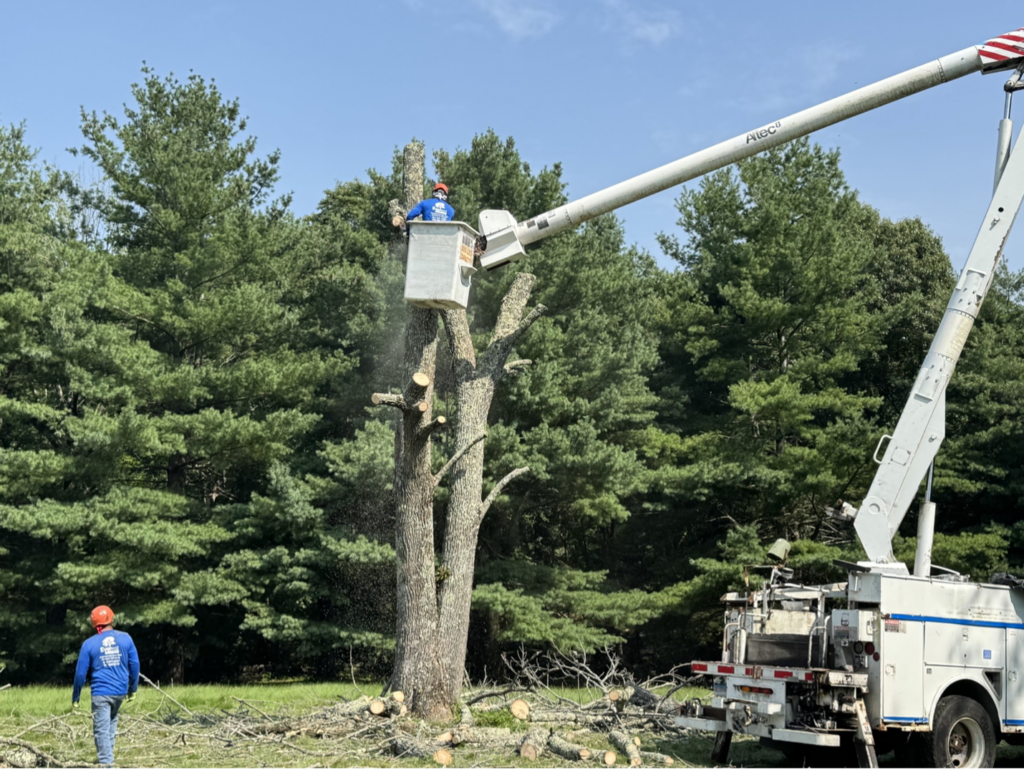
Creating an architectural snag in Grace Farms’ North Field as another example of circularity.
The ash tree supports a “rich and diverse ground flora,” according to The Tree Council, a UK-based nonprofit. “Shed ash leaves retain more nutrients and are recycled more rapidly than those of most other trees … increasing nutrient availability for the mycorrhizal (fungi) and soil communities.” Its berries are a food source for birds and small mammals, while its leaves are an important food source for moths such as the privet hawkmoth and the centre-barred swallow. Mature trees provide nesting sites for birds such as woodpeckers and owls, as well as for some bat species, according to The Tree Council. While caring for these trees is tremendously important given their impact on wildlife and biodiversity, salvaging the remains of a once-healthy ash tree is equally beneficial.
“We work to keep the carbon on site, using all limbs and logs to feed the soil,” said Kelly. To create architectural snags, the horticulture team removed hazardous limbs from the ash trees, leaving the trunks standing to provide nutrients and shelter for a host of animals, birds, insects, and seedlings, as well as fungi, Kelly said. “These standing trees occur naturally in the woodlands and are referred to as snags. Almost every part of a dead tree, at varying stages of decomposition, can be used by wildlife. Snags are used for nesting, roosting, foraging, perching, and territorial displays.”
Primary cavity nesters, such as woodpeckers, excavate cavities for nesting and roosting. However, they use these cavities for only one season, after which secondary cavity users move in, she explained. “These snags naturally decay, attracting insects, fungi, lichen, and moss, eventually replenishing soil nutrients. They can also act as ‘nurse’ logs, allowing new tree seedlings to sprout.”
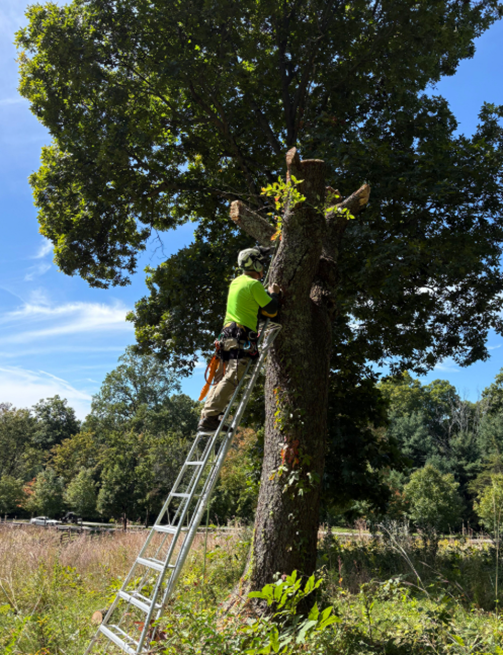
Arborist Chris Roddick working on an ash tree in the paddocks. He uses special tools and saws to create an architectural snag, including a secondary cavity.
Seeing a dead tree left standing in a public or private landscape can seem like a sign of mismanagement or neglect of the property. However, in recent years, designers and environmentalists have been leaving dead trees in plain view, and some are making them centerpieces of landscape design.
Landscape architect and designer Edwina von Gal has touted the many benefits of snags and has included them in her own garden, according to Gardenista. Von Gal, who has spoken at Grace Farms about sustainability, pointed out a decaying tree on her property “with pride, telling the visitors about the snag’s many wildlife benefits.” Designers are also incorporating snags as centerpieces in their exhibitions, while public gardens, such as Sweden’s Gothenburg Botanical Garden, have used snags as art pieces.
Caring for Trees
Our comprehensive tree management program began in 2019. Ironically, the program emerged after our former Director of Operations & Sustainability, Adam Thatcher, noticed that one of Grace Farms’ ash trees had become infected with the invasive emerald ash borer. Thatcher, who is currently the CEO and Co-Founder of Grace Farms Tea & Coffee, said in one of our Perspectives that saving all the ash trees on the property would require a complete inventory of them. “Sharon Prince didn’t want to lose any trees, which resulted in taking preventive measures to protect our trees and ecosystem,” Thatcher said, referring to Grace Farms’ CEO & Founder.
Creating a program to care for more than 2,000 trees representing 50 species has allowed Grace Farms to track their health, identify necessary maintenance, and proactively assess environmental factors that could threaten their well-being, Thatcher said. While the goal is to keep trees healthy and avoid losing them, there is a certain dignity in leaving architectural snags in the landscape, where the trees continue to give back to the Earth. Seeing a tree as a gift — regardless of its stage of life — is perhaps our way of giving back, too.
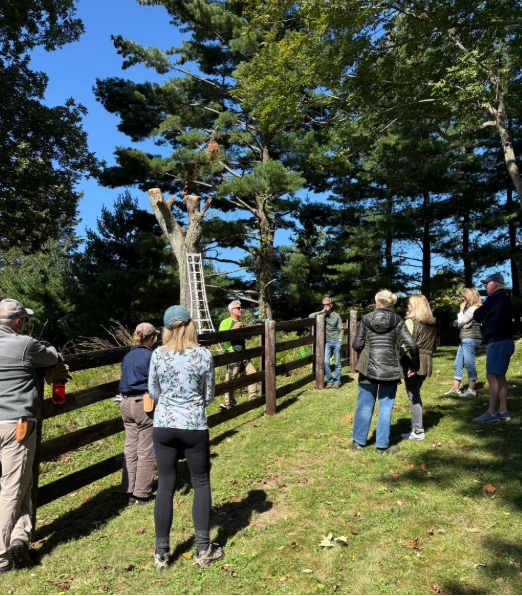
Grace Farms invited colleagues from Waveny Park and the New Canaan Land Trust to observe the process.
Nature Initiative Events
Nature Workshop | Garlic
Saturday, November 7, 11:00 a.m.–12:00 p.m.
Fall is the best time to plant garlic. Grace Farms Horticulture Specialist Michael Poulin demonstrates how to prepare, plant, and care for this common aromatic. Take home a hand-selected head of garlic to plant this autumn for a summer harvest.
Autumn Stroll
Saturday, November 14, 11:00 a.m.–12:00 p.m.
Experience the beauty of Grace Farms throughout every season during a guided walk through the landscape with the Grace Farms Garden Team. This immersive fall outing invites everyone to slow down, notice the shifting signs of the season, and discover the vibrant plant and animal life that makes this landscape so special.
Nature Workshop | Sustainable Holiday Decor
Saturday, December 12, 10:30 a.m.–12:00 p.m.
Make a one-of-a-kind holiday wreath with living plants and other natural materials from the Grace Farms landscape with the Grace Farms Garden Team. Take home your handmade wreath, perfect for the holiday season.
_________________
About Grace Farms
Grace Farms is a cultural and humanitarian center in New Canaan, Connecticut that brings people together across sectors to explore nature, arts, justice, community, and faith at the SANAA-designed River building and Barns on 80 acres of publicly accessible natural landscape. Since opening in 2015, Grace Farms has welcomed 1 million visitors from around the world to experience its unique integration of arts, architecture, nature, and purpose.
As a destination for arts and culture, Grace Farms presents innovative programming in music, visual and performing arts while fostering contemplation and connection through architecture and nature. Its humanitarian work includes leading the Design for Freedom movement to eliminate forced labor in the building materials supply chain and advancing initiatives to foster more grace and peace locally and globally.
The integration of cultural programming and humanitarian action reflects Grace Farms’ collaborative approach to generating new outcomes and meaningful change.
Membership
Grace Farms members enjoy early access to program registration, a 20% discount on paid programs, retail, and dining, and so much more.
Becoming a member helps us advance our mission to pursue a more peaceful world and supports the preservation of the River building and its surrounding 80 acres.
For more information, visit gracefarms.org/membership.
Visit our calendar of events to learn more about upcoming programs.
Sign-up for our newsletter
Follow us
@gracefarmsct #gracefarms


