Introduction
Designed and curated by artists and educators, the Open Arts Studio for Family Programming invites children ages 4 and up to engage in site-responsive, process-driven art experiences with their families. The activities are inspired by the landscape and architecture of Grace Farms as well as concepts that are relevant to its mission. The space of Grace Farms — the SANAA-designed River building and Barns on 80 acres of publicly accessible natural landscape — invite connectedness, contemplation, and creativity. Often beginning with a question, these inquiry-based art-making activities are carefully designed and thoughtfully implemented to provide meaningful and authentic hands-on experiences for children and their families. To register for the Open Arts Studio and other events.
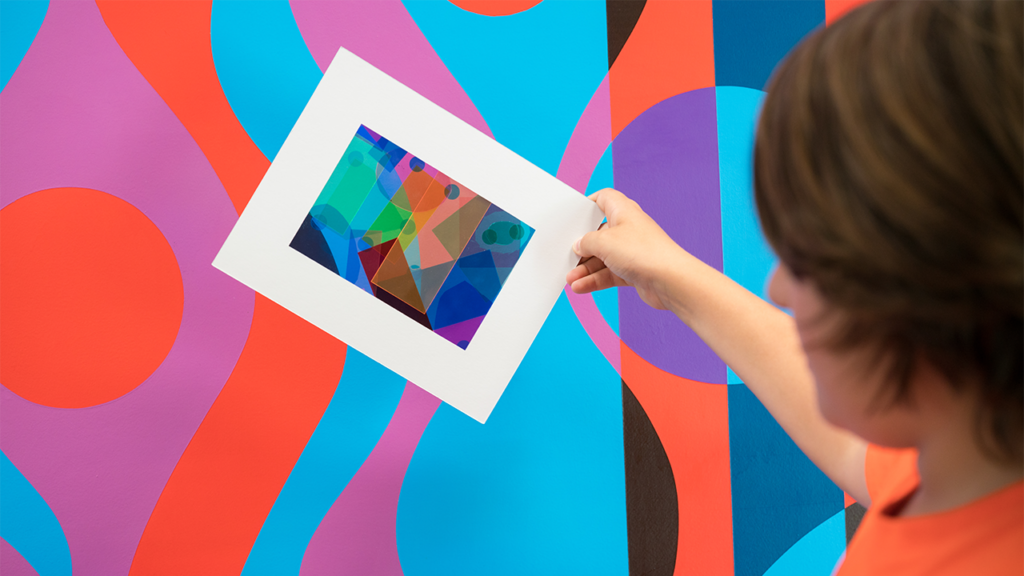
Participants in the Open Arts Studio responding to artist Beatriz Milhazes’ Moon Love Dreaming, 2016, the 108-foot wall mural in the West Barn. Milhazes blends geometric abstraction with floral motifs in this vibrant composition. The work invites a sense of rhythm and joy within the light-filled architecture.
In this Q&A, Anna Marie Greco, Director of Education, Mary Janacek, Assistant Director of Education, and Nancy Jameson, Arts Educator, discuss the unique aspects of this program.
Q: How would you describe the Open Arts Studio Grace Farms for someone visiting for the first time?
Nancy: It’s an intergenerational, sensory-rich, open-ended art experience inspired by Grace Farms, the place, the permanent artworks, natural landscape, and the work of the cultural and humanitarian foundation. The programs are for children ages four through 11 and their adult caregivers.
Mary: One of the best things about it is that you can sign up for this art class without having to sign up for a series. It is a wonderful resource for families whose children love to make art, because they can work it around their schedules. While the projects also change monthly, children can join any time and not feel they’ve missed out on learning given the way it’s structured. Of course, we do have a lot of first-time visitors, a lot of families visiting from far away. The Open Arts Studio is a lovely way for them to engage with artmaking while learning more about Grace Farms.
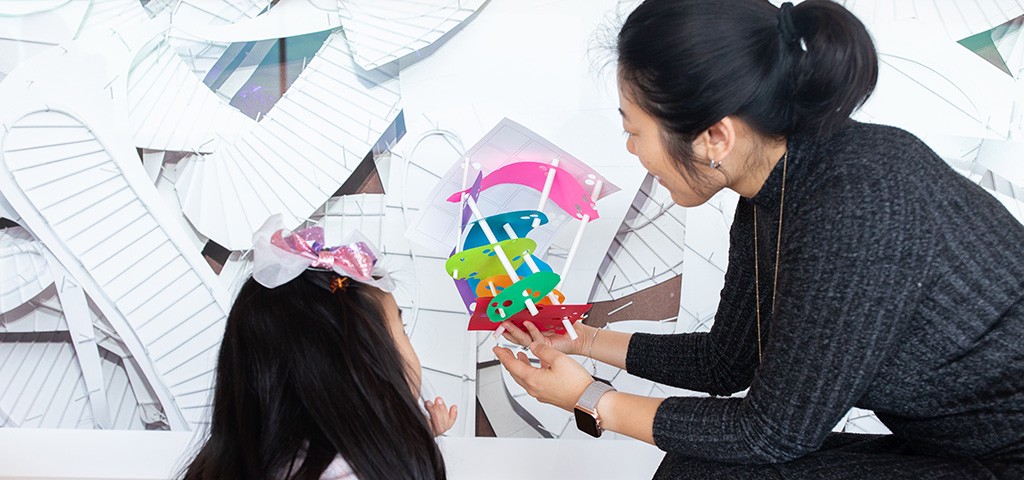
Thomas Demand’s Farm 56, 2015, a large-scale photographic work that shows the iterations of SANAA’s architectural models for Grace Farms’ River building. In the Open Arts Studio, children learn more about the design and the River building’s architecture.
Nancy: It is a drop-in art experience facilitated by a seasoned early childhood educator. And to Mary’s point, it is a great resource for families in the area who are looking for an occasional art experience without signing up for a four- or six-week class.
Q: Do some families come to Grace Farms and discover the Open Arts Studio?
Nancy: Yes, a resounding yes! In fact, we have some families who come to Grace Farms and typically head straight to the Court. When they discover the Open Arts Studio, it adds a whole other dimension to their experience and then they, of course, stay on site longer.
Mary: While some families who live in the area come every month, there are a lot of families who visit for the first time. Maybe they looked at the website before and booked a ticket to the Open Arts Studio. Others will come into the room and wonder, “What are you doing today?” That brings more children and families into the studio.
Anna: The program is offered for a range of time throughout the day. This offering hopefully works with family schedules and allows for flexibility during a visit to the site. The hope is that this will remove a barrier for participation as there is no set start time.
Mary: Also, we have a lot of families who will come who have older kids. They might do something else with one parent, while the other attends with their younger children. So, it’s nice when a family comes with children of different ages and interests because there’s something for everybody at Grace Farms.
Q: What would be an example of a prompt?
Nancy: The prompts are designed to invite inquiry. So, when participants are asked, “What happens when you look at the same object from different perspectives?” they are invited to think, explore, and discover. In this example, perspective can go into more cerebral interpretation. It invites children of all ages to think and observe in different ways.
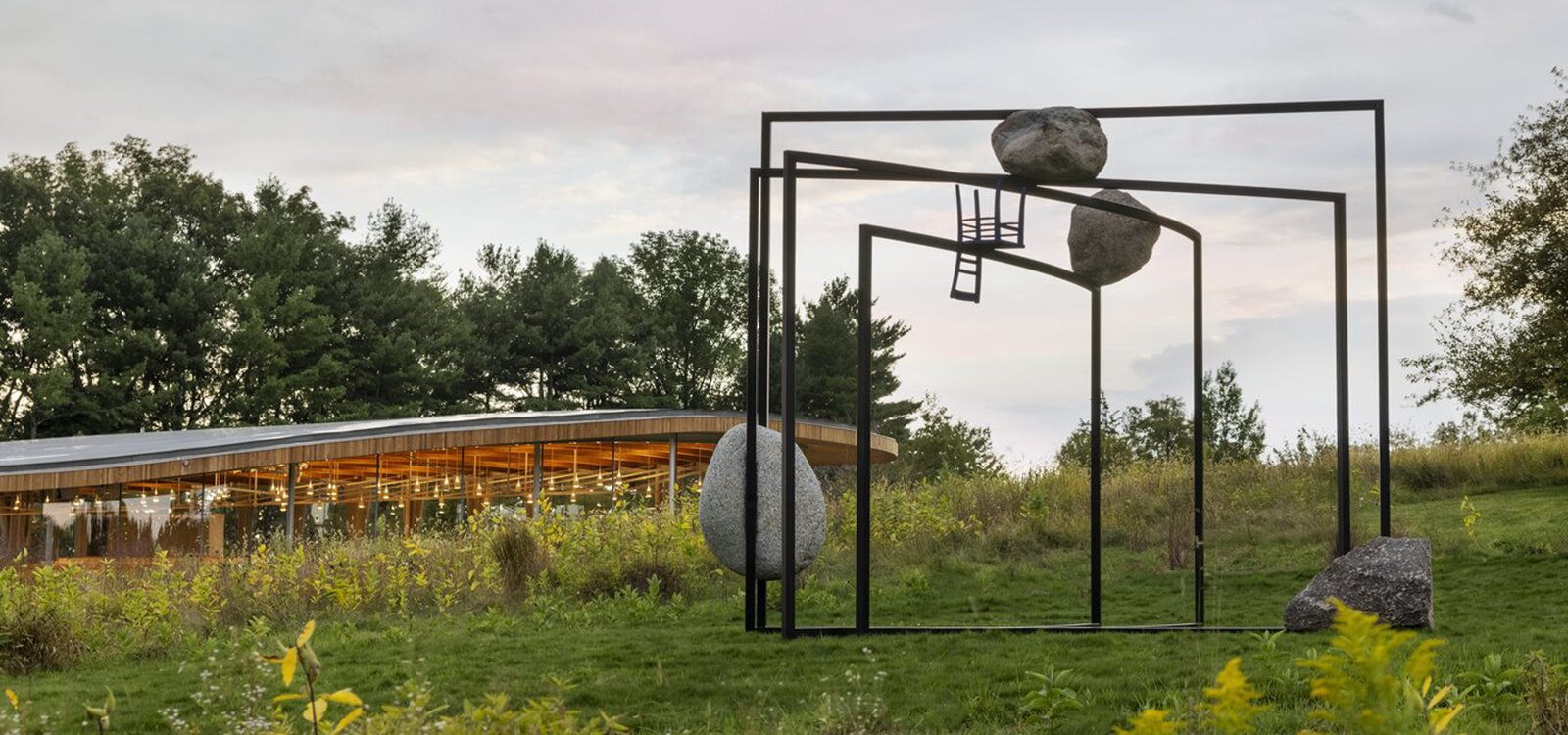
Alicja Kwade’s ParaPosition, 2025, located in the North Field near the Sanctuary. ParaPosition’s array of steel and stone draws viewers into the frame of this massive, yet fragile, universe. The substantial stones, with their immense weight, appear to defy gravity in an almost weightless balancing act. The chair beckons viewers to reflect on our relationship with the world and contemplate the fundamental nature of our existence. Photo by Dean Kaufman
Mary: Right now, we’re responding to Alicja Kwade’s sculpture, ParaPosition. Visitors are invited to look at the SANAA Armless Chairs (bunny chairs) and draw what they see from different angles. It maps nicely to the upside-down blue chair in Alicja Kwade’s sculpture. They can learn to see something differently, akin to how the upside-down blue chair is asking us to consider points of view. We can also use this exercise with younger children through finding a simple question we know they can respond to.
And within that project, there’s still some very traditional informal art making practices. It’s a still life. You’re looking at a chair from different perspectives, but you are drawing a chair, which if you were to go to a formal drawing class, you would do still lives. But the way that we’ve interpreted that is you draw it from different perspectives on translucent vellum paper and then layer it. The final artwork is an abstract image of all the different perspectives layered on top of one another.
Q: Has anything ever surprised you in children’s responses?
Mary: With every project that happens here, Nancy wants to have an element of surprise and delight. For this month’s project, because they’re doing these drawings on translucent vellum, she brought in a light table. When they’re all done, they put their drawings on a light table to see it glow. She always tries to incorporate surprise and delight. I was talking to Anna about this earlier and I think that this grew out of the Practicing Joy series. Nancy then made that part of every project, giving children the opportunity to explore joy.
Nancy: You have an idea of how things will play out, and children take it to another level. It is a thrill for adults, parents, and educators. In an architecture inspired workshop, a group of children came together to build a bus. It was a beautiful, spontaneous moment of collaboration amongst several children of varying ages. To see them coming together around the proposition, “We all Build,” was a surprise and delight.
More than once, I have heard children in the Arts Studio say, “I have never done this before!”
Anna: You created a project, and they expanded it to include the room, the bunny chairs, the architecture.
Q: So, you are creating this space for perspectives and interpretations, as well as employing Grace Farms’ artwork, too?
Anna: One of the reasons that I love this program is the multiple lenses we use, including our mission and values. Grace Farms Foundation has six values; one of them is new outcomes. I feel with the arts and open-ended art projects they’re all new or unexpected outcomes. Through the lens of an art project participants are playing, exploring, and reworking the materials. We don’t have a final product in mind, and so it ties nicely to the mission and values of Grace Farms.
Q: It’s supporting the individuality of each participant?
Mary: Right. We were talking about this earlier that we like the idea of not doing it the perceived right way. Nancy really embraces that concept and that this is a good place to make mistakes, to do things differently, you know?
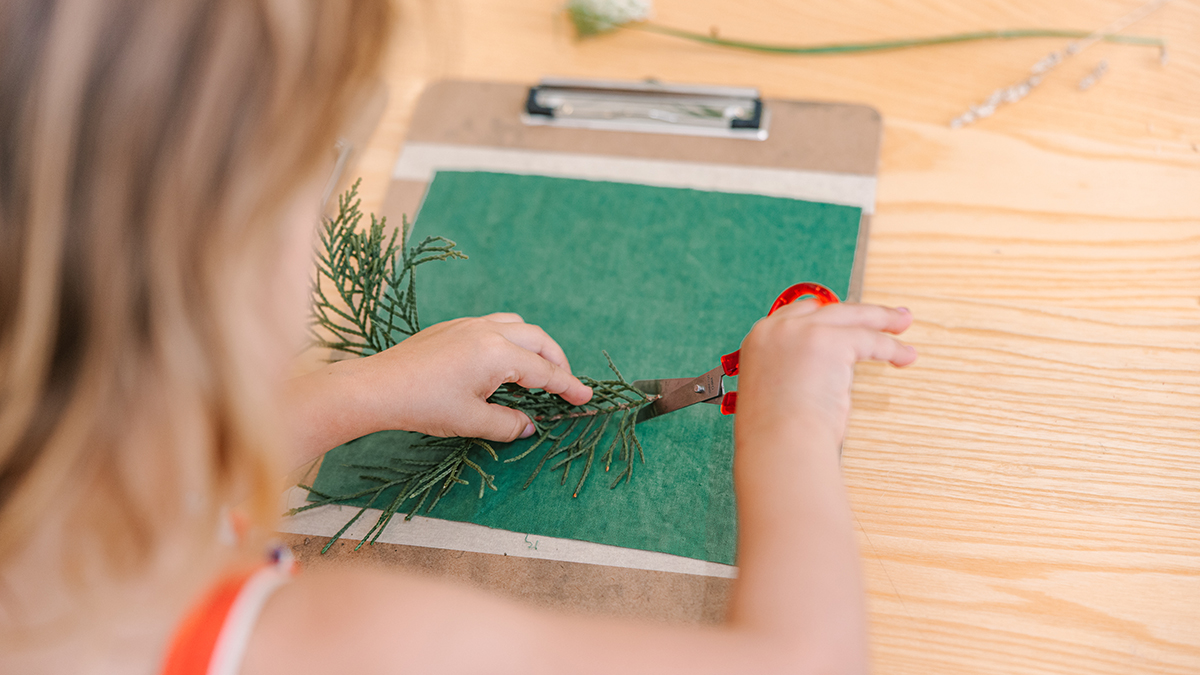
Nancy: It is in real time. This process unfolds in remarkable ways, even if it is a toddler using a glue stick or scissors for the first time. There are a lot of firsts in this room. To help child use scissors for the first time is a joy because it is a simple tool that they will use for years to come.
Anna: It is creative problem solving through the lens of art, creation, and making. It is also an exploration of how you transform an idea into an object, test that idea, and see how it works. Each participant creates a unique piece in response to the prompt.
Q: Through this process then, children can start developing artistic skills?
Mary: Yeah, exactly. And I think that was part of the foundation of this program. It wasn’t just that kids would come in here and learn to draw or learn color theory. It’s absolutely part of it. But it’s also the culture of Grace Farms; what can we do here and nowhere else? And part of what they’re coming here to do is not just learn about art, but they are coming here to learn about architecture. What a unique thing for kids to get to learn about, including the landscape and the environment.
Nancy: Artistic skills and making their mark. Mark making is such an important part of self-expression. With practice, it becomes a part of artistic expression and symbolic drawing. I invite them to take home the ideas. This becomes a springboard for creativity on a continuum. Younger children are introduced to concepts that build into higher learning about architecture.
Q: For example, you can bring the class to the Grace Farm Garden or use elements from the landscape to create. Right?
Anna: Yes, a current example is that Kimberly Kelly, our Director of Horticulture, is growing pigment plants. As these plants are ready, we’ll harvest them to create pigments. When you come into the Arts Studio to do a painting project, there is then the invitation to go to the garden and see where these colors came from, and you can have a multi-layered experience and see the path a pigment took from the garden to a piece of paper.
Nancy also applies Design for Freedom principles to all the materials that she uses, considering sustainability and circularity. Those are all, again, foundation values.
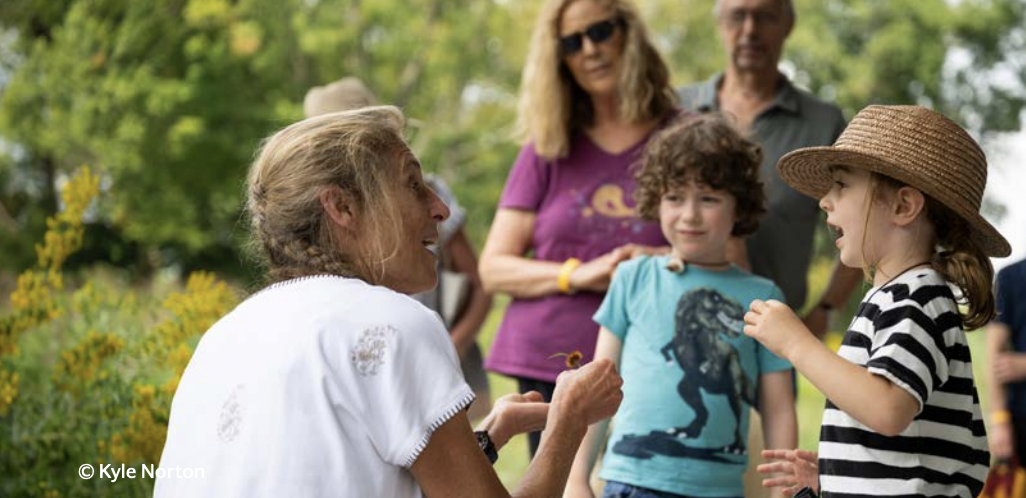
Kimberly Kelly, our Director of Horticulture, as well as the Education Team, often lead tours in the garden and around Grace Farms’ nearly 80 acres, teaching them about the magic of growing and caring for plants and the environment.
Q: Why is it so important right now, particularly for young people to have access to artistic expression?
Anna: Mary touched on this too, the interdisciplinary nature of it, and the fact that we talk about landscape and we talk about architecture and the arts. One of the trends that I have seen in education is people picking subjects earlier and earlier. If you’re going to take art classes, you’re going to take formal art classes and be an artist, or if you’re going to do mathematics, and so on. There seems to be specialization much earlier, whereas this program, it is really about an interdisciplinary approach and keeping all these different subjects together and seeing how they relate to one another.
It also might spark a curiosity which allows them to pursue something that’s unexpected.
Mary: Across our programs, people who come here are looking to interact with people, they’re looking to get off the phone, they’re looking to explore materials, they’re looking for these sensory-rich experiences. And I think what’s been so interesting to me, is seeing how the kids come here and really unplug. They are enjoying themselves and making art.
Nancy: Children are driven to create. In one way or another; it is their way of asserting themselves and making sense of the world.
Q: And a chance to interact with each other, too?
Anna: Typically, it’s maybe two or three family groups coming together at a table and sharing materials and getting to see one another’s projects. And that’s why because of the open-ended nature of it, you could come in and someone’s a little bit further along in the project and you can see how, again, they’ve addressed the question or they’ve worked with the materials and just have that social interaction is a part of it. You don’t have to sit there and listen to somebody give you a lecture.
Nancy: I just think we are looking to connect. We often have people who are new to this community, and it brings people together in a relaxed way.
Q: And then the parents or the caregivers get to interact too. Right?
Anna: I think that’s one of the surprising things too that we were mentioning is a lot of adults do arrive expecting that the child is going to do the activity and then they wind up participating as well and helping and being a part of it.
Q: In terms of this shared creative space you’ve created, how does this differ from traditional classrooms?
Mary: We were talking about this earlier, Nancy has a history of teaching in a more structured classroom environment and classroom management. She can structure the space in ways that make sense, like making sure that people have the materials they need and the time to engage in a project at various stages. She brings her classic training as a teacher yet creates a very open-ended style of creating and learning.
Everyone really needs to know what to do, because without any rules it would be chaotic. A certain amount of structure is needed to bring people and children together to create.
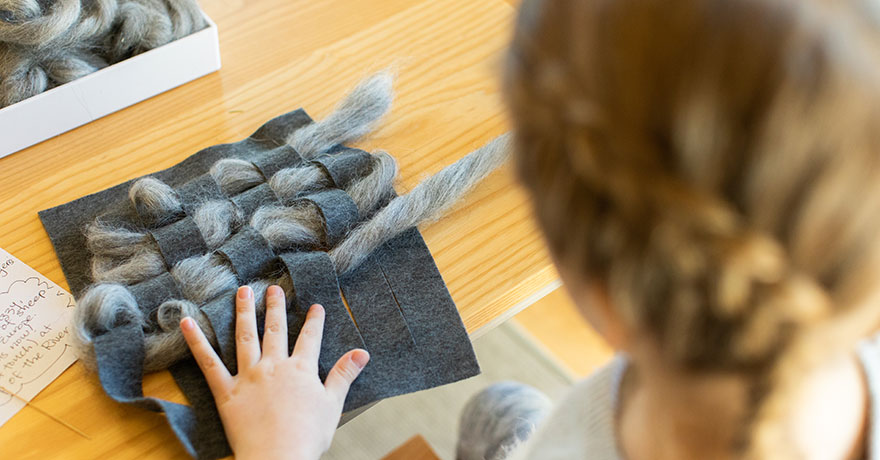
A River building inspired arts project.
Q: What surprises you most from these programs?
Mary: So many people come to Grace Farms and for some if it’s their first time coming. Our art programming for children and their families or caregivers, is lovely introduction to Grace Farms.
Anna: For me, because my background is in the museum field and I’ve worked in contemporary art museums as well, the arts are usually rooted to an exhibition or to a specific artist. Here, we’re embracing art as an open-ended project where the kids are allowed to explore. At the end of the day, we just want the kids to have a better understanding or families to have a better understanding of what they’re seeing around them in the space, whether it’s an art installation or an architectural building.
I also think our programming is unique in aligning it with what’s happening here.
___________________
About Grace Farms
Grace Farms is a cultural and humanitarian center in New Canaan, Connecticut that brings people together across sectors to explore nature, arts, justice, community, and faith at the SANAA-designed River building and Barns on 80 acres of publicly accessible natural landscape. Since opening in 2015, Grace Farms has welcomed 1 million visitors from around the world to experience its unique integration of arts, architecture, nature, and purpose.
As a destination for arts and culture, Grace Farms presents innovative programming in music, visual and performing arts while fostering contemplation and connection through architecture and nature. Its humanitarian work includes leading the Design for Freedom movement to eliminate forced labor in the building materials supply chain and advancing initiatives to foster more grace and peace locally and globally.
The integration of cultural programming and humanitarian action reflects Grace Farms’ collaborative approach to generating new outcomes and meaningful change.
Membership
Grace Farms members enjoy early access to program registration, a 20% discount on paid programs, retail, and dining, and so much more.
Becoming a member helps us advance our mission to pursue a more peaceful world and supports the preservation of the River building and its surrounding 80 acres.
For more information, visit gracefarms.org/membership.
Visit our calendar of events to learn more about upcoming programs.
Sign-up for our newsletter
Follow us
@gracefarmsct #gracefarms