Four New Design for Freedom Pilot Projects Announced
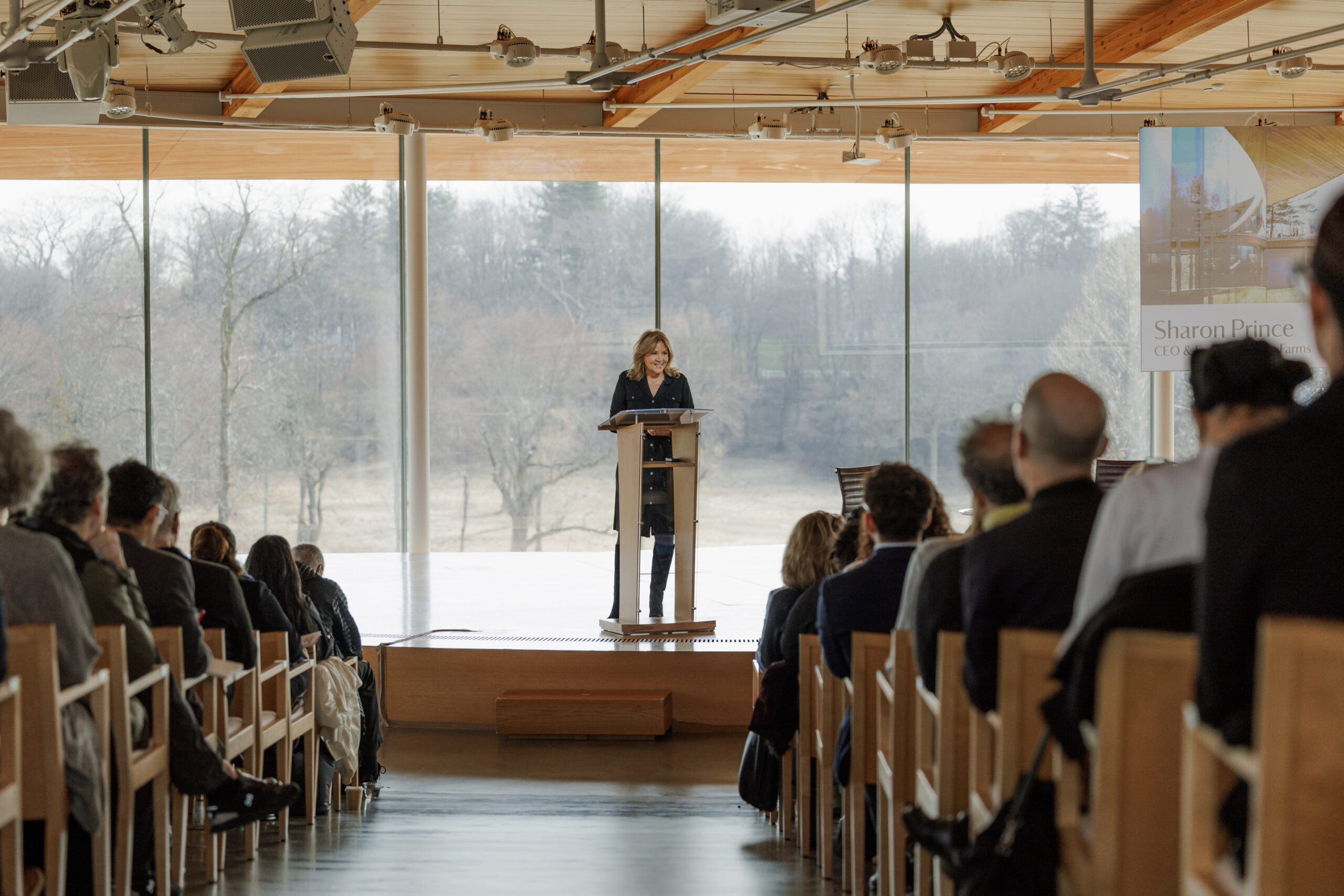
Sharon Prince, CEO and Founder of Grace Farms, opens the Design for Freedom Summit, welcoming over 550 industry leaders across sectors from around the world, as well as students and professors from leading universities. (Photos by Melani Lust)
The Design for Freedom movement reached a new milestone yesterday as Grace Farms hosted its fifth annual Design for Freedom Summit, convening leaders from architecture, construction, technology, manufacturing, academia, and government to advance the global push toward a more ethical built environment. The day-long summit brought together voices from across sectors to tackle some of the built environment’s most pressing challenges, including U.S. foreign policy and how it can be used to help end forced labor, ethical sourcing for data centers, material circularity in construction, the narratives of monuments in underrepresented communities, and ethical decarbonization.
Reflecting the movement’s growing reach, Grace Farms announced four new Design for Freedom Pilot Projects, including two international projects. Grace Farms also recognized student leaders who won the 2026 ACSA Design for Freedom Competition for architecture students. More than 550 leaders attended this year’s Summit, as well as students from 21 colleges and universities nationally.
Featured speakers included Sharon Prince, CEO and Founder of Grace Farms; Ambassador Cindy Dyer (ret.), Former U.S. Ambassador-at-Large to Monitor and Combat Trafficking in Persons; Dave Wildman, Global Head of Data Centers of Infrastructure & Workplace Sustainability at Bloomberg; Jha D Amazi, Principal, MASS Design Group; architects Toshiko Mori and Kai-Uwe Bergmann, Partner, BIG.
Sharon Prince, CEO and Founder of Grace Farms, said, “Five years ago, we asked a simple but urgent question: what if the buildings we design and inhabit were built with the full dignity of every person who harvests, mines, and processes the materials that make them possible? Today, that question is a global movement. This is our moment. The construction industry is now positioned to become a global leader in supply chain transparency and human rights.”
The Summit began with a welcome address from Sharon Prince, who then joined Ambassador (ret.) Cindy Dyer to discuss the impact of U.S. foreign policy on forced and child labor.
The panel on Ethical Sourcing and Circular Construction in Datacenters was moderated by Grace Farms’ Ethical Materials Director Nora Rizzo and featured Miranda Gardiner, Executive Director at iMasons Climate Accord; Dave Wildman, Global Head of Data Centers of Infrastructure & Workplace Sustainability at Bloomberg; and Noah Goldstein, Sustainable Construction Lead – Data Centers, Google. The panel addressed the challenge of reconciling AI and digital infrastructure growth with responsible sourcing practices.
Nora Rizzo said, “There is great opportunity, but also significant risk associated with the rapid expansion of AI and digital infrastructure. Collectively we are managing one of the most complex and high stakes supply chains on the planet. How do we get this right?”
Grace Farms Founding Creative Director Chelsea Thatcher and curator of With Every Fiber, the Design for Freedom exhibit at Grace Farms, moderated a discussion with artists whose commissioned work is featured in the newest iteration of the long-term exhibit, including artist and Ohio University professor John Sabraw, Studio Cooke John Principal Nina Cooke John, and Webb Yates Engineers Director Steve Webb. The panel explored innovations in pigment, stone, and glass and how advances in these materials open possibilities for more ethical and sustainable sourcing.
Chelsea Thatcher said, “With Every Fiber is the first and only permanent exhibition dedicated to Design for Freedom. It is a space curated for presence and attention, where materials rotate to reflect both urgent challenges in the building materials supply chain and innovations advancing more ethical, sustainable practices. The exhibition has expanded from a focus on timber, textiles, and concrete into pigments, glass, and stone, deepening a dialogue around circularity, reuse, and the intersection of ethics and innovation.”
Other highlights of the day included separate performances by GRAMMY©-nominated drummer Jake Goldbas and violinist Ana Isabella España, presented in collaboration with Sphinx Organization. Grace Farms Tea & Coffee CEO & Co-Founder Adam Thatcher spoke about their signature ethically sourced teas and coffees, which give 100% of profits to support Design for Freedom. Later this spring, Grace Farms will open its first public café at JPMorgan Chase’s new global headquarters in Manhattan. Participants also were able to enjoy a tea service, arts and architecture tours, a timber materials talk, and a discussion about the Indonesia Rest House Project with Hayes & James Slade, Founding Principals, Slade Architecture.
Breakout sessions and workshops explored prison labor in the U.S., global policy responses to child labor and worker exploitation, and included the screening of two films, Dancing Trees and Søren Pihlmann: Make Materials Matter, that opened the Humanity in Architecture Film Festival earlier this year.
The day also featured a talk led by Jha D Amazi, Principal, Public Memory & Memorials Lab, MASS Design Group, about expanding public narratives to represent communities long excluded from U.S. memorial landscapes.
The final discussion of the day on Cultural Context and Risk in the Global Timber Supply Chain was presented by Kai-Uwe Bergmann, Partner, BIG, who highlighted BIG’s award-winning Gelephu Mindfulness City project in Bhutan; Gustavo Ferroni, Program Manager, The Freedom Fund (Brasil) who brought in a perspective from the Amazon wth a focus on what we can learn from indigenous communities; and a global forest view provided Toshiko Mori, Principal, Toshiko Mori Architect PLLC, and architecture professor at Harvard University Graduate School of Design; and Sharon Prince. A new book, Spatial (In)Justice, published this week, features contributions by Sharon Prince and Design for Freedom Working Group member Katie Swensen of MASS Design Group. Prince’s chapter focuses on Western red cedar that was ethically sourced from Haida Gwaii in British Columbia and used in Grace Farms’ fascia. Taan Forest, from which the Western red cedar comes, is featured in Grace Farms’ new photographic artwork, Haida Gwaii, 2025 by James Florio.
Dr. Mae-Ling Lokko, Founder, Willow Technologies; Assistant Professor, Yale School of Architecture; and Assistant Director, Yale Center for Ecosystems + Architecture (Yale CEA) spoke about Material Innovation and how more ethical building is possible by using bio-based materials. Yale CEA brough the Carver Color Lab to Grace Farms as part of the Summit, offering attendees a chance to explore the development of natural, healthy colorants for the built environment.
At the Summit, new Pilot Projects were announced. Design for Freedom Pilot Projects are integral to the movement, acting as models for more transparent and ethical supply chains. Each year, Grace Farms selects and works closely with a small number of projects designed by leading architects to develop innovative research and advance responsible sourcing. Each project generates its own outcomes and research, creating ripple effects throughout the market and telling the story of an industry challenging established thinking to bring a more humane future into view. There are now more than a dozen Pilot Projects across four continents.
The newly announced projects are:
- National Juneteenth Museum (Fort Worth, Texas)
The National Juneteenth Museum will be the epicenter for the education, preservation and celebration of Juneteenth nationally and globally, hosting exhibitions, discussions, and events about the significance of African American freedom. The new building is designed by Bjarke Ingels Group (BIG), Alligood Song Architecture and architect-of-record KAI Enterprises.
- Bloomberg Park Avenue Office Expansion (New York, New York)
Designed by Fogarty Finger and with Socotec as sustainability and advisory partner, the expansion of the company’s Park Avenue Office will create a healthful and inspiring space for Bloomberg employees to gather and collaborate. It demonstrates how Pilot Projects translate principles of integrity into practice, delivering real value in the workplace while illuminating the potential to scale this work across Bloomberg’s broader real estate and property management portfolio.
- National accessArts Centre (Calgary, Canada)
The National accessArts Centre is Canada’s oldest and largest disability-arts organization, supporting a growing community of more than 400 artists through training, creation, and exhibition opportunities across multiple disciplines. Their new pavilion, the Multidisciplinary Disability Community Arts Hub, will be a home for the performing arts that approaches disability arts as a central force in cultural life. This zero-carbon building is designed for rehearsal and incubation, with public-facing spaces that bring the neighborhood into the campus, and the campus into civic life. The project is designed by DIALOG.
- Médano by Viñoly (Montevideo, Uruguay)
Médano by Viñoly is a sustainable beachfront residential development designed by Rafael Viñoly Architects. Positioned behind coastal dunes, its elongated, sinuous form follows the natural topography, preserving the character of the coastline while minimizing its visual presence and framing views of the Atlantic Ocean and a northern lagoon. Stretching 425 meters along the shoreline, the low-lying “landscraper” comprises approximately 120 terraced residences. Conceived as a Nearly Zero-Energy development, the project integrates passive design strategies, renewable energy systems, and generous indoor-outdoor living. This is the first Pilot Project in the residential market and in South America.
Student winners of Grace Farms and the Association of Collegiate Schools of Architecture (ACSA) Design for Freedom | Ethical and Equitable Materiality to End Forced Labor student competition were also announced. The competition reached over 300 students and faculty worldwide. Participants proposed ways architects can eradicate forced labor from the built environment. Student winners recognized at the Summit by one of the nine jurors, Madame Architect’s Founder, Julia Gamolina.
Winners in the Design Project category were:
First Place: Peace Museum – Beyond the Scars
Nidhi Naik & Shamita Shyam Honawar, University of Illinois, Urbana-Champaign
Second Place: Patches in Waiting A Shelter for Equity and Material Justice
Leonor Aguero Vivas, University of Calgary
Third Place: Modular Housing for Material Justice
Sofia Ramirez, University of New Mexico
Winners in the Materials Research category were:
First Place: Unmasking Greenwashing: Creating an Ethical Timber Supply Chain
Natalie Darakjian, Noelle Osborne & Reed Wilson, University of Southern California
Second Place: Behind the Rubber
Xingyu Liu, University of Illinois, Urbana-Champaign
Third Place: Unbuild to Rebuild
Teodor Mlynczyk & Kritika Sarawagi, Carnegie Mellon University
Sharon Prince concluded the day by looking ahead to what is next for Design for Freedom, saying, “As we look ahead to the next five years, our race to Design for Freedom will meet the technology race head on. We aim to upend AI right where we have the ability to do so. AI cannot flourish without the datacenters, the servers, the infrastructure we are building. So, when miles of deep foundation piles and millions of pounds of structural steel are specified and procured, we are advocating for pressure points to be clear. We must build without using the slavery discount, without exploitation built into the next generation of AI or the next generation of workers.”
The full agenda and list of speakers can be found here.
Support
The 2026 Design for Freedom Summit is supported by Collaborators ASSA ABLOY and Sciame; Advocates Acelab, HKS, ShawContract, and Turner; Contributors COOKFOX, iF DESIGN, International Masonry Institute (IMI), Skanska, Slade Architecture, WXY architecture + design; Supporters Altana, Amanda Martocchio Architecture, Louis Fusco Landscape Architects, Maine Passive House, Material Bank, Perkins Eastman, Stuart-Lynn Company, WRNS Studio; and in-kind sponsors Grace Farms Tea & Coffee and Tony’s Chocolonely.
About Grace Farms
Grace Farms is a cultural and humanitarian center in New Canaan, Connecticut that brings people together across sectors to explore nature, arts, justice, community, and faith at the SANAA-designed River building and Barns on 80 acres of publicly accessible natural landscape. Since opening in 2015, Grace Farms has become a destination for arts and culture, welcoming 1 million visitors from around the world to experience its innovative programming in music, visual and performing arts while fostering contemplation and connection through architecture and nature.
Its humanitarian work includes leading the Design for Freedom movement to eliminate forced labor in the building materials supply chain and advancing initiatives to foster more grace and peace locally and globally.
The integration of cultural programming and humanitarian action reflects Grace Farms’ collaborative approach to generating new outcomes and meaningful change. For more information visit gracefarms.org
About Grace Farms Tea & Coffee
Grace Farms Tea & Coffee is a nonprofit-owned Certified B Corp™ dedicated to ethical and sustainable sourcing. Through teas and coffees that give back 100% of profits to support Design for Freedom™, Grace Farms Tea & Coffee invites customers to experience the mission of Grace Farms Foundation—advancing freedom, dignity, and ethical supply chains worldwide.
Press Contacts
Elizabeth Rapuano
Grace Farms
[email protected]
Ashley Bustamante
Polskin Arts
[email protected]