On October 17, Grace Farms will delve into the exquisite details of Japan’s tea diplomacy and the centuries-old practice of its tea ceremony. The ceremony that usually takes place in a designated space or “tea room,” brings together elements of architecture, landscape painting, calligraphy, flower arranging, and more. The level of precision required to master the ceremony takes years of practice, perhaps as long as 10 years, according to a featured article on the practice in National Geographic.
“Still widely practiced in Japan (and increasingly internationally), the tea ceremony is an elegant, codified ritual, rooted in Zen thought and symbolism and designed to achieve a total immersion in the moment as well as shared intimacy with fellow participants.”
Tea has played a significant role in diplomacy over the centuries, from building goodwill between people and nations to helping resolve conflicts. Japan’s tea diplomacy, Chadō Gaikō, has been used strategically to foster alliances and build cross-cultural understanding. In a world increasingly divided, the ancient ceremonial art of preparing tea continues to offer a way to bring harmony. It is also considered an important form of “soft power,” bringing individuals, organizations, and governments together to hopefully resolve differences.

James Kondo, Chairman of the International House of Japan
At this special event, Grace Farms, known for bringing people and organizations across sectors together to address our most pressing challenges, will host, Tea Diplomacy, in partnership with the International House of Japan. Kent E. Calder, one of the world’s leading experts in the field on the remarkable role tea diplomacy plays to address humanitarian issues, will join James Kondo, Chairman of the International House of Japan, for a timely conversation about how tea ceremonies build community and foster connections across cultures. Calder’s latest book, Chado Gaiko: Japanese Tea Diplomacy in a Global World, explores how traditional Japanese tea ceremonies serve as a form of soft power and cultural diplomacy to bridge international divides.

Kent E. Calder
Calder is the Edwin O. Reischauer Professor and Director of the Edwin O. Reischauer Center for East Asian Studies at Johns Hopkins School of Advanced International Studies. This event was developed in collaboration with the International House of Japan and American Friends of the International House of Japan.
The term Chadō in Calder’s book title refers to the Japanese tea tradition known as Sadō (茶道) or Chadō, often translated as “The Way of Tea.” Sen no Rikyū, the influential 16th-century tea master, helped shape the practice and its philosophy during Japan’s Warring States period, a time of conflict and efforts to unify the nation. In modern times, the use of this soft power is integral in how Japan builds and maintains peace with others.
The History of Tea at Grace Farms
Since opening in October 2015, Grace Farms has embraced tea as an important gesture of welcome. At the heart of the tea experience is the glass-enclosed Tea Pavilion, a warm space to gather, learn, and experience tea in new ways. Frank Kwei, our Tea Expert and Educator, has been central to creating this experience since Grace Farms opened. He often provides visitors with their first introduction to Grace Farms, fostering a deeper appreciation of the intentionality of SANAA’s architecture and the impact of our work to advance good in the world.
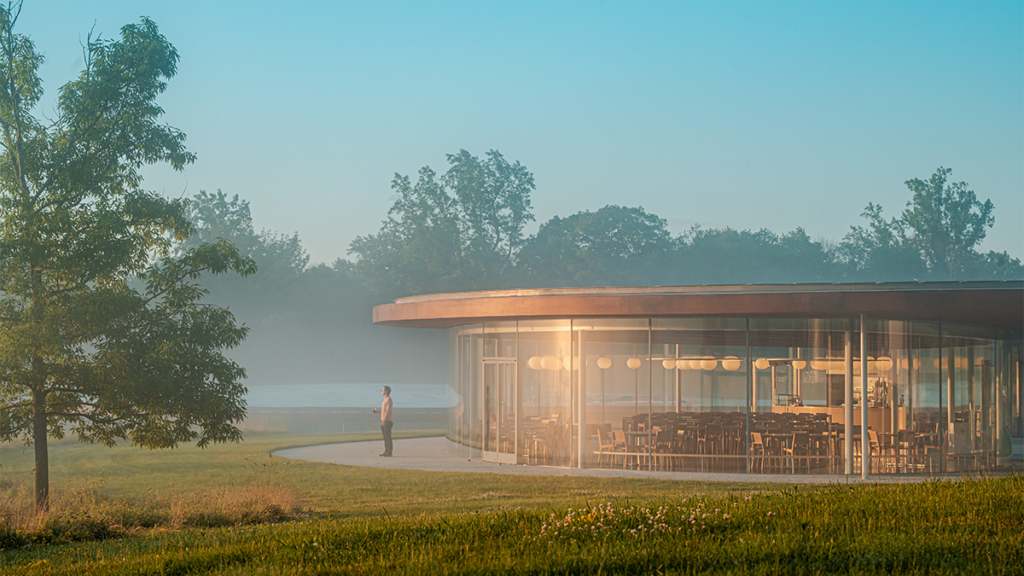
Adam Thatcher, CEO of Grace Farms Tea & Coffee and Co-founder with Sharon Prince, CEO & Founder of Grace Farms, overlooking the meadows at Grace Farms, nearly 80 acres of 10 bio-diverse habitats. The award-winning River building in the background is intentionally embedded in nature, reflective and ever-changing.
Pausing over a cup of tea in the Commons or the Pavilion, a reflective space with 360-degree views of the natural landscape, creates an opportunity to connect with nature and one another, a rarity in a world so tethered to technology and the isolation that can ensue. This welcoming space also provides an opportunity to educate visitors about our work to advance ethical and sustainable supply chains, from the production of our tea to our efforts to eliminate forced labor in the building materials supply chain through Design for Freedom.
Beyond raising awareness of fair and just labor practices in tea and coffee production, our commitment extends to putting these principles into action. In 2021, Grace Farms launched Grace Farms Tea & Coffee, a Certified B Corp™ that prioritizes ethical sourcing, sustainability, and collaborations with women-owned collectives. It was co-founded by Sharon Prince, CEO & Founder of Grace Farms, along with Adam Thatcher, CEO of Grace Farms Tea & Coffee.
“One of our goals was to not only make a delicious product but also make a product that aligns with our values and can demonstrate ethical and sustainable supply chains.” — Adam Thatcher, Fast Company
This mission-driven social enterprise has since expanded its reach through partnerships with more than 20 global organizations, including JPMorganChase, Bloomberg, and Google. It gives back 100% of its profits to support Design for Freedom, Grace Farms’ global initiative to end forced labor in the building materials supply chain.
In 2025, the company was recertified as a Certified B Corp™, increasing its score from 102.8 to 124.9. This improvement was driven by its scalable impact model for ethical and sustainable sourcing. Organizations certified by the nonprofit B Lab must meet rigorous standards across areas such as workers’ rights, environmental practices, governance, and community impact.
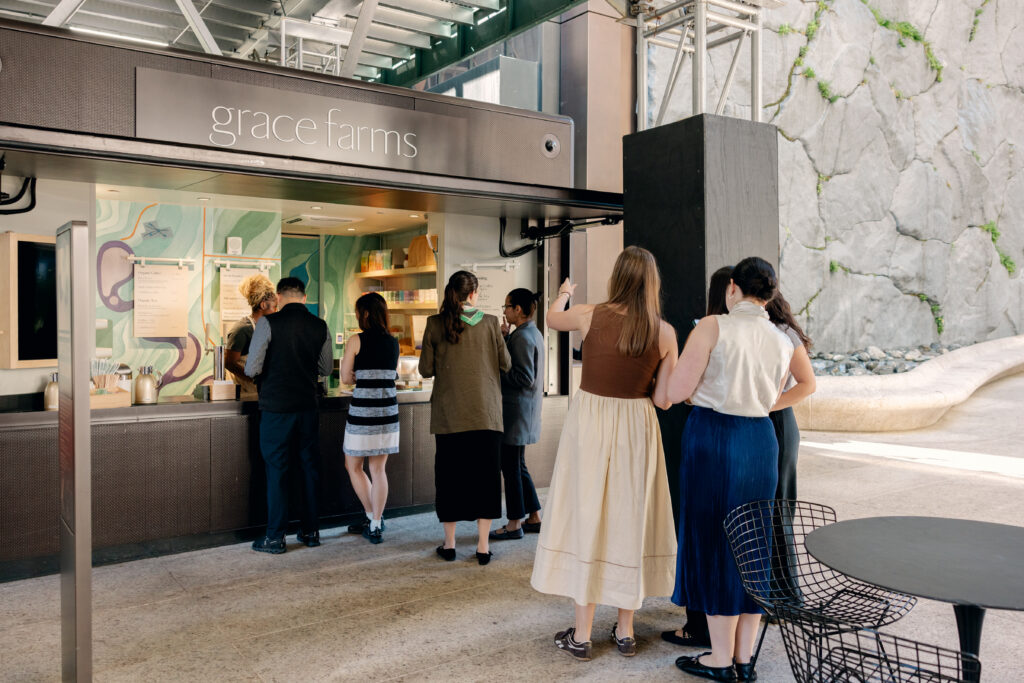
The opening of Grace Farms Cafe at JPMorganChase’s global headquarters.
Grace Farms Tea & Coffee reached another milestone in June 2026, when Grace Farms Cafe in New York City opened to the public in the plaza at the base of JPMorganChase’s global headquarters, at the corner of 48th Street and Madison Avenue.
“Every cup supports the Design for Freedom movement and helps advance a future free from forced and child labor.” — Adam Thatcher
To accomplish these unprecedented outcomes, space and what it communicates have played a crucial role. As Sharon Prince emphasized in her inaugural Lectures with Concert in January 2026, spaces can create a more just and equitable world — from who is invited, to how spaces are built, to which values are communicated.
So, the simple act of serving tea in a beautiful and harmonious space, inviting people from all backgrounds and ages to the “table,” can indeed advance the common good and result in unexpected outcomes.
Public Programming
Our public programming around tea, led by Frank Kwei and our Education Team, invites visitors to explore the distinctions among major black teas and sample notable varieties, including Darjeeling, Assam, and Ceylon teas. In a restorative setting overlooking the awe-inspiring landscape of Grace Farms, visitors can learn about the nuances of tea and the importance of supporting fair labor practices.

Afternoon Tea
Monthly on Fridays | 3–4:30 pm
Gather with friends in the glass-enclosed Tea Pavilion for an inviting afternoon spent sipping your favorite pot of Grace Farms Tea, accompanied by eye-catching seasonal bites.
Journey Into the World of Tea
Monthly on Wednesdays | 3–4:30 pm
Explore tea traditions through guided tastings, demonstrations, and engaging conversation. This series is led by tea expert and educator Frank Kwei, who brings decades of knowledge to each session.
To learn more about these and additional events, visit gracefarms.org/events.
____________________
About Grace Farms
Grace Farms is a cultural and humanitarian center in New Canaan, Connecticut that brings people together across sectors to explore nature, arts, justice, community, and faith at the SANAA-designed River building and Barns on 80 acres of publicly accessible natural landscape. Since opening in 2015, Grace Farms has welcomed 1 million visitors from around the world to experience its unique integration of arts, architecture, nature, and purpose.
As a destination for arts and culture, Grace Farms presents innovative programming in music, visual and performing arts while fostering contemplation and connection through architecture and nature. Its humanitarian work includes leading the Design for Freedom movement to eliminate forced labor in the building materials supply chain and advancing initiatives to foster more grace and peace locally and globally.
The integration of cultural programming and humanitarian action reflects Grace Farms’ collaborative approach to generating new outcomes and meaningful change.
Membership
Grace Farms members enjoy early access to program registration, a 20% discount on paid programs, retail, and dining, and so much more.
Becoming a member helps us advance our mission to pursue a more peaceful world and supports the preservation of the River building and its surrounding 80 acres.
For more information, visit gracefarms.org/membership.
Visit our calendar of events to learn more about upcoming programs.
Sign-up for our newsletter
Follow us
@gracefarmsct #gracefarms