Books such as the Secret Lives of Trees and The Architecture of Trees invite us into a rarely seen world, revealing how trees grow, how they support one another, and how they are part of a complex and beautiful web of life that is critical to the health of our planet. Beautiful and majestic, each species, with its unique characteristics and contributions, also serves as a source of inspiration for architectural design.
The 17-century Chêne Chapelle in France, for instance, was built into an ancient oak tree, according to Grist. Although lightning hollowed out its center, the tree surprisingly continued to live, even producing acorns. The clergy at the time believed that the fact that the 800-year-old oak tree continued to thrive after the lightning strike meant that the oak was imbued with “divine” powers. Rather than have the chapel dictate the design, the architects or builders embedded the chapel in the hollowed-out oak, following its natural contours.
Centuries later, nature is still influencing architectural design. Biophilic design has integrated nature into design to enhance our connection to the environment. For instance, the Ford Foundation’s 12-story-high atrium in New York is filled with magnolias, eucalyptus, jacaranda, pear trees, and more, while Singapore’s Jewel Changi airport features 2,500 trees, native to Madagascar, Australia, Malaysia and Indonesia, according to an AP article.
But what if nature were the actual designer, going beyond just mere integration with architecture? Last year Grace Farms intentionally set out to design seating with that in mind. For Grace Farms’ 10-year anniversary last October, the foundation commissioned Kazuyo Sejima to design six site-specific sculptural benches for the Plaza, a welcoming space flanked by two renovated barns, with the center of the grassy Plaza surrounded by fruit trees. Sejima and Ryue Nishizawa (SANAA) designed Grace Farms’ award-winning River building and Barns. Dancing Trees (2025) are six site-specific sculptural benches that conform to the natural curves of the black cherry wood, which was sourced nearby in Western Connecticut.
The journey of making Dancing Trees is featured in a short film that premiered at Grace Farms’ Humanity in Architecture Film Festival in January, hosted in collaboration with Architecture & Design Film Festival. In the film, Kimbery Kelly, our Director of Horticulture, discusses the characteristics of black cherry, how it grows, and why certain trees were chosen for Dancing Trees. In this Perspective, Kelly takes us on a deeper journey into why this species was chosen and the importance of listening to nature.
Even though they are anchored in the soil, plants move, performing dances in their amazingly complex world. – Kimberly Kelly
____________________________
Look at the forest, or any natural setting: there is an intricate tapestry woven together, revealing a symphony of movement and life. Even though they are anchored in the soil, plants move, performing dances in their amazingly complex world. How and where does each leaf, branch, root, or flower need to be to thrive? What triggers from within send a vine searching upward for the sun, curling around a neighbor? It has been common belief that nature has always had a ‘survival of the fittest’ approach. Now we are learning so much more about cooperation, adaptation, and complex symbiotic relationships that exist in the natural world.
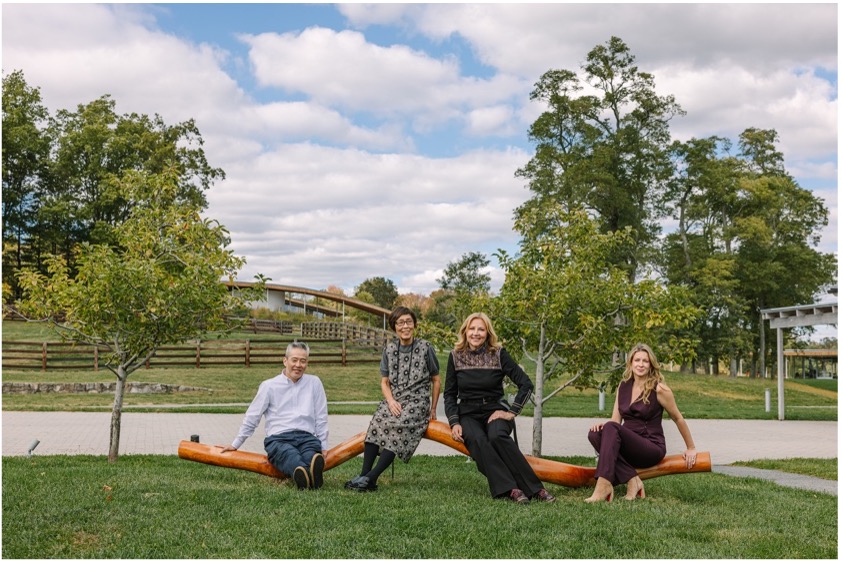
The unveiling of Dancing Trees in the Plaza, the new site-specific sculptural benches designed by Kazuyo Sejima of SANAA. From left to right: Toshihiro Oki, Grace Farms Architecture Advisor Kazuyo Sejima, Sharon Prince, CEO and Founder of Grace Farms, Chelsea Thatcher, Founding Creative Director, Grace Farms. (photo by Melani Lust)
The Shaping of Black Cherry
How do plants move? How do these amazing shapes and patterns grow from a tiny seed, to explore the world around them? Through physiological processes, such as trophic and nastic movements, plants respond to the environment to fulfill their basic needs and, as we are discovering, the needs of those around them. There are also times when these natural movements are interrupted or respond to other environmental stimuli resulting in unique forms.
As an early- to secondary succession plant in the forest, Prunus serotina (Black cherry), is a rapid grower. It is also considered an important keystone tree as it is host to over 300 species of caterpillars! (Tallamy et al). Caterpillars are the second or larval stage in the four-stage metamorphosis of the transition into a moth or butterfly, an important pollinator for flowers, fruits and vegetables.
A Food Source
Black cherry, a fast-growing shade tree with fragrant white flowers that bloom in spring, attract bees and butterflies during this time. And when the fruit ripens in late summer, it’s a food source for over 30 species of birds. (American Beauties, Native Plants). The North American native is a “bird magnate” for Robins, Woodpeckers, Mockingbirds, and more.
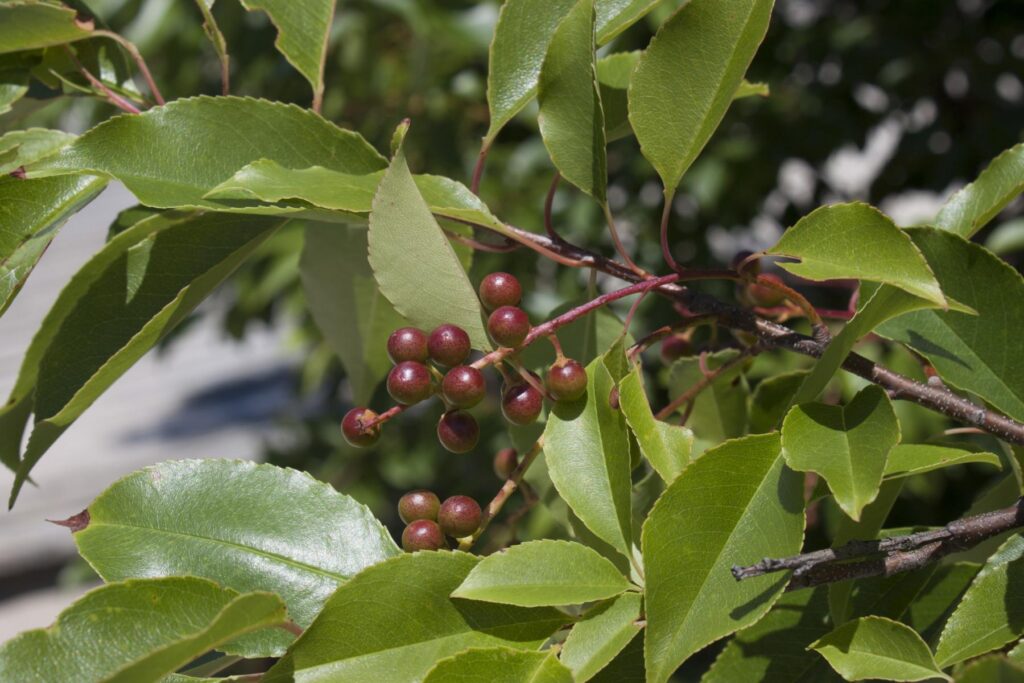
Ripened fruit of the Black cherry tree in late summer, a source of food for birds and wildlife. (Photo source: USDA)
As beneficial Prunus serotina is to wildlife and pollinators, Black cherry trees are also highly regarded by architects and designers for their rich, reddish-brown hard wood often used in furniture, cabinets, and veneers. But how they grow, sometimes by a process of natural ‘shaping’ make the Black cherry even more prized. This process is caused by a fungus commonly referred to as Black knot, a serious disease of plum and cherry trees (Prunus species) throughout the United States. While it can get progressively worse over time — stunting a tree’s growth or killing it — the damage may be less severe on sweet and sour cherry trees (The Morton Arboretum).
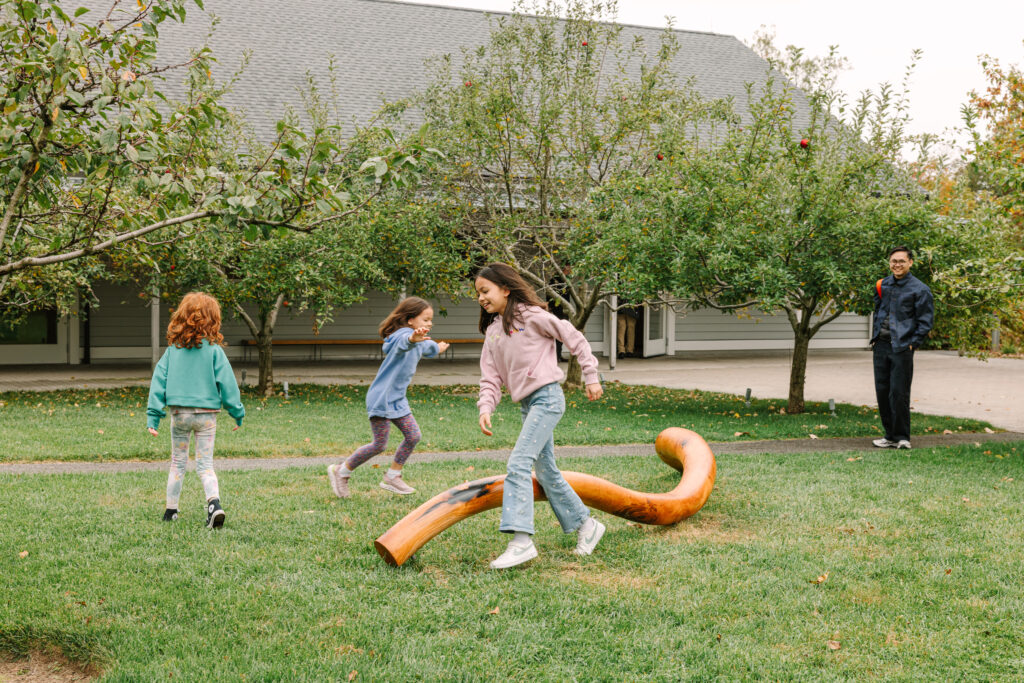
During the 10-year anniversary celebration, and the unveiling of Dancing Trees, children explored and played around the sculptural benches. (photo by Melani Lust)
Nature as our Partner in Design
Black knot, (University of Minnesota Extension) which would normally be considered entirely detrimental to trees, does have its benefits: As a Black cherry tree naturally grows toward the sun, in a curvature dance with others competing trees for the sun, the fungus can further curve and shape Black cherry. The gall or knot can encircle a limb or branch, restricting the flow of sugars, water, and hormones past the infected site. This imbalance can lead to deformation or curling of the branch beyond the gall. This ‘deformation’ creates some of the most beautiful burlwood, highly valued by woodturners, craftspeople, and decorators.
The incorporation of nature into the fields of architecture and interior design, or Biophilia, defined as the “love of life” in ancient Greece (Arch Daily), continues to take hold. It connects people with nature to improve their well-being and quality of life. Perhaps the next step in the design, as in Grace Farms’ approach to the design of Dancing Trees, is to invite nature to be our partner in the process of building and design.
____________________________
About Grace Farms
Grace Farms is a cultural and humanitarian center in New Canaan, Connecticut that brings people together across sectors to explore nature, arts, justice, community, and faith at the SANAA-designed River building and Barns on 80 acres of publicly accessible natural landscape. Since opening in 2015, Grace Farms has welcomed 1 million visitors from around the world to experience its unique integration of arts, architecture, nature, and purpose.
As a destination for arts and culture, Grace Farms presents innovative programming in music, visual and performing arts while fostering contemplation and connection through architecture and nature. Its humanitarian work includes leading the Design for Freedom movement to eliminate forced labor in the building materials supply chain and advancing initiatives to foster more grace and peace locally and globally.
The integration of cultural programming and humanitarian action reflects Grace Farms’ collaborative approach to generating new outcomes and meaningful change.
Membership
Grace Farms members can visit without advance registration and enjoy a 20% discount on paid programs, retail, and dining, invitations to members-only gatherings, complimentary events, and a welcome gift from Grace Farms Tea & Coffee.
Becoming a member helps us advance our mission to pursue a more peaceful world and supports the preservation of the River building and its surrounding 80 acres.
For more information, visit gracefarms.org/membership.
Visit our calendar of events to learn more about upcoming programs.
Sign-up for our newsletter
Follow us
@gracefarmsct #gracefarms