Evan Williams
Woven in Tears, 2025
Woven in Tears is an original composition by Evan Williams recorded by an ensemble of the London Philharmonic Orchestra and commissioned for Grace Farms’ exhibition With Every Fiber: Pigment, Stone, Glass.
Created in response to Nasreen, Dr. Hannah Rose Thomas’s portrait of artist, human rights activist, and survivor of modern slavery Nasreen Sheikh, the 18-minute work transforms sound into reflection. Through layered instrumentation and evolving rhythms, the composition mirrors the stark contrast between the confinement of Sheikh’s past and the freedom she achieved through her activism and work empowering other women.
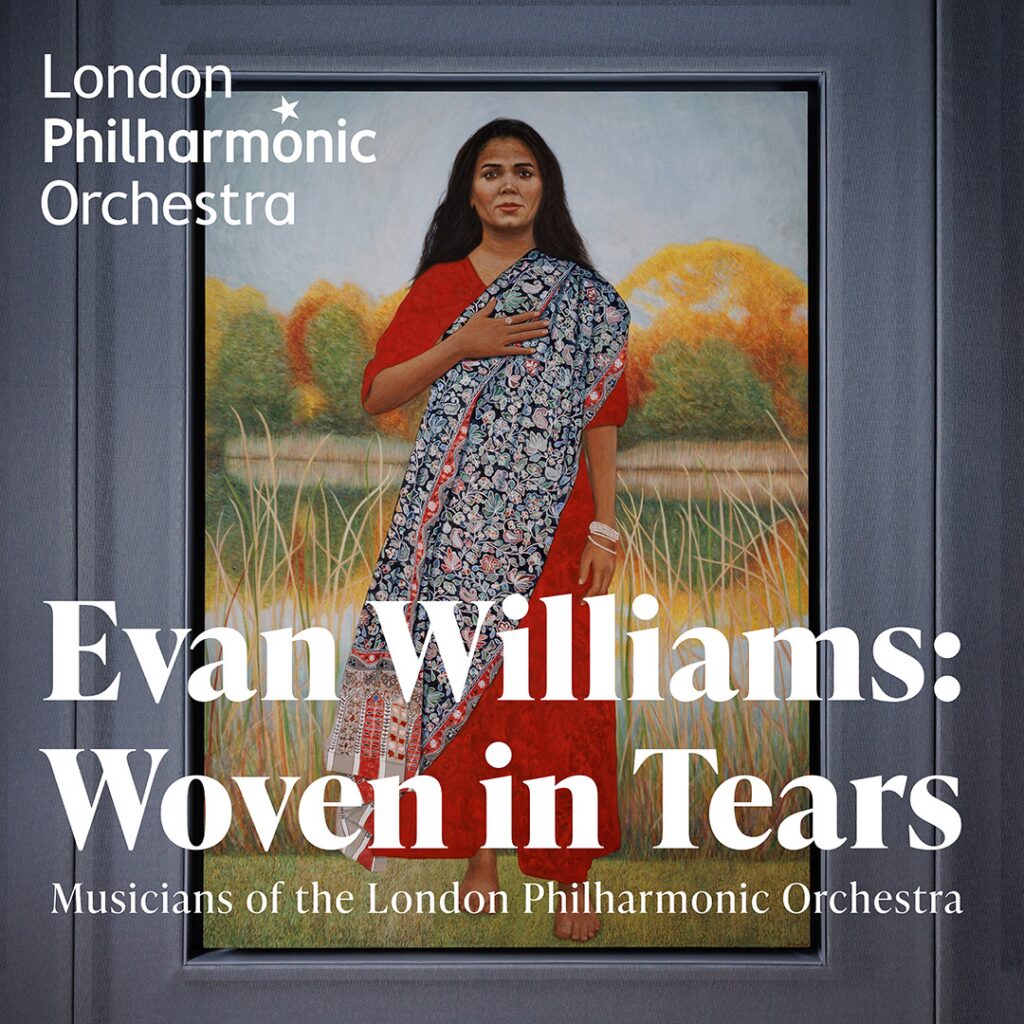
Released digitally by the London Philharmonic Orchestra label, this recording features a dedicated ensemble of London Philharmonic Orchestra musicians: Kate Oswin and Claudia Tarrant-Matthews (violins), Martin Wray (viola), Kristina Blaumane (cello), and Clíodna Shanahan (piano).
Woven in Tears is now available on streaming services and for download.
Listen to Woven in TearsLearn More
Woven in Tears
by Evan Williams, 2025
Woven in Tears was especially written for the With Every Fiber exhibit, and responds to Hannah Rose Thomas’s portrait of Nepali activist Nasreen Sheikh, a survivor of sweatshop labor and attempted forced marriages. In her work, Sheikh teaches women the skills to create and sell their own garments, empowering them economically. The portrait features a shawl created by Sheikh herself, along with the lush nature of the Grace Farms. The freedom of the portrait is in stark contrast to the confinement Sheikh was subjected to in her youth.
The title of the work is inspired by the words of Sheikh. In her TedxVail talk, she speaks of being constantly surrounded by garments in the sweatshop where she worked and slept. She says, “I hated those clothes. They were woven with the energy of my suffering.” In another talk to the 2023 Summit At Sea Conference, she says, “I could not talk to anybody, so I started to talk to the clothes that I was making, and I said to those clothes that whoever is going to wear these clothes, I hope that they can feel me, I hope that they can see my tears…”
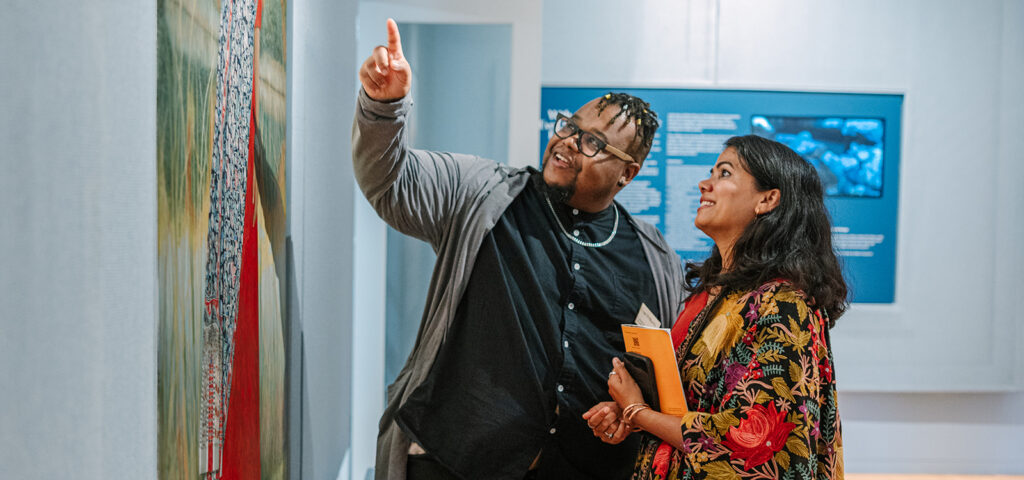
Evan Williams and Nasreen Sheikh looking at Nasreen in the With Every Fiber exhibit at Grace Farms
The title of the piece is also inspired by Thomas’ book Tears of Gold. And the musical material is influenced by her painting method. Thomas often paints women who survived traumatic events using techniques of Renaissance painters, employing gold leaf and egg tempera. Her portraits mirror those of European royalty or devotional paintings of Catholic saints. In response to this, Woven in Tears employs musical material from the air “Flow, My Tears” by English Renaissance composer John Dowland. The material is presented in the opening using the klangfarbenmelodie or “tone-color melody” technique with a different instrument of the ensemble playing one of the notes of the melody in a unique timbre, representing each individual thread coming together to weave a tapestry. The work of Sheikh and organizations like Grace Farms reminds us that each of us is a thread, coming together as a tapestry for justice.
No matter how small our role may seem, it is integral to this tapestry.
Later in the work, the theme is presented as a proportional canon, another Renaissance musical technique, with each statement of the melody either lengthened or shortened, and weaving in and out of the others. Slowly, over the course of the piece, the minor lament is transformed into major, becoming another proportional canon, this time, bursting with joy and freedom, then a loving passacaglia, a Baroque courtly dance, reinforcing the regal nature of the painting and its subject.
Throughout the work, glisses, plucking, and other techniques are used by both the string players and the pianist to evoke the fibers of strings threading each other. Tapping gestures are first used to evoke the constant mechanical noise that Sheikh was forced to hear day and night. Later, they evoke the peaceful sounds of the 100-year-old loom that she acquired for her first business, using her skills and sustainable practices to empower herself and other women in her region. Sudden and poignant moments of silence represent the peaceful rest that Sheikh so desperately desired.
Learn More about the Composition